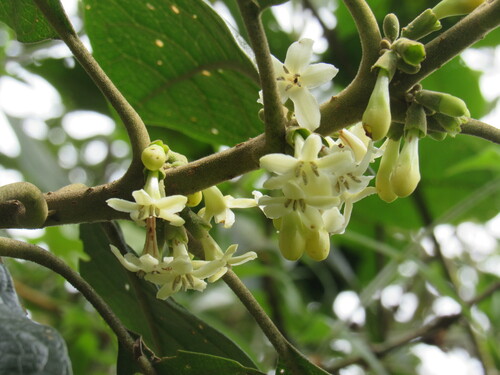
Rotheca serrata
(L.) Steane & Mabb.
Barangi, Blue fountain bush

(c) Dinesh Valke, some rights reserved (CC BY-SA)

(c) pbsingh, some rights reserved (CC BY-NC)

no rights reserved
What to Eat
Edible parts: Leaves, Flowers, Roots
The tender leaves are eaten raw or briefly roasted as a vegetable, providing a bitter flavouring and used in curries. The young unopened flowers are fried. The ripe fruit are roasted and made into chutney. The roots are dried, powdered, and used to flavour liquor.
Where to Find It
It is a tropical plant. It grows near the edge of the sea. In Indonesia it grows from sea level to 1,500 m above sea level. It grows in grassland and open forests. In Yunnan.
Asia, China, Himalayas, India, Indochina, Laos, Malaysia, Myanmar, Northeastern India, SE Asia, Sri Lanka, Thailand,
How to Identify
An erect evergreen shrub. It grows 1-5 m tall. It branches from the base. The main stem is almost square with white spots on the green bark. The leaves are oval to heart shaped and taper quickly to the tip. Leaves grow in threes. The leaves are arranged in a cross shape and they have short stalks. They are narrowly oval and there are coarse teeth. They are dark green and shiny above and pale underneath. They are 5-30 cm long by 3-15 cm wide. The veins are greenish-purple and prominent near the base. The flowers are greenish or bluish white. They are surrounded by leafy bracts. The flowering shoots are at the top and at the ends of branches. When young they have a grey covering. These occur it the ends of branches. They are elongated. The flowers are large. The fruit are flattened berries.
How to Grow
Plants can be grown from seeds or softwood cuttings. It can be grown as a hedge. It can also be grown from shoots from the roots.
Propagation: Seed - best sown as soon as possible. Germination can be erratic but usually takes place within 20 - 60 days at 20°c. When large enough to handle, prick the seedlings out into individual pots and grow them on until large enough to plant out.
Medicinal Uses
The plant is commonly used in traditional medicine as a poultice for skin diseases, yaws, headache, leprosy and persistent fever. It is an ingredient of an embrocation for stiff joints. The dried leaves, roots or stems enter in various prescriptions for haemorrhoids. A decoction of leaves and/or stem is used as a carminative, and to relieve fevers and chronic headache The pounded leaves are applied externally in various prescriptions for cephalalgia, ophthalmia skin infections, leprous sores, rheumatism and painful joints. The pounded leaves, combined with camphor and wood ashes, are applied topically to skin diseases. The leaf juice is said to be an anti-leech medicine. A decoction of the stem is used as an antimalarial and to relieve abdominal pain. A decoction of the fruit is given to relieve colic. Ripe and unripe fruits are chewed with the leaves of Piper betle for treating coughs. The wood is considered diuretic. The root is considered antiemetic. It is used in medicine for treating fevers, rheumatism and dyspepsia. The flowers are consumed during labour. The seeds are used to some extent for treating oedema.
Other Uses
The plant responds well to trimming and is commonly grown as an ornamental hedge in southeast Asia.
Wikipedia
Source ↗Rotheca serrata, commonly known as the blue fountain bush, the blue-flowered glory tree or the beetle killer, is a species of flowering plants in the family Lamiaceae. It is native to India, Sri Lanka and Malaysia.
Other Information
It is a cultivated plant.
Notes
It is also used in medicine. There are about 400 Clerodendrum species.
Names & Synonyms
Angaravalli, Barangi, Beja oti esing, Bharangi, Bhargi, Bharungi, Bommalamarri, Cherutekku, Gantubarangi, Hin-byar, Hin-khar, Kan henda, Kankabharnni, Kertase, Lei dum-suak, Mata kesang, Mismau khasiba, Moirang khanam, Nangal bhanga, Oti'oyi'ng, Phaleng hethoh, Phelang-riho, Phuinhamshak, Pinggir tomek, Pumi aye, Rilong-phlang, Sarum lutur, Senggunggu, Sengugu, Singugu, Siri tekku, Smlpavqdovniov, Srigungu, Tambun tasek, Tenjal tasek, Timba tasek, Tinjal tasek, Tipin poto, Yin-byar
References (37)
- Ambasta, S.P. (Ed.), 2000, The Useful Plants of India. CSIR India. p 132 (As Clerodendrum serratum)
- Arora, R. K., 2014, Diversity in Underutilized Plant Species - An Asia-Pacific Perspective. Bioversity International. p 39 (As Clerodendrum serratum)
- Ashton, M. S., et al 1997, A Field Guide to the Common Trees and Shrubs of Sri Lanka. WHT Publications Ltd. pdf p 395 (As Clerodendrum serratum)
- Burkill, I.H., 1966, A Dictionary of the Economic Products of the Malay Peninsula. Ministry of Agriculture and Cooperatives, Kuala Lumpur, Malaysia. Vol 1 (A-H) p 593 (As Clerodendrum serratum)
- Cat. pl. Ceylon 46. 1824 (As (L.) Moon) (As Clerodendrum serratum)
- Dobriyal, M. J. R. & Dobriyal, R., 2014, Non Wood Forest Produce an Option for Ethnic Food and Nutritional Security in India. Int. J. of Usuf. Mngt. 15(1):17-37 (As Clerodendrum serratum)
- Facciola, S., 1998, Cornucopia 2: a Source Book of Edible Plants. Kampong Publications, p 244 (As Clerodendrum serratum)
- Hani Medicine of Xishuangbanna, 1999, p 683 (As Clerodendrum serratum)
- Hedrick, U.P., 1919, (Ed.), Sturtevant's edible plants of the world. p 204 (As Clerodendron serratum)
- Japanese International Research Centre for Agricultural Science www.jircas.affrc.go.jp/project/value_addition/Vegetables (As Clerodendrum serratum)
- Kar, A., & Borthakur, S. K., 2008, Wild vegetables of Karbi - Anglong district, Assam, Natural Product Radiance, Vol. 7(5), pp 448-460 (As Clerodendron serratum)
- Kar, A., et al, 2013, Wild Edible Plant Resources used by the Mizos of Mizoram, India. Kathmandu University Journal of Science, Engineering and Technology. Vol. 9, No. 1, July, 2013, 106-126
- Khodram,S. D., et al, 2019, Local knowledge of edible flowers used in Mizoram. Indian Journal of Traditional Knowledge Vol 18(40 pp 715-723
- Kiran, K. C., et al, 2019, Diversity and Seasonal Availability of Potential Wild Edible Plants from Vidarbha Region of Maharashtra State, India. Int.J.Curr.Microbiol.App.Sci (2019) 8(2): 1434-1446 (As Clerodendrum serratum)
- Konsam, S., et al, 2016, Assessment of wild leafy vegetables traditionally consumed by the ethnic communities of Manipur, northeast India. Journal of Ethnobiology and Ethnomedicine, 12:9 (As Clerodendrum serratum)
- Lim, T. K., 2015, Edible Medicinal and Non Medicinal Plants. Volume 9, Modified Stems, Roots, Bulbs. Springer p 24
- Liu, Yi-tao, & Long, Chun-Lin, 2002, Studies on Edible Flowers Consumed by Ethnic Groups in Yunnan. Acta Botanica Yunnanica. 24(1):41-56 (As Clerodendrum serratum var. amplexifolium)
- Martin, F.W. & Ruberte, R.M., 1979, Edible Leaves of the Tropics. Antillian College Press, Mayaguez, Puerto Rico. p 224 (As Clerodendrum serratum)
- McMakin, P.D., 2000, Flowering Plants of Thailand. A Field Guide. White Lotus. p 71
- Medhi, P., Sarma, A and Borthakur, S. K., 2014, Wild edible plants from the Dima Hasao district of Assam, India. Pleione 8(1): 133-148
- Meitei, L. R., et al, 2022, An ethnobotanical study on the wild edible plants used by forest dwellers in Yangoupokpi Lokchao Wildlife Sanctuary, Manipur, India. Ethnobotany Research and Application 23:15
- Misra, R. C., et al, 2013, Genetic resources of wild tuberous food plants traditionally used in Similipal Biosphere Reserve, Odisha, India. Genetic Resources and Crop Evolution. Vol. 60 No. 2. Springer (As Clerodendrum serratum)
- Murtem, G. & Chaudhrey, P., 2016, An ethnobotanical note on wild edible plants of Upper Eastern Himalaya, India. Brazilian Journal of Biological Sciences, 2016, v. 3, no. 5, p. 63-81 (As Clerodendrum serratum)
- Ochse, J. J. et al, 1931, Vegetables of the Dutch East Indies. Asher reprint. p 725 (As Clerodendrum serratum)
- Patiri, B. & Borah, A., 2007, Wild Edible Plants of Assam. Geethaki Publishers. p 99 (As Clerodendrum serratum)
- Pegu, R., et al, 2013, Ethnobotanical study of Wild Edible Plants in Poba Reserved Forest, Assam, India. Research Journal of Agriculture and Forestry Sciences 1(3):1-10 (As Clerodendrum serratum)
- Reddy, K. N. et al, 2007, Traditional knowledge on wild food plants in Andhra Pradesh. Indian Journal of Traditional Knowledge. Vol. 6(1): 223-229 (As Clerodendrum serratum)
- Sawian, J. T., et al, 2007, Wild edible plants of Meghalaya, North-east India. Natural Product Radiance Vol. 6(5): p 414 (As Clerodendrum serratum)
- Shin, T., et al, 2018, Traditional knowledge of wild edible plants with special emphasis on medicinal uses in Southern Shan State, Myanmar. Journal of Ethnobiology and Ethnomedicine (2018) 14:48
- Singh, H.B., Arora R.K.,1978, Wild edible Plants of India. Indian Council of Agricultural Research, New Delhi. p 22 (As Clerodendrum serratum)
- Tanaka, (As Clerodendrum serratum)
- Teron, R. & Borthakur, S. K., 2016, Edible Medicines: An Exploration of Medicinal Plants in Dietary Practices of Karbi Tribal Population of Assam, Northeast India. In Mondal, N. & Sen, J.(Ed.) Nutrition and Health among tribal populations of India. p 156
- Vartak, V.D. and Kulkarni, D.K., 1987, Monsoon wild leafy vegetables from hilly regions of Pune and neighbouring districts, Maharashtra state. J. Econ. Tax. Bot. Vol. 11 No. 2 pp 331-335 (As Clerodendrum serratum)
- WATT (As Clerodendrum serratum)
- Wild edible plants of Himachal Pradesh (As Clerodendrum serratum)
- World Checklist of Useful Plant Species 2020. Royal Botanic Gardens, Kew
- Xu, Z., Tao, G. & Tan, J., 1988, Tropical Wild Flowers and Plants in Xishuangbanna, Agricultural Publishing House. photo 28 (As Clerodendrum serratum)