Hedyotis capitellata
Wall.
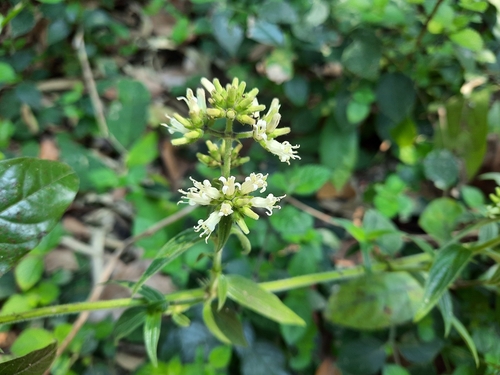
(c) ab_satta, some rights reserved (CC BY-NC), uploaded by ab_satta

(c) Tomas Maul, some rights reserved (CC BY-NC)

(c) Tomas Maul, some rights reserved (CC BY-NC)
What to Eat
Edible parts: Leaves
The cooked leaves are eaten with rice.
Where to Find It
A tropical plant. In China it grows in broad-leaved forests and sunny mountain slopes at about 1,500 m above sea level. In Yunnan.
Asia, China, India, Indochina, Indonesia, Laos, Malaysia, Myanmar, SE Asia, Thailand, Vietnam,
How to Identify
A sprawling herb or small shrub. It can be climbing. It grows 1 m tall. The stems are slightly 4 angled. The leaves are narrowly sword shaped. They are 2-12 cm long by 1-4 cm wide. They can have teeth on the edge. The flowers are in 3-15 round heads near the ends of the branches.
Medicinal Uses
Used in medicine.
Notes
There are about 450 Hedyotis species. It is used in medicine.
Names & Synonyms
Akar lada, Akar sambueh, Daun silaiman, Seketan, Si-mastolor, Tawng heng, Umat sampu kalada, Yaung-lon-chan-tha
References (4)
- Ambasta, S.P. (Ed.), 2000, The Useful Plants of India. CSIR India. p 258
- Burkill, I.H., 1966, A Dictionary of the Economic Products of the Malay Peninsula. Ministry of Agriculture and Cooperatives, Kuala Lumpur, Malaysia. Vol 1 (A-H) p 1148
- Singh, H.B., Arora R.K.,1978, Wild edible Plants of India. Indian Council of Agricultural Research, New Delhi. p 26
- WATT


