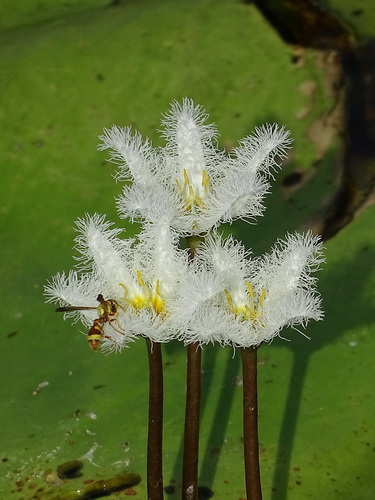
Nymphoides cristata
(Roxburgh) O. Kuntze
White water snowflake, Floating heart, Fairy water-lily

(c) Subhajit Roy, some rights reserved (CC BY-NC-ND), uploaded by Subhajit Roy
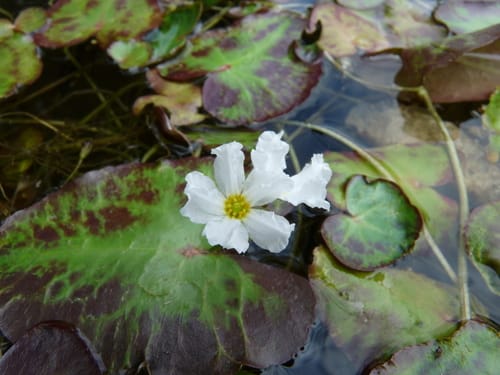
(c) pisum, some rights reserved (CC BY-NC)
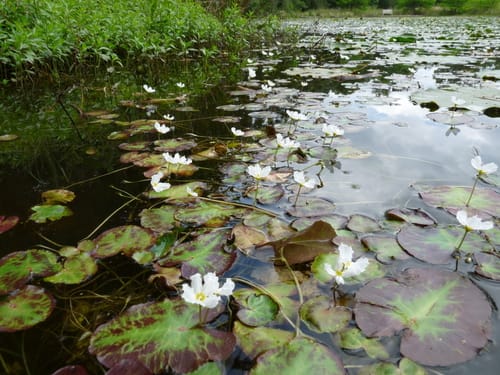
(c) pisum, some rights reserved (CC BY-NC)
What to Eat
Edible parts: Leaves, Fruit, Buds, Stems
The stems, roots, buds, and leaves are eaten boiled or curried, with the boiled plant's softer parts being consumed.
Where to Find It
A tropical plant. It grows under water in standing water. It needs full sun. They grow in warm places. It suits hardiness zones 8-12. In Sichuan.
Asia, China, Himalayas, India, Indonesia, Japan, Malaysia, Nepal, Pakistan, SE Asia, Taiwan, Thailand,
How to Identify
A water-lily like plant. It grows under water. It can be free floating. The leaves are oval or heart shaped and 8-15 cm across. The gap in the leaves is V shaped. The leaf stalk is short and sheaths the base. The leaves float. They are green but mottled red. The flowers emerge above the water. The flowers are white. They have 5 petals and are 2 cm across. The edges of the flowers are wavy. The centre is yellow.
How to Grow
Plants can be grown in shallow water over nutrient-rich soils. The seeds need to be kept dry for a few months before planting.
Notes
There are about 30 Nymphoides species.
Names & Synonyms
Alli gadda, Antara tamara, Anthara thamara, Chandmalla, Cumuda, Ghainchu, Hime-gagatuba, Khatara, Khatara, Kolare chikal, Kumu, Kumudini, Kumukhatara, Marang chatom ara ba, Nodel ampel, Paktubtao, Panchuli, Silver lotus, Tagarmul
References (15)
- Ambasta S.P. (Ed.), 2000, The Useful Plants of India. CSIR India. p 328 (As Limnanthemum cristatum)
- Burkill, I.H., 1966, A Dictionary of the Economic Products of the Malay Peninsula. Ministry of Agriculture and Cooperatives, Kuala Lumpur, Malaysia. Vol 2 (I-Z) p 1368 (As Limnanthemum cristatum)
- Chao, Pi-Yu, et al, 2014, Antioxidant Activity in Extracts of 27 Indigenous Taiwanese Vegetables. Nutrients 2014, 6, 2115-2130
- GAMMIE, (As Limnanthemum cristatum)
- Gen. sp. Gent. 342. 1838 (As Limnanthemum cristatum)
- Hu, Shiu-ying, 2005, Food Plants of China. The Chinese University Press. p 628
- Jiwajinda, S., et al, 2002, Suppressive Effects of Edible Thai Plants on Superoxide and Nitric Oxide Generation. Asian Pacific Journal of Cancer Prevention, Vol 3, 2002
- Llamas, K.A., 2003, Tropical Flowering Plants. Timber Press. p 276
- Martin, F.W. & Ruberte, R.M., 1979, Edible Leaves of the Tropics. Antillian College Press, Mayaguez, Puerto Rico. p 192 (As Limnanthemum cristatum)
- Revis. gen. pl. 2:429. 1891
- Romanowski, N., 2007, Edible Water Gardens. Hyland House. p 111
- SHORTT, (As Villarsia cristata)
- Singh, H.B., Arora R.K.,1978, Wild edible Plants of India. Indian Council of Agricultural Research, New Delhi. p 31, 78
- Slocum, P.D. & Robinson, P., 1999, Water Gardening. Water Lilies and Lotuses. Timber Press. p 84
- WATT, (As Limnanthemum cristatum and Villarsia cristata)