Meyna laxiflora
Robyns

(c) Rock Outcrops Network VBR test, some rights reserved (CC BY-NC), uploaded by Rock Outcrops Network VBR test
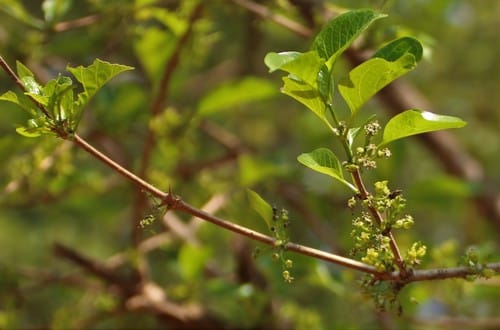
(c) Shiwalee Samant, some rights reserved (CC BY-NC)
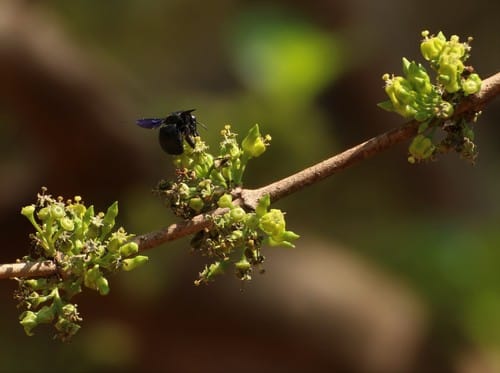
(c) Shiwalee Samant, some rights reserved (CC BY-NC)
What to Eat
Edible parts: Leaves, Fruit
The young leaves and fruit are used as a vegetable. The fruit are sweet and edible.
Where to Find It
A tropical plant. They occur in plains and low hills in deciduous forests in India.
Asia, India,
How to Identify
A small evergreen tree. It grows up to 10 m high. The trunk is almost smooth. The bark is dark brown with straight spines. The leaves are opposite and oval. They are 5-13 cm long by 2-7 cm wide. There are shiny with 6-9 pairs of side veins. The small leafy structures at the base of the leaf are triangular. The flowers are greenish-white. They are hairy inside. They occur in a flat topped cluster. The fruit are yellow and round. They are 4-5 cm across. They are edible.
Nutrition
| Part | Moisture | kJ | kcal | Protein | Vit A | Vit C | Iron | Zinc |
|---|---|---|---|---|---|---|---|---|
| Fruit | — | — | — | — | — | 35.6 | 5.2 | — |
Wikipedia
Source ↗Meyna laxiflora is a species of flowering plant in the family Rubiaceae. It has a world-wide distribution across tropical and subtropical regions.
Other Information
Famine food
Names & Synonyms
Alu, Atu, Boibindi, Burgeli, Cegagadda, Gobergally, Gundkare, Halawni, Helu, Huloo, Katai, Ketkora, Mainakanta, Mainphal, Manakkarai, Moltakanta, Mon, Monphal, Muduna, Mullakare, Muyna, Pundrika, Veliki, Visikilamu
References (12)
- Ambasta, S.P. (Ed.), 2000, The Useful Plants of India. CSIR India. p 369
- Bole, P.V., & Yaghani, Y., 1985, Field Guide to the Common Trees of India. OUP p 5
- Dey, A. & Mukhererjee, A., 2015, Living and Survival Amidst Hunger: Wild Edible Botanicals as a Prime Forest Productivity in the Rural Purulia District, West Bengal, India from Colonial to Present. Research Journal of Forestry 9(3): 71-86
- Dobriyal, M. J. R. & Dobriyal, R., 2014, Non Wood Forest Produce an Option for Ethnic Food and Nutritional Security in India. Int. J. of Usuf. Mngt. 15(1):17-37
- Jadhav, R., et al, 2015, Forest Foods of Northern Western Ghats: Mode of Consumption, Nutrition and Availability. Asian Agri-History Vol. 19, No. 4: 293-317
- Khaple, A. K., Gurav, M. & Hubballi, S., Population Studies of Wild Edible Fruit Tree Species in Kodagu. International Journal of Life Sciences Vol. 1 No. 3
- Kumar, R. & Saikia, P., 2020, Wild edible plants of Jharkhand and their utilitarian perspectives. Indian Journal of Traditional Knowledge Vol 19 (2), April 2020, pp 237-250
- Martin, F.W. & Ruberte, R.M., 1979, Edible Leaves of the Tropics. Antillian College Press, Mayaguez, Puerto Rico. p 217
- Shah, G.L., 1984, Some economically important plant of Salsette Island near Bombay. J. Econ. Tax. Bot. Vol. 5 No. 4 pp 753-765
- Sharma, B.D., & Lakshminarasimhan, P., 1986, Ethnobotanical Studies on the Tribals of Nasik District (Maharashtra). J. Econ. Tax. Bot. Vol. 8 No. 2 pp 439-446
- Singh, H.B., Arora R.K.,1978, Wild edible Plants of India. Indian Council of Agricultural Research, New Delhi. p 39, 67
- Valvi, S. R. & Rathod, 2011, Mineral composition of some wild edible fruits from Kolhapur District. International Journal or Applied Biology and Pharmaceutical Tehcnology. 2(1): 392


