Diospyros ebenum
Koenig.
Ceylon Ebony, Ebony persimmon
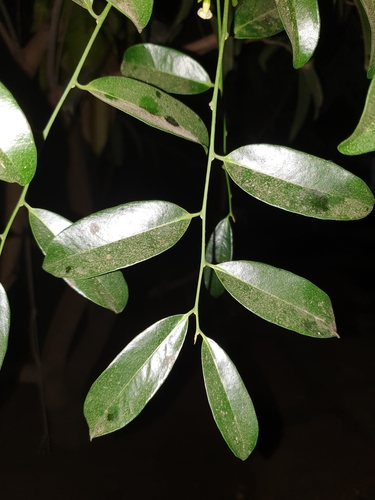
(c) Aravinth, some rights reserved (CC BY), uploaded by Aravinth
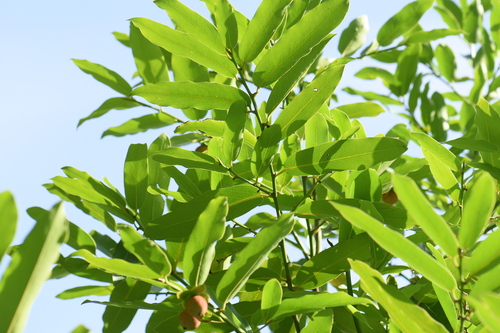
(c) Narendra Bhagwat, some rights reserved (CC BY-NC)
What to Eat
Edible parts: Fruit
The fruit can be eaten raw, though it is gummy and astringent and is generally only consumed during times of famine.
Known Hazards
Where to Find It
It is a tropical plant. It grows in humid coastlands and lowland forests. It needs rich, moist soils and a protected sunny position. It is damaged by drought and frost. In XTBG Yunnan.
Asia, Australia, Belize, Brazil, Central America, China, India, Indochina, Malaysia, Mexico, Northeastern India, Philippines, SE Asia, Sri Lanka*, Vietnam,
How to Identify
A tree which loses its leaves. It is a tall tree. The bark is grey. The wood is hard, black and heavy. The leaves are alternate and have short leaf stalks. The leaves are oval or oblong and leathery. They are entire and glossy. The male and female flowers are separate on the same tree. The flowers do not have leaf stalks. They male flowers are in clusters and the female flowers occur singly in the axils of leaves. The fruit is an oval berry. They are 2-2.5 cm across. They have a rusty brown surface. There are 3 to 8 seeds.
How to Grow
A plant of comparatively dry areas in the tropics. Prefers a well-drained soil containing clay. A slow-growing tree. We have seen no individual confirmation for this species, but in general Diospyros species are dioecious and require both male and female forms to be grown if fruit and seed are required.
Propagation: Seed has very short viability and should be sown as soon as possible after collection. Remove the flesh before sowing, as it contains germination inhibitors. Sow in a shady nursery seedbed in a mix of soil and fine sand at a 3:1 ratio. Plant seeds horizontally or vertically with the radicle end down, at a depth of 1–1.5 times the seed's thickness, spacing them 3–5cm apart. Seeds are very sensitive to drying out during germination and early growth and must be watered regularly. Germination normally occurs within one week. In one trial, fresh seed sown one day after collection showed an 85% germination rate within 17–65 days. Fresh seeds generally have high fertility. Seedlings develop long taproots early, often before any significant shoot elongation takes place. Growth is decidedly slow.
Medicinal Uses
The fruit has medicinal properties as an attenuant and lithontripic. Pounded bark and leaves are used externally as a blistering plaster.
Other Uses
This species is very promising as a shade tree in cardamom (Elettaria cardamomum) plantations. The heartwood is very black and clearly demarcated from the light yellowish-grey sapwood, which is often streaked with black. The texture is very fine, close, and even, with a straight grain. The wood is very hard, heavy, and very durable, being resistant to insect attack and fungi. It is difficult to season and work by hand but takes a high glossy finish. It is mainly exported to China for furniture and to Europe as a fancy wood, and is also used for sports goods, musical and mathematical instruments, ornamental carvings, piano keys, chess pieces, rulers, brush backs, stands for ornaments, and turnery. As with all Diospyros species, the wood structure across the genus is practically indistinguishable. Heartwood development depends largely on tree size and other conditions, with wide variation in sapwood-to-heartwood ratios even within the same species. When present, the heartwood can be black with rosy, yellowish, brownish, or ashy streaks, sometimes nearly or totally black, sharply demarcated from the thin to very wide band of whitish, yellowish, or red sapwood. The texture is fine, smooth, and very dense in the heartwood; the grain is generally very straight. The wood ranges from hard to very hard and heavy to very heavy — the sapwood is tough and flexible while the heartwood is brittle. The heartwood is very durable; the sapwood moderately so. Logs almost invariably check from the heart outward during seasoning, and sawn lumber must be stacked carefully and weighted to prevent warping; once thoroughly dried it becomes very stable. Small trees with little heartwood are used locally for posts, beams, joists, rafters, window sills, and agricultural implements; small poles serve as skids in lumbering. The heartwood is used for scabbards, canes, hilts, tool handles, gunstocks, saw frames, musical instruments (especially guitar fingerboards and keys), furniture, cabinetwork, inlaying, paperweights, inkstands, and desk supplies. The tough sapwood suits T-squares, drawing instruments, shuttles, bobbins, spindles, golf-club heads and shafts, and axe, pick, and hammer handles.
Wikipedia
Source ↗Ceylon ebony or Diospyros ebenum (Sinhala: කළුවර Kaluwara) (Tamil: கருங்காலி Karungaali), is a species of tree in the genus Diospyros and the family Ebenaceae. The tree produces valuable black wood.
Production
It is slow growing.
Notes
There are about 485 species of Diospyros mostly in the tropics. The wood is very hard,
Names & Synonyms
Abnus, Eba na, Ebans, Ebony tree, Kaluwaru, Karai, Karemara, Karu, Karungaali, Karunkali, Kendhu, Mushtumpi, Nallavalludu, Nalluti, Sapota-preta, Thi huyen, Tuki, Tumbi, Tumiki, Vauari
References (17)
- Ambasta, S.P. (Ed.), 2000, The Useful Plants of India. CSIR India. p 176
- Arora, R. K., 2014, Diversity in Underutilized Plant Species - An Asia-Pacific Perspective. Bioversity International. p 66 (As Diospyros ebenaster)
- Barwick, M., 2004, Tropical and Subtropical Trees. A Worldwide Encyclopedic Guide. Thames and Hudson p 148
- Bodkin, F., 1991, Encyclopedia Botanica. Cornstalk publishing, p 345
- Burkill, I.H., 1966, A Dictionary of the Economic Products of the Malay Peninsula. Ministry of Agriculture and Cooperatives, Kuala Lumpur, Malaysia. Vol 1 (A-H) p 842
- Gouldstone, S., 1983, Growing your own Food-bearing Plants in Australia. Macmillan p 122
- Hedrick, U.P., 1919, (Ed.), Sturtevant's edible plants of the world. p 277
- Jayaraman, U., & Singh, V., 1987, A Census of Edible Species of Diospyros L. in India. J. Econ. Tax. Bot. Vol. 10 No. 2 pp 416-419
- Kannan, M., et al, 2015, Ethnobotanical survey on wild edible plants of Kalrayan Hills, Salem District, Tamil Nadu, India. Global J. Res. Med Plants & Indigen. med. 4(12): 236-246
- Sahni, K.C., 2000, The Book of Indian Trees. Bombay Natural History Society. Oxford. p 124
- Schuler, S., (Ed.), 1977, Simon & Schuster's Guide to Trees. Simon & Schuster. No. 103
- Segura, S., et al, 2018, The edible fruit species in Mexico. Genet Resour Crop Evol (2018) 65:1767–1793 (As Diospyros ebenaster)
- Singh, H.B., Arora R.K.,1978, Wild edible Plants of India. Indian Council of Agricultural Research, New Delhi. p 55
- Singh, V. B., et al, (Ed.) Horticulture for Sustainable Income and Environmental Protection. Vol. 1 p 215
- Standley, P. C. & Record, S. J., 1936, The Forests and Flora of British Honduras. (Belize). p 317 (As Diospyros ebenaster)
- Tamil herbs, 2007, Edible Plants of the Tropical Dry Evergreen Forest.
- TodaFruta.com.br (As Diospyros ebenaster)


