Olea ferruginea
Royle
Indian olive
(c) Leonid Rasran, some rights reserved (CC BY-NC)

(c) erichopbotanist, some rights reserved (CC BY-NC)

(c) Jacky Judas, some rights reserved (CC BY)
What to Eat
Edible parts: Fruit, Fruit-oil, Leaves - tea
The wood is much-prized and durable, with a strong smell similar to bay rum, and is used for fine furniture and turnery. The wood is strong, hard, durable and heavy and resistant to termites and wood borers. The spindle wood is very light, while the heartwood is dark yellow to reddish brown. Olea europaea subsp. cuspidata produces edible fruit. They contain a biologically important oleanolic compound isolated from the chloroform extract (Anwar et al. 2013). The ripened fruits serve as a source of natural antioxidants due to their potential total phenolic compounds (Sharma et al. 2013). Traditionally in the Himalayas, the fruit of Olea europaea subsp. cuspidata has been used as medicine (Hassan et al. 2022). This species is cultivated as an ornamental tree for parks and gardens. It is also used for the production of table olives and oil. The sap of the fruit of this tree can also be used to make ink.
Where to Find It
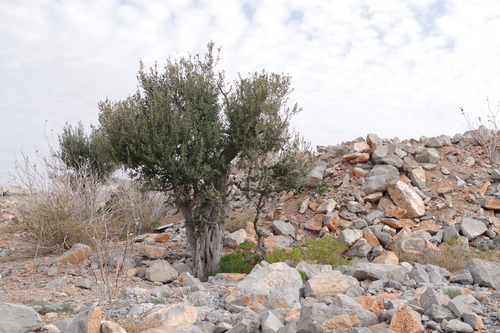
A subtropical plant. It grows in the drier Western Himalayas. It grows up to 2,400 m altitude.
Afghanistan, Asia, Himalayas, India, Nepal, Pakistan,
How to Identify
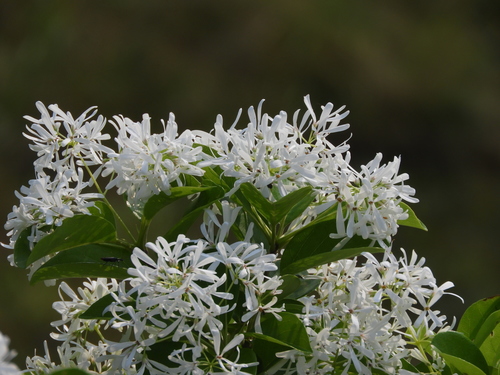
A small evergreen tree. The bark is grey and strips off when old. The leaves are 5-10 cm long. They are reddish underneath and are pointed and leathery. The edges of the leaves curve back slightly. The flowers are small and whitish. They are in clusters 2-4 cm long in the axils of leaves. The fruit are black when ripe and 8 mm long. There is one seed inside. The fruit are oily.
Production
In NW Pakistan fruit are harvested in September.
Other Information
It is a cultivated food plant.
Notes
There are over 40 Olea species. It is used as a rootstock to graft olive on to.
Names & Synonyms
Bairbanj, Kahu, Kan, Kao, Kaphlainj, Khuna, Koo, Kowo, Shawan, Showan, Shwawan, Zaitun
References (14)
- Abbasi, A. M., Khan, M & Zafar, M., 2013, Ethno-medicinal assessment of some selected wild edible fruits and vegetables of Lesser-Himalayas, Pakistan. Pak. J. Bot. 45 (SI):215-222
- Ahmad, K. & Pieroni, A., 2016, Folk knowledge of wild food plants among the tribal communities of Thakht-e-Sulaiman Hills, North-West Pakistan. Journal of Ethnobiology and Ethnomedicine, 12:17
- Ambasta, S.P. (Ed.), 2000, The Useful Plants of India. CSIR India. p 407
- Amin, M., et al, 2023, Edible wild plant species used by different linguistic groups of Kohistan Upper Khyber Pakhtunkhwa (KP), Pakistan. Journal of Ethnobiology and Ethnomedicine 19:6 p 11
- Flora of Pakistan. www.eFloras.org
- Ill. bot. Himal. Mts. 1(8):267. 1835; 2(7): t. 65, fig. 1. 1835
- Khalid, N., et al, 2023, Wild food plants gathered by four cultural groups in North Waziristan, Pakistan. Genet Resour Crop Evol. 70:1243–1276
- Khan, A. H., et al, 2023, Traditional foraging for ecological transition? Wild food ethnobotany among three ethnic groups in the highlands of the eastern Hindukush, North Pakistan. Journal of Ethnobiology and Ethnomedicine 19:9
- Joshi, S., Olea ferruginea Royle, Indian olive: an underutilised fruit tree crop of North-west Himalaya. Fruits, Vol. 67, p. 121-126
- Polunin, O., & Stainton, A., 2006, Flowers of the Himalaya, Oxford India Paperbacks. p 259
- Sahni, K.C., 2000, The Book of Indian Trees. Bombay Natural History Society. Oxford. p 128
- Sher, H. et al, 2011, Ethnobotanical and Economic Observations of Some Plant Resources from the Northern Parts of Pakistan. Ethnobotany research & Applications 9:027-041
- Singh, H.B., Arora R.K.,1978, Wild edible Plants of India. Indian Council of Agricultural Research, New Delhi. p 68 (As Olea cuspidata)
- Upreti, K., et al, 2010, Diversity and Distribution of Wild Edible Fruit Plants of Uttarakhand. Bioversity Potentials of the Himalaya. p 174