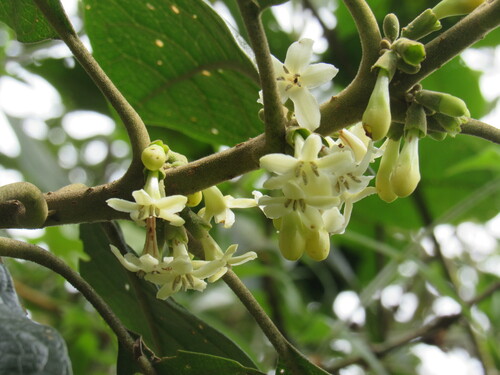
Premna herbacea
Roxb.

(c) dechaphaetkrathok, some rights reserved (CC BY-NC)
What to Eat
Edible parts: Fruit, Leaves
The ripe fruit are eaten raw, and the young leaves and shoots are cooked and eaten as a vegetable.
Where to Find It
It is a tropical plant. It grows on clays and scree slopes and rocky outcrops.
Asia, Australia, Bangladesh, Himalayas, India, Indochina, Laos, Myanmar, Northeastern India, SE Asia,
How to Identify
A small herb or shrub. It keeps growing from year to year. It has a woody rootstock. It has soft shoots that grow 5-20 cm high. The leaves die back in the winter. The leaves do not have leaf stalks. The leaves are often in rings near the ground. They are broadly oval and have teeth along the edge. The flowers are white and green. They are in groups at the ends of branches. The fruit is round and fleshy. It is small and black and shiny.
Medicinal Uses
The juice from roots and rhizomes is used in India to treat dropsy, cough, asthma, fever, rheumatism and cholera.
Notes
Also put in the family Verbenaceae.
Names & Synonyms
Adavinelli koora, Baman hati, Bharangamula, Bharangi, Bhui jam, Bol-sal-thanuri, Bolsalthanuri, Buma samba, Gandu bharangi, Ghanta nharan kura, Hora chalu, Kada-met, Keradapini, Khera daphni, Machgaldeb, Mathigathan, Mati-pharuwa, Matia jam, Matiphesa, Nai thega, Neala neareadu, Ote atil ba, Phin jamun, Siru tekku
References (11)
- Ambasta, S.P. (Ed.), 2000, The Useful Plants of India. CSIR India. p 489
- Baro, D., Baruah, S. and Borthukar, S. K. 2015, Documentation on wild vegetables of Baksa district, BTAD (Assam). Scholars Research Library. Archives of Applied Science Research, 2015, 7 (9):19-2
- Paczkowska, G . & Chapman, A.R., 2000, The Western Australian Flora. A Descriptive Calatogue. Western Australian Herbarium. p 567
- Fl. ind. ed 1832, 3:80. 1832
- Narzary, H., et al, 2013, Wild Edible Vegetables Consumed by Bodo tribe of Kokrajhar District (Assam), North-East India. Archives of Applied Science Research, 5(5): 182-190
- Pasha, M. K. & Uddin, S. B., 2019, Minor Edible Fruits of Bangladesh. Bangladesh J. Plant Taxon. 26(2): 299–313
- Patiri, B. & Borah, A., 2007, Wild Edible Plants of Assam. Geethaki Publishers. p 101
- Rajkalkshmi, P. et al, 2001, Total carotenoid and beta-carotene contents of forest green leafy vegetables consumed by tribals of south India. Plant Foods for Human Nutrition 56:225-238 (As Pygmaeopremna herbacea)
- Sawian, J. T., et al, 2007, Wild edible plants of Meghalaya, North-east India. Natural Product Radiance Vol. 6(5): p 420
- Singh, H.B., Arora R.K.,1978, Wild edible Plants of India. Indian Council of Agricultural Research, New Delhi. p 68
- Upreti, K., et al, 2010, Diversity and Distribution of Wild Edible Fruit Plants of Uttarakhand. Bioversity Potentials of the Himalaya. p 182 (As Pygmaeopremna herbacea)