Saurauia cerea
Griff.
ActinidiaceaeFruit
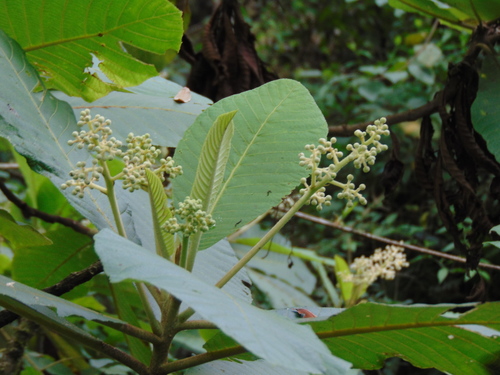
iNaturalist · cc-by-nc
(c) Kevin Meza, some rights reserved (CC BY-NC)
(c) Kevin Meza, some rights reserved (CC BY-NC)
What to Eat
Edible parts: Fruit
The fruit are eaten.
Where to Find It
It is a subtropical plant. It grows on moist mountain forests and valleys between 400-2,200 m above sea level. In Yunnan.
Asia, China, India, Myanmar, Northeastern India, SE Asia, Tibet,
Countries: United Arab Emirates, Afghanistan, Armenia, Azerbaijan, Bangladesh, Bahrain, Brunei, Bhutan, China, Georgia, Indonesia, Israel, India, Iraq, Iran, Jordan, Japan, Kyrgyzstan, Cambodia, North Korea, South Korea, Kuwait, Kazakhstan, Laos, Lebanon, Sri Lanka, Myanmar, Mongolia, Maldives, Malaysia, Nepal, Oman, Philippines, Pakistan, Qatar, Saudi Arabia, Singapore, Syria, Thailand, Tajikistan, Timor-Leste, Turkmenistan, Turkey, Taiwan, Uzbekistan, Vietnam, Yemen
How to Identify
A tree. It grows 5-15 m tall. The leaf blades are oval and 17-36 cm long by 12-20 cm wide. The leaves have yellow hairs underneath when young. The flowers are large and occur singly. They are 4 cm across. The fruit are greenish white and a flattened round shape. They are 8 mm across and have 5 ribs.
Production
In China plants flower in July to September and fruit October to November.
Notes
An accepted name in The Plant List.
Names & Synonyms
Maraw, Metzulashi, Numraw
Probably now a synonym of Saurauia cerea.
References (3)
- Dobriyal, M. J. R. & Dobriyal, R., 2014, Non Wood Forest Produce an Option for Ethnic Food and Nutritional Security in India. Int. J. of Usuf. Mngt. 15(1):17-37
- Singh, H.B., Arora R.K.,1978, Wild edible Plants of India. Indian Council of Agricultural Research, New Delhi. p 71
- Singh, V. B., et al, (Ed.) Horticulture for Sustainable Income and Environmental Protection. Vol. 1 p 219


