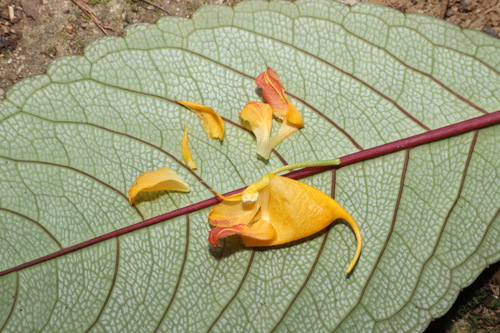
Impatiens amplexicaulis
Edgew.
Clasping-leaf balsam
BalsaminaceaeSeeds/Nuts

iNaturalist · cc-by-nc
(c) swanand kesari, some rights reserved (CC BY-NC), uploaded by swanand kesari
(c) swanand kesari, some rights reserved (CC BY-NC), uploaded by swanand kesari

iNaturalist · cc-by-nc
(c) swanand kesari, some rights reserved (CC BY-NC)
(c) swanand kesari, some rights reserved (CC BY-NC)
What to Eat
Edible parts: Seeds
The seeds are eaten.
Where to Find It
It is a temperate plant. In Tibet it grows along roadsides between 2,900-3,200 m above sea level.
Asia, China, Himalayas, India, Nepal, Tibet,
Countries: United Arab Emirates, Afghanistan, Armenia, Azerbaijan, Bangladesh, Bahrain, Brunei, Bhutan, China, Georgia, Indonesia, Israel, India, Iraq, Iran, Jordan, Japan, Kyrgyzstan, Cambodia, North Korea, South Korea, Kuwait, Kazakhstan, Laos, Lebanon, Sri Lanka, Myanmar, Mongolia, Maldives, Malaysia, Nepal, Oman, Philippines, Pakistan, Qatar, Saudi Arabia, Singapore, Syria, Thailand, Tajikistan, Timor-Leste, Turkmenistan, Turkey, Taiwan, Uzbekistan, Vietnam, Yemen
How to Identify
An annual plant. It grows 20-40 cm tall. The stems are 4 sided. The leaves are opposite in the lower part of the stem and opposite in the upper part. They do not have leaf stalks. The leaves are oblong and 5-15 cm long by 3-5 cm wide. There are teeth along the edge. There are 6-13 flowers in a group in the axils of leaves. The flowers are pink or purple. The fruit is a capsule. The seeds are oval and black-brown.
Notes
There are about 850 Impatiens species.
References (3)
- Gautam, R. S., et al, 2020, Wild Edible Fruits of Nepal. Int. J. Appl. Sci. Biotechnol. Vol 8(3): 289-304
- Singh, H.B., Arora R.K.,1978, Wild edible Plants of India. Indian Council of Agricultural Research, New Delhi. p 82 (As Impatiens amplexicaule)
- Trans. Linn. Soc. London 20:37. 1846