Piper ribesioides
Wall.
Laos chili wood
(c) rahimidris, some rights reserved (CC BY-NC)

(c) VanLap Hoàng, some rights reserved (CC BY)
What to Eat
Edible parts: Stem, Fruit, Leaves - chewed
The young leaves are chewed with betel nut. The stalk is used as flavoring in food dishes and is sold fresh in Laotian markets.
Where to Find It
A tropical plant.
Andamans, Asia, Indochina, Indonesia, Laos, Malaysia, Myanmar, SE Asia, Thailand,
How to Identify
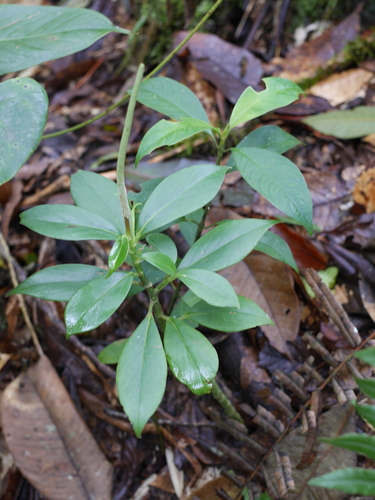
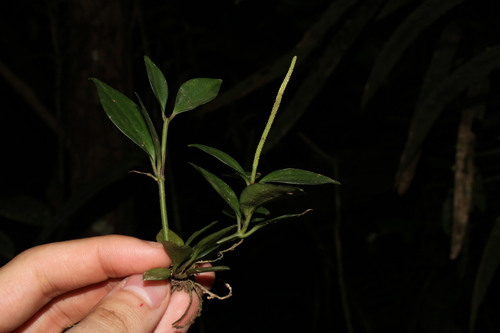
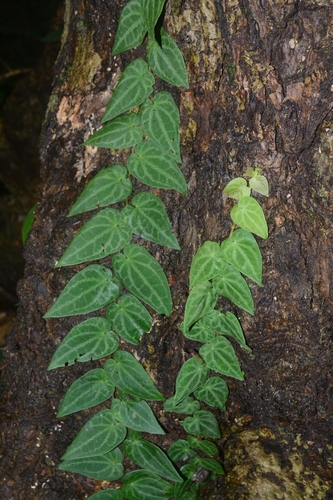
A vigorous climbing vine in the pepper family (Piperaceae) found in tropical regions. The plant produces edible leaves, fruits, and stems that are sold in markets throughout Laos.
How to Grow
Very closely related to P. Cubeba and P. Pedicellosum.
Medicinal Uses
This species is related to P. Cubeba and is said to have similar uses. These uses are:- Cubeb is a bitter, antiseptic, stimulant herb with a pungent, turpentine-allspice aroma. Both the fruits and essential oil are used and have diuretic and expectorant effects whilst also improving digestion. The fruits contain a number of medically active compounds including an essential oil; a bitter principle (cubebin); an alkaloid (piperidine); resin and a fixed oil. The immature, dried fruits are used in the treatment of coughs, bronchitis, sinusitis, throat and genito-urinary infections, poor digestion and amoebic dysentery. Cubeb oil is antiseptic, carminative, diuretic and a stimulating expectorant. It is used as an ingredient of some throat lozenges.
Other Uses
An essential oil is obtained from the fruit.
Wikipedia
Source ↗Piper ribesioides, also known as Lao chili wood, mai sakhaan (Lao: ສະຄ້ານ, Lao pronunciation: [sā.kʰâːn]), sankhaan, sankharn, sankahn or sakahn is a species of black pepper plant. The woody vine or stem of the plant has a hot, peppery and chili flavour, with a lingering aftertaste and slightly numbing sensation to the tongue. It is commonly used in Lao cuisine both in Laos and the predominately Lao ethnic region of Northeastern Thailand. It is the most important ingredient in Laos' famous Or lam. Its berries are sometimes pressed for an oil that is also used in cooking. Piper ribesioides, is a lesser known woody species known to occur in Laos, Myanmar, Andaman-Nicobar Islands, and Malesia. This taxon was located in the Andaman Islands in 1834 by Dr Helfer, a geologist who made extensive botanical collections from Tenasserim (Myanmar) and the Andaman Islands. Unfortunately, he was murdered by the indigenous people of the northern Andaman Islands and his collections from Tenasserim and Andaman Islands were mixed up, causing much confusion about the geographical origin of the botanical collections. Hence the locality of all herbarium collections made by Helfer have been designated as Tenasserim/Andaman Islands. Exact occurrence of several collections made by Helfer was later reconfirmed by other botanists during their explorations. One of his collections deposited at Central National Herbarium, Howrah (CAL) designated the locality as Tenasserim/Andaman Islands was Piper ribesioides; however, the occurrence of this species in Andaman Islands was doubted until its rediscovery in 1990 by Mathew and Abraham. This woody climbing liana is evidently rare in the Andaman Islands. Living accessions of this rare insular species from the Andaman Islands is conserved at the Field Gene Bank of Jawaharlal Nehru Tropical Botanic Garden and Research Institute, Trivandrum, South India.
Other Information
Stems are sold in markets in Laos.
Notes
There are between 1000-2000 Piper species. They are mostly in the tropics.
Names & Synonyms
Akar kalong ular, Cawi, Dunlok, Lada rimba, Mai sakhaan, Sa khan, Sireh murai, Ta khaan lek, Taw-kun
References (6)
- Burkill, I.H., 1966, A Dictionary of the Economic Products of the Malay Peninsula. Ministry of Agriculture and Cooperatives, Kuala Lumpur, Malaysia. Vol 2 (I-Z) p 1782
- Ferns, Useful Tropical Plants
- Jacquat, C., 1990, Plants from the Markets of Thailand. D.K. Book House p 63
- Luczaj, L., et al, 2021, Wild food plants and fungi sold in the markets of Luang Prabang, Lao PDR. Journal of Ethnobiology and Ethnomedicine (2021) 17:6
- Ong, H., et al, 2012, Traditional knowledge and usage of edible plants among the Semai community of Kampung Batu 16, Tapah, Perak, Malaysia. Scientific Research and Essays Vol. 7(4), pp. 441-445, 30 January, 2012
- World Checklist of Useful Plant Species 2020. Royal Botanic Gardens, Kew