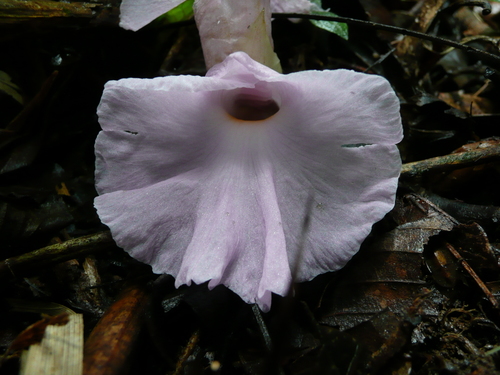
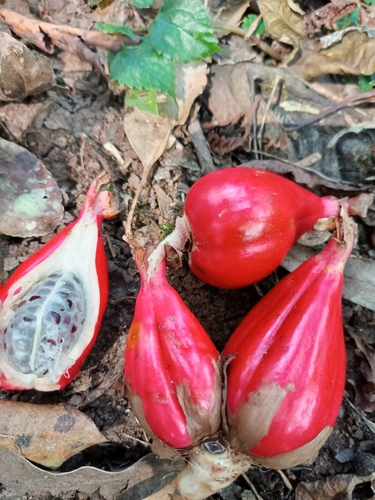
Curcuma parviflora
Wallich

(c) Tony Rodd, some rights reserved (CC BY-NC-SA)
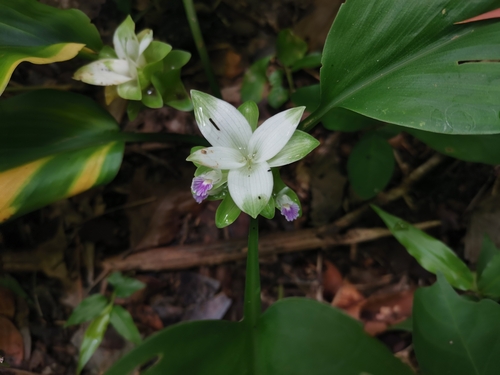
(c) Wich’yanan (Jay) Limparungpatthanakij, some rights reserved (CC BY-NC)
What to Eat
Edible parts: Leaves, Flowers
Young leaves are served blanched with chili sauce. Flowers are boiled and eaten with shrimp paste and chili sauce.
Where to Find It
A tropical plant. It grows in shady deciduous forests.
Asia, India, Indochina, Indonesia, Laos, Malaysia, Myanmar, SE Asia, Thailand,
How to Identify
A ginger family herb. It grows 30-40 cm high. There are 3-5 leaves. The are oval and long and up to 23 cm long by 8 cm wide. The leaf stalk is smooth and 10 cm long. The flower arrangement is cylindrical and at the end of the shoot. It is 6 cm long by 2-3 cm wide. The bracts are like pouches and join together for half their length. They are 3 cm long by 1-1.2 cm wide. Each bract surrounds two flowers. The flowers are 1.5 cm long. The fruit is a capsule which is long and oval.
How to Grow
Plants in this genus generaly prefer a humus-rich, moist but well-drained soil in partial shade.
Propagation: Seed - best sown as soon as it is ripe. Germinates best at temperatures around 20°c. Division of the rhizome when the plant is dormant.
Notes
There are about 50 Curcuma species. They are mostly in SE Asia.
Names & Synonyms
Dork grajeaw, Krachieo khaao, Mai-ta-raw-thing, Phu-ya-bawmg
References (9)
- Anderson, E. F., 1993, Plants and people of the Golden Triangle. Dioscorides Press. p 208
- Facciola, S., 1998, Cornucopia 2: a Source Book of Edible Plants. Kampong Publications, p 248
- Jacquat, C., 1990, Plants from the Markets of Thailand. D.K. Book House p 116
- Kachenchart, B., et al, 2008, Phenology of Edible Plants at Sakaerat Forest. In Proceedings of the FORTROP II: Tropical Forestry Change in a Changing World. Bangkok, Thailand.
- Kuhnlein, H. V., et al, 2009, Indigenous Peoples' food systems. FAO Rome p 171
- Sirirugsa, P., 1999, Thai Zingiberaceae: Species Diversity and their Uses. http://www.iupac.org/symposia/proceedings/phuket 97
- Somnasang, P., Moreno, G and Chusil K., 1998, Indigenous knowledge of wild hunting and gathering in north-east Thailand. Food and Nutrition Bulletin 19(4) p 359f
- Somnasang, P., et al, 2000, Knowing gathering and eating: Knowledge and attitudes about wild food in an Isan Village in north eastern Thailand. Journal of Ethnobiology 20(2):197-216
- Thitiprasert, W., et al, 2007, Country report on the State of Plant Genetic Resources for Food and Agriculture in Thailand (1997-2004). FAO p 95