Xanthosoma robustum
Schott
Ape
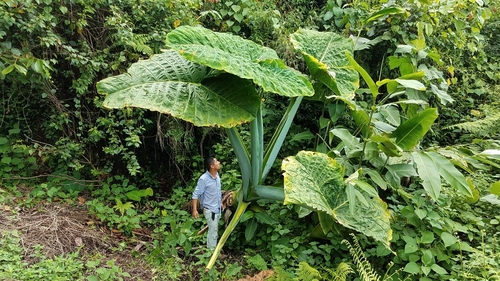
(c) Alan Rockefeller, some rights reserved (CC BY), uploaded by Alan Rockefeller

(c) Bernabe Alejandro Uc Dzul, some rights reserved (CC BY-NC), uploaded by Bernabe Alejandro Uc Dzul

(c) CARLOS VELAZCO, some rights reserved (CC BY-NC), uploaded by CARLOS VELAZCO
What to Eat
Edible parts: Tubers, Root, Leaves
Young leaves are eaten in soup. Tubers and roots are also eaten.
Known Hazards
Where to Find It
A tropical plant. It grows in wet soil and usually boggy ground. It grows up to 900 m above sea level in Central America,
Asia, Central America*, Costa Rica, Guatemala, Hawaii, Honduras, Indonesia, Mexico, North America, Pacific, SE Asia, USA,
How to Identify
A herb. It is in the taro family. The stem can be 1-4 m long and 10-20 cm thick. They often lie along the ground. The leaf stalks are 40-180 cm long. The leaf blades are oval to sword shaped and can be 2 m long.
Nutrition Score: 29/100
| Part | Moisture | kJ | kcal | Protein | Vit A | Vit C | Iron | Zinc |
|---|---|---|---|---|---|---|---|---|
| Leaves - dry | 4.6 | — | — | 30.4 | — | — | — | — |
How to Grow
It is grown from offshoots.
Wikipedia
Source ↗Xanthosoma robustum, also known as Elephant Ear, is a robust herbaceous plant native to Central Mexico and Central America that can grow up to 4 meters tall. It's an important plant with uses in medicine, environmental applications, and as a food source. This species has large, waxy, green leaves that can grow over a meter long. The plant also produces distinct inflorescences with a white to yellowish-green spathe and a pale yellow to ochre spadix.
Notes
There are 57 Xanthosoma species.
Names & Synonyms
Kipul raksasa, Lokg, Mafafa blanca, Malvaron, Oreja de elefante, Paxnikak, Rejalgar, Quequeshque, Tup
References (11)
- de Polle, E., Plantas Silvestres Comestible de Guatemala. 1(1) Universidad de San Carlos de Guatemala.
- Diaz-Betancourt, M., et al, 1999, Weeds as a future source for human consumption. Rev. Biol. Trop. 47(3):329-338
- Kermath, B. M., et al, 2014, Food Plants in the Americas: A survey of the domesticated, cultivated and wild plants used for Human food in North, Central and South America and the Caribbean. On line draft. p 927
- Larios, et al., 2013, Plant management and biodiversity conservation in Náhuatl homegardens of the Tehuacán Valley, Mexico. Journal of Ethnobiology and Ethnomedicine 2013 9:74.
- Mapes, C. & Basurto, F., 2016, Biodiversity and Edible Plants of Mexico. Chapter 5 in R. Lira, et al. (eds.), Ethnobotany of Mexico, Ethnobiology, Springer. p 112, 116
- Oesterr. Bot. Wochenbl. 3:370. 1853
- Pena, F. B., et al, 1998, Los quelites de la Sierra Norte de Puebla, Mexico: Inventory Y Formas de Preparacion. Bol. Soc. Bot. Mexico 62:49-62
- Standley, P. & Steyermark, J., 1958, Flora of Guatemala. Fieldiana: Botany, Volume 24 part 1 p 362
- Staples, G.W. and Herbst, D.R., 2005, A tropical Garden Flora. Bishop Museum Press, Honolulu, Hawaii. p 613
- Sukarya, D. G., (Ed.) 2013, 3,500 Plant Species of the Botanic Gardens of Indonesia. LIPI p 1141
- Turreira-Garcia, N., et al, 2015, Wild edible plant knowledge, distribution and transmission: a case study of the Achi Mayans of Guatemala. Journal of Ethnobiology and Ethnomedicine. 11:52


