Smilax megacarpa
A DC
Da guo ba qia
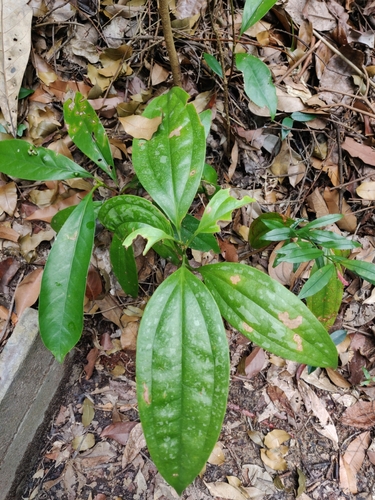
(c) airgel, some rights reserved (CC BY-NC), uploaded by airgel
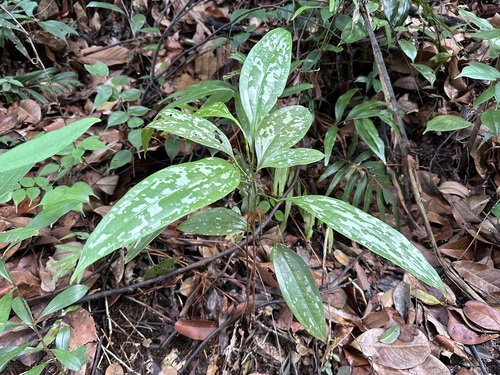
(c) scallions, some rights reserved (CC BY), uploaded by scallions
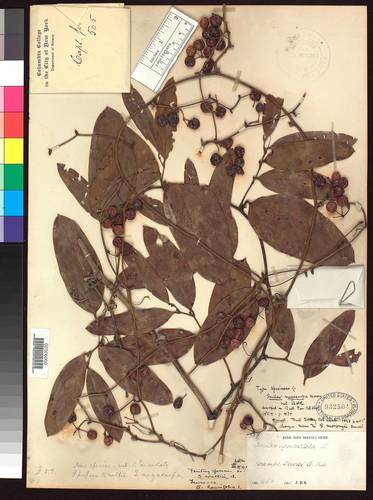
(c) Smithsonian Institution, National Museum of Natural History, Department of Botany, some rights reserved (CC BY-NC-SA)
What to Eat
Edible parts: Fruit, Rhizome, Root
The dark red berries are conserved and eaten. The rhizome and roots are also eaten.
Where to Find It
A tropical plant. It grows in forest thickets and shaded slopes from near sea level to 1500 m in southern China. In Yunnan.
Asia, Cambodia, China, India, Indochina, Indonesia, Laos, Malaysia, Myanmar, Pacific, Philippines, SE Asia, Thailand, Vietnam,
How to Identify
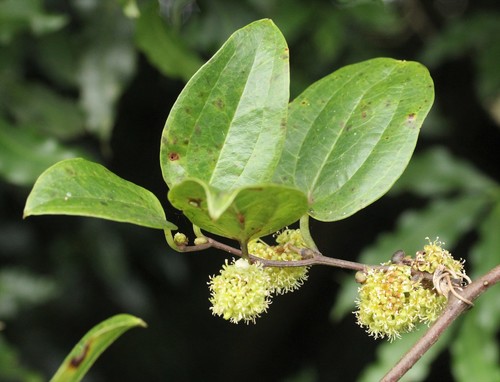
A climbing vine. It usually does not have prickles. The stem is branched. It is 10 m long and woody. The leaf stalk is 1.5-5 cm long and has narrow wings. Tendrils are usually present. The leaf blade is oval and 10-20 cm long by 3-12 cm wide. It is papery. There can be 1-3 flowerings stalks together. They are 3-6 cm long. There can be 6-20 flowers on each stalk. The flowers are greenish yellow. The fruit is a dark red berry. It is round and 1.5-2 cm across.
Medicinal Uses
The plant is used in local medicine in Laos, where it plays a role in medicines given after childbirth and against cough.
Notes
There are about 300 Smilax species.
Names & Synonyms
Akar kelona, Porpreus, Vor rombers
References (8)
- Altschul, S.V.R., 1973, Drugs and Foods from Little-known Plants. Notes in Harvard University Herbaria. Harvard Univ. Press. Massachusetts. no. 374
- Ambasta, S.P. (Ed.), 2000, The Useful Plants of India. CSIR India. p 577
- Burkill, I.H., 1966, A Dictionary of the Economic Products of the Malay Peninsula. Ministry of Agriculture and Cooperatives, Kuala Lumpur, Malaysia. Vol 2 (I-Z) p 2075
- Chen Xinqi, Liang Songyun, Xu Jiemei, Tamura M.N., Liliaceae. Flora of China. p 40
- Lim, T. K., 2015, Edible Medicinal and Non Medicinal Plants. Volume 9, Modified Stems, Roots, Bulbs. Springer p 77
- PROSEA handbook Volume 9 Plants yielding non-seed carbohydrates. p 189
- Turreira Garcia, N., et al, 2017, Ethnobotanical knowledgeof the Kuy and Khmer people in Prey Lang, Cambodia. Cambodian Journal of Natural History 2017 (1): 76-101
- World Checklist of Useful Plant Species 2020. Royal Botanic Gardens, Kew