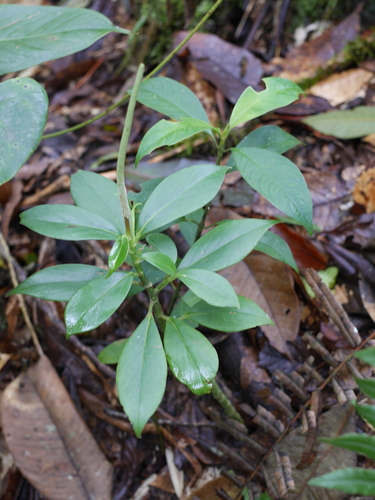
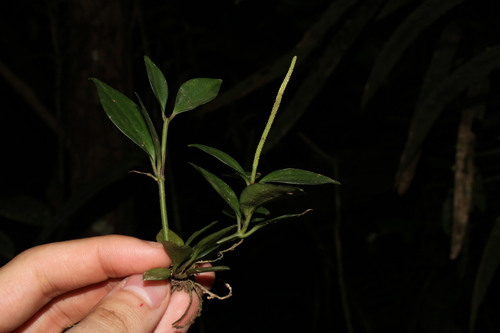
Piper marginatum
Jacq.
Marigold pepper

(c) Helio Lourencini, some rights reserved (CC BY-NC-SA)
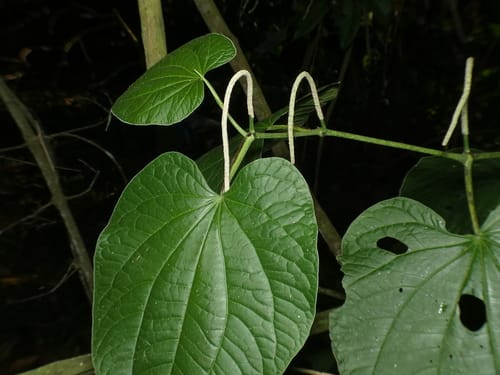
(c) Helio Lourencini, some rights reserved (CC BY)

(c) Shaan Aroeste, some rights reserved (CC BY)
What to Eat
Edible parts: Leaves, Fruit - spice
Leaves are brewed into tea, and the fruit are used as a spice.
Where to Find It
A tropical plant.
Amazon, Brazil, Central America, French Guiana, Panama, South America, Suriname,
How to Identify
A tropical shrub in the Piperaceae family, with leaves and fruit used as edible products.
Wikipedia
Source ↗Piper marginatum, the cake bush, Anesi wiwiri, marigold pepper, Ti Bombé in Creole or Hinojo, is a plant species in the genus Piper found in moist, shady spots in the Amazon rainforest in Surinam, French Guiana and Brazil. The leaves contain flavonoids such as vitexin and marginatoside (6 -O-β gentiobiosyl vitexin). The plant also contains 3,4-Methylenedioxypropiophenone, 2,4,5-Trimethoxypropiophenone, 2-Methoxy-4,5-methylenedioxypropiophenone, 1-(3,4-Methylenedioxyphenyl)propan-1-ol (Marginatumol), 5,4′-Dihydroxy-7-methoxyflavanone and 5,7-Dihydroxy-4′-methoxyflavanone. An essential oil can be produced from the plant showing deterrent and larvicidal activities against Aedes aegypti.
Notes
There are between 1000-2000 Piper species. They are mostly in the tropics.
References (2)
- Altschul, S.V.R., 1973, Drugs and Foods from Little-known Plants. Notes in Harvard University Herbaria. Harvard Univ. Press. Massachusetts. no. 488 (As Piper san-joseanum)
- Kermath, B. M., et al, 2014, Food Plants in the Americas: A survey of the domesticated, cultivated and wild plants used for Human food in North, Central and South America and the Caribbean. On line draft. p 665