Austromyrtus dulcis
(C. White) L. S. Smith
Midjin, Midjimberry, Midgen Berry, Quaker’s Cherry

Zaareo (via Wikimedia Commons)

Pezoporus wallicus (via Wikimedia Commons)

geraldine4184

(c) Suzanne Wilson, some rights reserved (CC BY-NC), uploaded by Suzanne Wilson

(c) Jacob Crisp, some rights reserved (CC BY-NC), uploaded by Jacob Crisp
(c) Scott W. Gavins, some rights reserved (CC BY-NC), uploaded by Scott W. Gavins
What to Eat
Edible parts: Fruit, Seeds
The berries are a popular traditional bushfood, eaten by indigenous Australians and non-indigenous people. The melt-in-the-mouth berries are sweet and aromatic, with a pleasant peppery/gingery flavour. While recognized as having good flavour qualities, the berries have not been commercialized due to harvesting and handling issues. Midgim is also popular in amenity horticulture as an adaptable shrub for a variety of situations, handling a range of soils and climatic conditions. It springs up and grows like a wheat field .... one can go through acres of the scrub with its white, sweet-tasting berry until stopped by a lagoon or salt water. It is the most sought-for berry or fruit on the island. Children will collect it by the tin-full, and even the elders will join with gusto in its eating.
Where to Find It
A tropical and subtropical plant. It can grow from tropical to temperate climates and in semiarid regions. It can tolerate light frosts. It needs moist well drained soil or dry soil. It can grow in full sun or light shade. It suits hardiness zones 9-11. Geelong Botanical Gardens. Coffs Harbour Botanical Gardens.
Australia*,
How to Identify
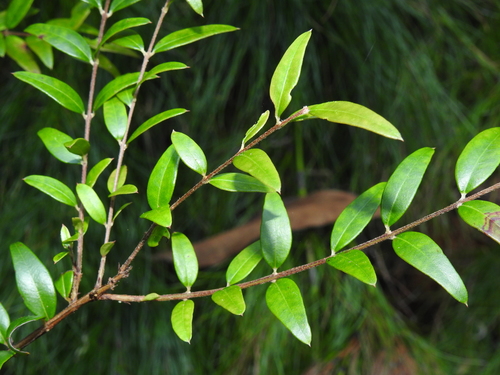
A ground cover plant. It forms mounds. It grows 30-60 cm high and spreads 1-2 m wide. The young shoots are reddish. The leaves are 1-3 cm long by 0.5 cm wide. They are oval or sword shaped. The leaves are bronze coloured. The flowers are 1 cm across. The flowers are white and occur singly but in fluffy masses. The fruit is a berry. It is about 1 cm across. The fruit are brownish-white with black dots. The fruit are edible.
Nutrition Score: 31/100
| Part | Moisture | kJ | kcal | Protein | Vit A | Vit C | Iron | Zinc |
|---|---|---|---|---|---|---|---|---|
| Fruit | 75.8 | 386 | 92 | 0.9 | — | — | 5.1 | 0.2 |
How to Grow
Plants can be grown from cuttings or seed. Fresh seed germinate in 21-28 days. Stored seed take longer to germinate and probably should be soaked before planting. It should be pruned regularly.
Wikipedia
Source ↗Austromyrtus dulcis is a species of plant native to eastern Australia. It grows as a small spreading shrub and is easily recognised by its characteristic berries that usually ripen in summer and autumn. Common names include the midgen berry, midyim, and silky myrtle.
Other Information
It is popular.
Notes
There are 14 Austromyrtus species. They occur in Australia.
Names & Synonyms
References (24)
- Bodkin, F., 1991, Encyclopedia Botanica. Cornstalk publishing, p 120
- Bonney, N., 1997, Economic Native Trees and Shrubs for South Australia. Greening Australia (SA) inc. Campbelltown SA 5074 p 168
- Bonney, N., 2012, Edible Wild Native Plants for Southern Australia. p 110
- Cherikoff V. & Isaacs, J., The Bush Food Handbook. How to gather, grow, process and cook Australian Wild Foods. Ti Tree Press, Australia p 52
- Cribb, A.B. & J.W., 1976, Wild Food in Australia, Fontana. p 23
- Edible and Useful Native Plants (off internet)
- Elliot, W.R., & Jones, D.L., 1982, Encyclopedia of Australian Plants suitable for cultivation. Vol 2. Lothian. p 262
- Etherington, K., & Imwold, D., (Eds), 2001, Botanica's Trees & Shrubs. The illustrated A-Z of over 8500 trees and shrubs. Random House, Australia. p 108
- Facciola, S., 1998, Cornucopia 2: a Source Book of Edible Plants. Kampong Publications, p 157
- Haslam, S., 2004, Noosa's Native Plants. Noosa Integrated Catchment Assn. Inc. p 17
- Hibbert, M., 2002, The Aussie Plant Finder 2002, Florilegium. p 36
- Leiper, G & Houser, J., Mutooroo. Plant Use by Australian Aboriginal People. Assembly press, Queensland.
- Low, T., 1991, Wild Food Plants of Australia. Australian Nature FieldGuide, Angus & Robertson. p 35
- Low, T., 1992, Bush Tucker. Australia’s Wild Food Harvest. Angus & Robertson. p 53
- Lyle, S., 2006, Discovering fruit and nuts. Land Links. p 82
- Molyneux, B & Forrester, S., 1997, The Austraflora A-Z of Australian Plants. Reed. p 47
- Nicholson, N & H., 1996, Australian Rainforest Plants 2, Terania Rainforest Publishing. NSW. p 11
- Proc. Roy. Soc. Queensland 67:35. 1956
- Ryan, M. (Ed.), 2003, Wild Plants of Greater Brisbane. Queensland Museum. p 132
- Smith, K & I., 1999, Grow your own bushfoods. New Holland. Australia. p 54
- Stanley, T. D. & Ross, E. M., 1986, Flora of south-eastern Queensland Volume 2. Queensland Government p 208
- Wrigley, J.W., & Fagg, M., 1982, Australian Native Plants. Collns. p 76
- World Checklist of Useful Plant Species 2020. Royal Botanic Gardens, Kew
- www.ceres.org/au/bushfood catalogue