Avena fatua
L.
Wild oats
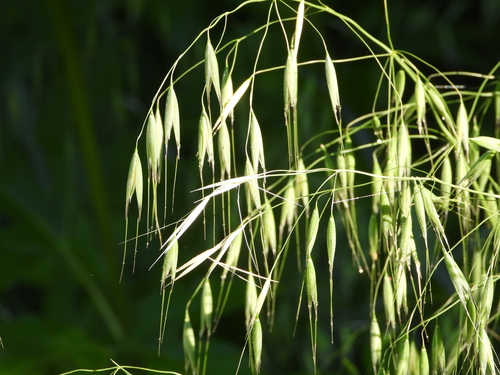
(c) Larry Swift, some rights reserved (CC BY-NC), uploaded by Larry Swift

no rights reserved, uploaded by Jesse Rorabaugh

(c) Jesse Rorabaugh, some rights reserved (CC BY), uploaded by Jesse Rorabaugh
What to Eat
Edible parts: Seeds, Cereal
Edible Parts: Seed Edible Uses: Coffee Nutritionally comparable to cultivated oats; good flavor once cleaned and cooked. Best low-tech use is oat milk (pound–boil–filter) or coarse porridge after rigorous de-awning/dehulling. Always avoid moldy heads and filter out hairs/awns; moderate intake if sensitive to avenin [2-3]. Rating: 3/5. Seed - cooked. The seed ripens in the latter half of summer and, when harvested and dried, can store for several years. It has a floury texture and a mild, somewhat creamy flavour. It can be used as a staple food crop in either savoury or sweet dishes. The seed can be cooked whole, though it is more commonly ground into a flour and used as a cereal in all the ways that oats are used, especially as a porridge but also to make biscuits, sourdough bread etc. The seed can also be sprouted and eaten raw or cooked in salads, stews etc. The roasted seed is a coffee substitute.Specific indigenous dietary records for A. fatua are limited; the grain has been opportunistically foraged where abundant and used similarly to domesticated oats (porridges, beverages). Most historical attention is agronomic—as a weed in colonial and modern cereal systems [2-3]. Harvest & Processing Workflow 1. Scout in late spring for straw-colored panicles with dark, bent awns; avoid diseased stands. 2.Clip panicles into sacks; air-dry 3–7 days until crisp. 3.Thresh (beat in a clean bin). 4. De-awn by rubbing or brief impact milling; sieve off awns/hairs. 5a) For oat milk: pound remaining spikelets, simmer 20–40 min, filter through fine cloth; reduce to taste. 5b) For groats/flour: parch lightly, crack hulls (dehuller or burr mill set wide), winnow/sieve; steam and roll for flakes or grind into flour. 5. Store cleaned grain
Where to Find It
It is a temperate plant. It grows in pasture land. It grows in high altitudes and in winter crops in the tropics. It normally grows where rainfall is 375-750 mm per year. It will grow in a wide range of soils and can tolerate alkaline and acid soils. It will grow with a pH down to 4.5. In Argentina it grows from sea level to 2,000 m above sea level. Tasmanian Herbarium. It grows in Sichuan.
Afghanistan, Africa, Albania, Argentina, Asia, Australia, Bhutan, Bolivia, Brazil, Britain, Canada, Central Asia, Chile, China, East Africa, Easter Island, Europe, Himalayas, India, Inner Mongolia, Iraq, Kazakhstan, Korea, Kyrgyzstan, Luxembourg, Mediterranean, Middle East, Nepal, New Zealand, North Africa, North America, Northeastern India, Pakistan, Russia, Sikkim, Slovenia, South Africa, Southern Africa, South America, Spain, Tajikistan, Tasmania, Turkey, Türkiye, Turkmenistan, Uruguay, USA, Uzbekistan, Zambia, Zimbabwe,
How to Identify
A stout, erect annual grass. It grows 1.2 m high. The stems are robust. The sheaths of the basal leaves are hairy. The leaves are flat and 45 cm long by 15 mm wide. The flowers are in heads up to 40 cm long. They are open and nodding. The awn is long (2.5-5 cm) and bent in the middle. The lower half is dark brown in each floret. The seed has a dense covering of hairs.
How to Grow
Height typically 0.4–1.2 m (to ~1.5 m); spread by clumping and prolific seeding rather than rhizomes. As an intentional landscape plant it has little value (and is often regulated); as a nurse/cover it’s risky due to weediness. A widespread, highly adaptable winter/spring annual grass with excellent grain nutrition masked by processing challenges and serious weediness. Valuable to foragers who can clean and cook it properly, but unsuitable for intentional introduction. Manage aggressively to prevent spread in agricultural and restoration settings. Succeeds in any moderately fertile soil in full sun. Prefers a poor dry soil. Tolerates a pH in the range 4.5 to 6.5. A parent of the cultivated oat, A. sativa but the seeds are somewhat smaller and yields lower. This species could be of importance in breeding programmes for the cultivated oats (A. sativa), where it could confer drought tolerance, disease resistance and higher yields. Oats are in general easily grown plants but, especially when grown on a small scale, the seed is often completely eaten out by birds. Some sort of netting seems to be the best answer on a garden scale. Look-Alikes & Confusion Risks: Cultivated oat (Avena sativa) — often larger, awns variable/shorter or absent in many cultivars; hull adherence varies; usually within fields by sowing. Slender wild oat (Avena barbata) — smaller spikelets, finer habit; common along the Pacific Coast. Wild oat complex (A. sterilis ssp. ludoviciana) — larger, earlier shattering. Bromes (e.g., Bromus diandrus, B. madritensis) — panicles differ; brome spikelets subtend multiple florets with different glume/lemma characters and often awns from the lemma tip, not the back. Key for A. fatua: large glumes; 2–3 florets; long twisted, geniculate black awn from lemma back; soft oat-like leaves with a big membranous ligule, no auricles. Pests & Problems: Diseases: crown rust (Puccinia coronata), smuts (Ustilago avenae), Barley Yellow Dwarf Virus (aphid-borne), Fusarium spp. (head blight; DON risk). Insects: aphids, armyworms, wireworms. Post-harvest: storage moths, weevils, molds. Mechanical: awns and silica hairs irritate skin/eyes; awns tangle in fleece and equipment. Cultivation (Horticulture): Generally not recommended to cultivate where invasive. If grown for study or food, confine to containers or controlled plots. Harvest before seed shattering and bag panicles to prevent escape. Cool-season sowing; modest fertility; avoid irrigation schedules that promote excessive seed set.
Propagation: By seed only. Sow shallowly (=1 cm) into cool, moist soil. Germinates at 5–20 °C. No dormancy treatment needed, though wild seed often has variable dormancy (spread germination over multiple seasons). Prevent escape by removing volunteers promptly.
Medicinal Uses
Diuretic Emollient Refrigerant The seeds are diuretic, emollient and refrigerant.
Other Uses
Fibre Mulch Paper Thatching The straw has a wide range of uses such as for bio-mass, fibre, mulch, paper-making and thatching. Some caution is advised in its use as a mulch since oat straw can infest strawberries with stem and bulb eelworm. Ecology & Wildlife: Provides seed forage for granivorous birds and small mammals; foliage grazed as tender seedlings. Dense infestations suppress native forbs and reduce crop yields. Functions as an alternate host for certain cereal diseases and aphids. Special Uses
Wikipedia
Source ↗Avena fatua is a species of grass in the oat genus. It is known as the common wild oat. This oat is native to Eurasia but it has been introduced to most of the other temperate regions of the world. It is naturalized in some areas and considered a noxious weed in others. A. fatua is a typical oat in appearance, a green grass with hollow, erect stems 1 to 4 feet (0.30 to 1.22 m) tall bearing nodding structures – panicles – of spikelets. The long dark green leaves are up to 1 centimetre (0.39 in) wide and rough due to small hairs. The seedlings are also hairy. The seed kernel is thinner, longer, darker and hairy when compared with the seed of the common cultivated oat (A. sativa). This species and other wild oats can become troublesome in prairie agriculture when it invades and lowers the quality of a field crop, or competes for resources with the crop plants. It takes very few wild oat plants to cause a significant reduction in the yield of a wheat or cultivated oat field.
Production
The grain is shed early making it hard to harvest.
Notes
It can become a serious weed in temperate cereal crops. There are about 25 Avena species.
Names & Synonyms
Avena guacha, Drake, Flaver, Gluhi oves, Jangali jau, Joa, Potato oat, Tartarean oat, Wongdaba, Yanmai
References (34)
- Ambasta S.P. (Ed.), 2000, The Useful Plants of India. CSIR India. p 63
- Anderson, M. K., 2012, Edible Seeds and Grains of California Tribes and the Klamath Tribe of Oregon in the Phoebe Apperson Hearst Museum of Anthropology Collections, University of California, Berkeley. USDA p 83
- Beckstrom-Sternberg, Stephen M., and James A. Duke. "The Foodplant Database." http://probe.nalusda.gov:8300/cgi-bin/browse/foodplantdb.(ACEDB version 4.0 - data version July 1994)
- Bircher, A. G. & Bircher, W. H., 2000, Encyclopedia of Fruit Trees and Edible Flowering Plants in Egypt and the Subtropics. AUC Press. p 49
- Bremness, L., 1994, Herbs. Collins Eyewitness Handbooks. Harper Collins. p 233
- Brouk, B., 1975, Plants Consumed by Man. Academic Press, London. p 26
- Brown, D., 2002, The Royal Horticultural Society encyclopedia of Herbs and their uses. DK Books. p 138
- Curtis, W.M., & Morris, D.I., 1994, The Student's Flora of Tasmania. Part 4B St David's Park Publishing, Tasmania, p 237
- Duke, J.A., 1992, Handbook of Edible Weeds. CRC Press. p 44
- Geng, Y., et al, 2016, Traditional knowledge and its transmission of wild edibles used by the Naxi in Baidi Village, northwest Yunnan province. Journal of Ethnobiology and Ethnomedicine. 12:10
- Harris, S., Buchanan, A., Connolly, A., 2001, One Hundred Islands: The Flora of the Outer Furneaux. Tas Govt. p 115
- Hedrick, U.P., 1919, (Ed.), Sturtevant's edible plants of the world. p 86
- Holden, J.H.W., 1979, Oats, in Simmonds N.W.,(ed), Crop Plant Evolution. Longmans. London. p 86
- Hu, Shiu-ying, 2005, Food Plants of China. The Chinese University Press. p 283 (Var. glabrata)
- Hussey, B.M.J., Keighery, G.J., Cousens, R.D., Dodd, J., Lloyd, S.G., 1997, Western Weeds. A guide to the weeds of Western Australia. Plant Protection Society of Western Australia. p 42
- Hwang, H., et al, 2013, A Study on the Flora of 15 Islands in the Western Sea of Jeollanamdo Province, Korea. Journal of Asia-Pacific Biodiversity Vol. 6, No. 2 281-310
- Jia, X., et al, 2022, Ethnobotany of wild edible plants in multiethnic areas of the Gansu–Ningxia–Inner Mongolia junction zone. Journal of Ethnobiology and Ethnomedicine 18:53
- Lamp, C & Collet F., 1989, Field Guide to Weeds in Australia. Inkata Press. p 31
- Lamp, C.A., Forbes, S.J. and Cade, J.W., 1990, Grasses of Temperate Australia. Inkata Press. p 88
- Lazarides, M. & Hince, B., 1993, Handbook of Economic Plants of Australia, CSIRO. p 29
- Low, T., 1992, Bush Tucker. Australia’s Wild Food Harvest. Angus & Robertson. p 88
- Malezas Comestibles del Cono Sur, INTA, 2009, Buernos Aires
- Menninger, E.A., 1977, Edible Nuts of the World. Horticultural Books. Florida p 146
- Murugan, Pal M., et al, 2010, Phytofoods of Nubra valley, Ladakh - The cold desert. Indian Journal of Traditional Knowledge. Vol. 9(2): 303-308
- Paczkowska, G. & Chapman, A.R., 2000, The Western Australian Flora. A Descriptive Catalogue. Western Australian Herbarium. p 98
- Plants for a Future database, The Field, Penpol, Lostwithiel, Cornwall, PL22 0NG, UK. http://www.scs.leeds.ac.uk/pfaf/
- Saunders, C.F., 1948, Edible and Useful Wild Plants. Dover. New York. p 54
- Sp. pl. 1:80. 1753
- Tasmanian Herbarium Vascular Plants list p 82
- Tozer, F., 2007, The Uses of Wild Plants. Green Man Publishing. p 43
- Vernon, R., 1983, Field Guide to Important Arable Weeds of Zambia. Dept of Agriculture, Chilanga, Zambia. p 106
- Wang, J. et al, 2013, A Study on the Utilization of Wild Plants for Food in Liangshan Yi Autonomous Prefecture. Plant Diversity and Resources. 35(4): 416-471
- Wild edible plants of Himachal Pradesh
- Zizka, G., 1991, Flowering Plants of Easter Island. Palmarum Hortus Francofurtensis


