Avena sterilis
L.
Sterile oats, Wild winter oat

(c) Javier Peralta de Andrés, some rights reserved (CC BY-NC), uploaded by Javier Peralta de Andrés
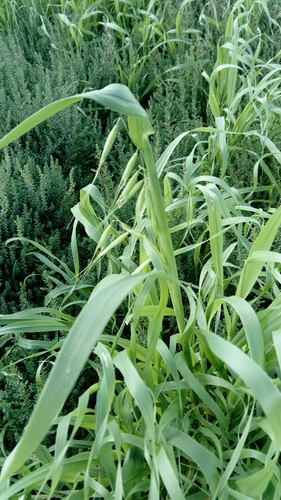
(c) Dariusz Kamiński, some rights reserved (CC BY-NC), uploaded by Dariusz Kamiński

(c) Vladimir Tkalčić, some rights reserved (CC BY-NC), uploaded by Vladimir Tkalčić
What to Eat
Edible parts: Seeds, Cereal
Edible Parts: Seed Edible Uses: Coffee Seed - cooked. The seed ripens in the latter half of summer and, when harvested and dried, can store for several years. It has a floury texture and a mild, somewhat creamy flavour. It can be used as a staple food crop in either savoury or sweet dishes. The seed can be cooked whole, though it is more commonly ground into a flour and used as a cereal in all the ways that oats are used, especially as a porridge but also to make biscuits, sourdough bread etc. The seed can also be sprouted and eaten raw or cooked in salads, stews etc. The roasted seed is a coffee substitute.
Where to Find It
It is a Mediterranean plant. It grows on cultivated and waste ground. In Argentina it grows from sea level to 800 m above sea level. Tasmanian Herbarium.
Africa, Albania, Argentina, Australia, Brazil, Chile, Europe, France, Greece, Italy, Mediterranean, Middle East, Portugal, Slovenia, South America, Spain, Syria, Tasmania, Turkey, Türkiye, Uruguay,
How to Identify
A tall annual grass. It is green or bluish-green. The stems can be single or in groups. The leaves are narrow and about 15 mm wide. They can have some hairs on the edges. The ligule is 4-6 mm long. The flower is a loose panicle. The spikelets droop on slender stalks. The awn is slender and 30-60 mm long and twisted below a distinct elbow. The flowers fall as a unit and the spikelet does not break up.
How to Grow
Succeeds in any moderately fertile soil in full sun. Tolerates a pH in the range 4.5 to 8. Occasionally cultivated for its edible seed, the yields are lower than those of A. sativa. It is probably a parent of the cultivated species of oats. This species could be of value in any breeding programme for the cultivated oats (A. sativa) where it could confer disease resistance and higher yields. Oats are in general easily grown plants but, especially when grown on a small scale, the seed is often completely eaten out by birds. Some sort of netting seems to be the best answer on a garden scale.
Propagation: Seed - sow in situ in early spring or in the autumn. Only just cover the seed. Germination should take place within 2 weeks.
Medicinal Uses
None known
Other Uses
Fibre Mulch Paper Thatching The straw has a wide range of uses such as for bio-mass, fibre, mulch, paper-making and thatching. Some caution is advised in its use as a mulch since oat straw can infest strawberries with stem and bulb eelworm. Special Uses
Wikipedia
Source ↗Avena sterilis (animated oat, sterile oat, wild oat, wild red oat, winter wild oat; syn. Avena ludoviciana Durieu; Avena macrocarpa Moench; Avena sterilis ssp. sterilis; Avena sterilis ssp. ludoviciana) is a species of grass weed whose seeds are edible. Many common names of this plant refer to the movement of its panicle in the wind.
Notes
There are about 25 Avena species.
Names & Synonyms
Jalovi oves
References (13)
- Blamey, M and Grey-Wilson, C., 2005, Wild flowers of the Mediterranean. A & C Black London. p 525
- Brouk, B., 1975, Plants Consumed by Man. Academic Press, London. p 26
- Holden, J.H.W., 1979, Oats, in Simmonds N.W.,(ed), Crop Plant Evolution. Longmans. London. p 86
- Hussey, B.M.J., Keighery, G.J., Cousens, R.D., Dodd, J., Lloyd, S.G., 1997, Western Weeds. A guide to the weeds of Western Australia. Plant Protection Society of Western Australia. p 44
- Jardin, C., 1970, List of Foods Used In Africa, FAO Nutrition Information Document Series No 2.p 1
- Lamp, C.A., Forbes, S.J. and Cade, J.W., 1990, Grasses of Temperate Australia. Inkata Press. p 90
- Lazarides, M. & Hince, B., 1993, Handbook of Economic Plants of Australia, CSIRO. p 29
- Paczkowska, G. & Chapman, A.R., 2000, The Western Australian Flora. A Descriptive Catalogue. Western Australian Herbarium. p 98
- Plants for a Future database, The Field, Penpol, Lostwithiel, Cornwall, PL22 0NG, UK. http://www.scs.leeds.ac.uk/pfaf/
- Sp. pl. ed. 2, 1:118. 1762
- Tasmanian Herbarium Vascular Plants list p 82
- World Checklist of Useful Plant Species 2020. Royal Botanic Gardens, Kew
- Zeven, A. C. & de West, J. M. J., 1982, Dictionary of cultivated plants and their regions of diversity. Wageningen. p 108


