Babiana hypogaea
Burchell
Autumn babiana, Dwarf babiana

(c) Ricus Nel, some rights reserved (CC BY), uploaded by Ricus Nel
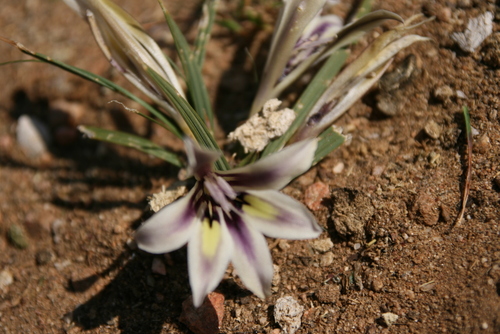
(c) franceschase, some rights reserved (CC BY-NC)

(c) Tony Rebelo, some rights reserved (CC BY-SA), uploaded by Tony Rebelo
What to Eat
Edible parts: Bulb, Corm, Root, Vegetable
The corms of Bobbejaankalkoentjie are collected locally from the wild as a food source. These corms are cooked and are reported to have a sweet and nutty flavour without the bitterness that often occurs in the corms of other Iridaceae.
Where to Find It
A tropical plant. It grows in sandy soil amongst grass in hot dry country. It grows in the Kalahari. It grows between 90-2,100 m above sea level. It can grow in arid places.
Africa, Australia, Botswana, East Africa, Namibia, South Africa, Southern Africa, Zambia, Zimbabwe,
How to Identify
A herb. It grows 12-20 cm high. It can form clumps. The corms are 2-3 cm across. The neck is 6-20 cm long. There are 4-7 leaves. They are erect. They are 7-20 cm long by 3-10 mm wide. The flower spike has 2-8 flowers congested on it. It comes from below the ground. The flowers are blue. They have a sweet spicy smell.
Nutrition
| Part | Moisture | kJ | kcal | Protein | Vit A | Vit C | Iron | Zinc |
|---|---|---|---|---|---|---|---|---|
| Bulb | 79 | — | — | — | — | — | 0.5 | 0.2 |
Wikipedia
Source ↗Babiana hypogaea is a perennial plant of about 5–8 cm (2.0–3.1 in) high that annually forms leaves and flowers from an underground corm that is assigned to the iris family. It has pale greenish yellow, buff or rarely white, mirro-symmetrical flowers and line- to sickle-shaped, slightly pleated, thinly hairy or hairless leaves that are held horizontally or inclined, that grows in the summer rainfall areas of southeastern Namibia and central and northern central South Africa. Flowers may be found between June and September and sometimes between December and May. It is called Bobbejaankalkoentjie (baboon turkey), Bobbejaanuintjie (baboon onion) or Ertappeluintjie (patato onion) in Afrikaans.
Notes
There are about 60-80 Babiana species. Most are in South Africa.
Names & Synonyms
Ertappel uintjie, Hwenya, Lichus, Muruwenya, Otjitore, Perde-uintjie, Tshuge
References (16)
- Flora Zambesiaca. http://apps.kew.org/efloras
- Fox, F. W. & Young, M. E. N., 1982, Food from the Veld. Delta Books. p 242
- Grivetti, 1976, 1979,
- Maroyi, A., 2011, The Gathering and Consumption of Wild Edible Plants in Nhema Communal Area, Midlands Province, Zimbabwe. Ecology of Food and Nutrition 50:6, 506-525
- Mason, 1971,
- Peters, 1990,
- Peters, C. R., O'Brien, E. M., and Drummond, R.B., 1992, Edible Wild plants of Sub-saharan Africa. Kew. p 32
- Plowes, N. J. & Taylor, F. W., 1997, The Processing of Indigenous Fruits and other Wildfoods of Southern Africa. in Smartt, L. & Haq. (Eds) Domestication, Production and Utilization of New Crops. ICUC p 186
- Royal Botanic Gardens, Kew (1999). Survey of Economic Plants for Arid and Semi-Arid Lands (SEPASAL) database. Published on the Internet; http://www.rbgkew.org.uk/ceb/sepasal/internet [Accessed 18th April 2011]
- Ruiters-Welcome, A. K., 2019, Food plants of southern Africa. Ph.D. thesis. Univ. of Johannesburg p 66
- Tredgold, M.H., 1986, Food Plants of Zimbabwe. Mambo Press. p 37
- van Wyk, Be., & Gericke, N., 2007, People's plants. A Guide to Useful Plants of Southern Africa. Briza. p 82
- Wehmeyer, A. S, 1986, Edible Wild Plants of Southern Africa. Data on the Nutrient Contents of over 300 species
- Welcome, A. K. & Van Wyk, B.-E., 2019, An inventory and analysis of the food plants of southern Africa. South African Journal of Botany 122 (2019) 136–179
- World Checklist of Useful Plant Species 2020. Royal Botanic Gardens, Kew
- Youngblood, D., 2004, Identification and Quantification of Edible Plant Foods in the Upper (Nama) Karoo, South Africa. Economic Botany 58 (Supplement) :S43-S65


