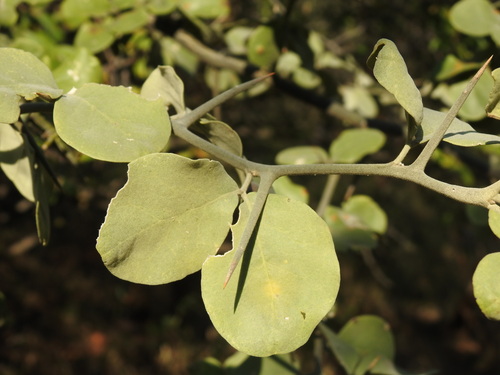
Balanites glabra
Mildbr. et Schlecht.

Susan Brown

Susan Brown

Susan Brown
What to Eat
Edible parts: Fruit, Nuts - oil
The wood of Balanites glabra is used for carvings. The leaves are used as fodder while the spiny branches make it suitable for use as fencing, either as a live or dead fence. Despite being mildly poisonous the fruits are eaten.
Where to Find It
A tropical plant. It can grow on dry soil. In East Africa it grows between 800-1,700 m altitude. It can grow in arid places.
Africa, Angola, Central Africa, East Africa, Ethiopia, Kenya, Somalia, South Sudan, Tanzania,
How to Identify
A shrub or small tree. It has long spines. They are 15 cm long. The shrub grows 3-10 m high. It is sometimes drooping. The leaves have leaflets that are broadly rounded at the end. The fruit are oval and orange. They are 25-28 mm long by 12-18 mm wide. The fruit contains a hard seed.
Wikipedia
Source ↗Balanites glabra is a species of tree or shrub, classified either as a member of the Zygophyllaceae or the Balanitaceae. This tree is native to East Africa.
Names & Synonyms
Elamaich, Kidi, Kilului, Mbubua, Ol-ngaswa
References (9)
- Bircher, A. G. & Bircher, W. H., 2000, Encyclopedia of Fruit Trees and Edible Flowering Plants in Egypt and the Subtropics. AUC Press. p 52
- Dale, I. R. and Greenway, P. J., 1961, Kenya Trees and Shrubs. Nairobi. p 534
- Heywood, V.H., Brummitt, R.K., Culham, A., and Seberg, O. 2007, Flowering Plant Families of the World. Royal Botanical Gardens, Kew. p 338 (Genus)
- Jardin, C., 1970, List of Foods Used In Africa, FAO Nutrition Information Document Series No 2.p 122
- Maundu, P. et al, 1999, Traditional Food Plants of Kenya. National Museum of Kenya. p 70
- Mutie, F. G., 2020, Conservation of Wild Food Plants and Their Potential for Combatting Food Insecurity in Kenya as Exemplified by the Drylands of Kitui County. Plants 2020, 9, 1017
- Mutie, F. M., et al, 2023, Important Medicinal and Food Taxa (Orders and Families) in Kenya, Based on Three Quantitative Approaches. Plants 2023, 12, 1145
- Royal Botanic Gardens, Kew (1999). Survey of Economic Plants for Arid and Semi-Arid Lands (SEPASAL) database. Published on the Internet; http://www.rbgkew.org.uk/ceb/sepasal/internet [Accessed 4th April 2011]
- World Checklist of Useful Plant Species 2020. Royal Botanic Gardens, Kew