Neololeba atra
(Lindl.) Widjaja
Cape Bamboo
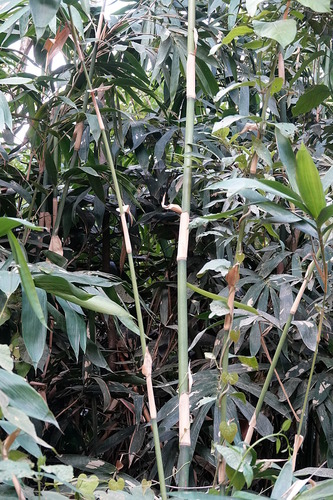
(c) Pete Woodall, some rights reserved (CC BY-NC), uploaded by Pete Woodall
What to Eat
Edible parts: Shoots, Growing tip
In Indonesia, strips of the black bamboo are used to make window blinds and the leaves are used for thatching.
Where to Find It
A tropical plant. It grows from sea level up to about 1250 m altitude in Papua New Guinea. Often the plant grows near watercourses that are flooded in wet seasons. It is very sensitive to cold.
Asia, Australia, Indonesia, Pacific, Papua New Guinea, PNG, Philippines, SE Asia,
How to Identify
A bamboo. It grows up to about 5 m tall and has canes about 3 cm across. There are several woody light coloured stems. It forms thick clumps which are hard to penetrate. The leaves are 20-50 cm long by 6-10 cm wide and rounded at the base. The leaves are light green. There are distinct hairs on the leaf sheath where the blade joins the stalk. The leaf sheath completely surrounds the stem. It flowers almost continually and doesn't die after flowering.
How to Grow
It is planted from cuttings of the cane. They take a little over a year to become established and produce edible shoots. They also grow wild. To stop clumps spreading the rhizome below the ground level needs to be chopped through. Young plants are not easily transplanted. Rooted shoots near the base can be separated off and replanted.
Other Uses
The thin-walled culm is used locally in basketry and other handicrafts. The culm is used for making water pipes, arrow heads and as a casual drinking vessel. Strips of the culms are used as binding material in roofings, fish traps and screens. The dead canes of this species are useful when lighting camp fires, even in wet weather.
Wikipedia
Source ↗Neololeba atra, the black bamboo, is a species of tropical Asian, Australian, and Papuasian bamboos in the grass family Poaceae.
Other Information
It occurs fairly widely as a self sown plant and is a minor food in several areas. It is cultivated in gardens at Kutubu in Papua New Guinea.
Notes
There are about 120 Bambusa species. They are tropical and subtropical in Asia.
Names & Synonyms
References (8)
- Borrell, O.W., 1989, An Annotated Checklist of the Flora of Kairiru Island, New Guinea. Marcellin College, Victoria Australia. p 21 (As Bambusa forbesii)
- Elliot, W.R., & Jones, D.L., 1982, Encyclopedia of Australian Plants suitable for cultivation. Vol 2. Lothian. p 281 (As Bambusa forbesii)
- French, B.R., 1986, Food Plants of Papua New Guinea, Asia Pacific Science Foundation p 132
- Hibbert, M., 2002, The Aussie Plant Finder 2002, Florilegium. p 37 (As Bambusa forbesii)
- Leach, G. J., 1988, Bush Food Plants of the Blackwater and Karawari Rivers Area, East Sepik Province, Papua New Guinea. Science in New Guinea 14(2). p 98 (As Bambusa forbesii)
- Peekel, P.G., 1984, (Translation E.E.Henty), Flora of the Bismarck Archipelago for Naturalists, Division of Botany, Lae, PNG. p 56 (As Bambusa forbesii)
- Reinwardtia 11:114, 1997
- World Checklist of Useful Plant Species 2020. Royal Botanic Gardens, Kew


