Bambusa multiplex
(Lour.) Raeuschel ex J. A & J. H. Schultes
Hedge Bamboo, Chinese dwarf bamboo
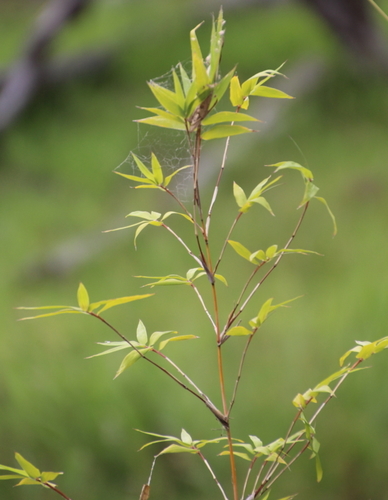
(c) tangatawhenua, some rights reserved (CC BY-NC), uploaded by tangatawhenua
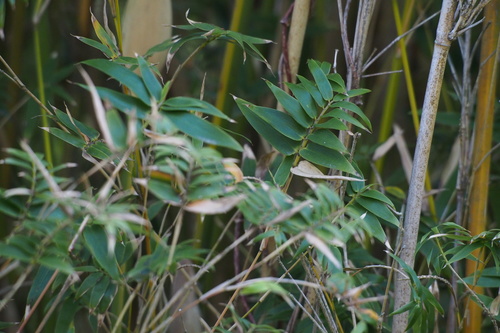
(c) harum.koh, some rights reserved (CC BY-SA), uploaded by harum.koh

(c) Tanja, some rights reserved (CC BY-NC), uploaded by Tanja
What to Eat
Edible parts: Shoots
Edible Parts: Shoots Stem Edible Uses: Young shoots - cooked. Bitter tasting, they are rarely eaten. They are less bitter if harvested before they emerge from the soil and then parboiled in water.
Where to Find It
A tropical and subtropical plant. In SE Asia it grows up to 1,500 m altitude. It tolerates temperatures as low as -8°C. It grows well on sandy soils. It needs a reasonable rainfall. It needs rich moist soils. It needs a sunny position. It is resistant to frost. It suits hardiness zones 9-12. Melbourne Botanical Gardens. Geelong Botanical Gardens. In XTBG Yunnan. In Sichuan.
Africa, Asia, Australia, Bangladesh, Brazil, Cambodia, China*, Colombia, Cuba, Dominican Republic, East Africa, Ecuador, Fiji, Haiti, Hawaii, Himalayas, India, Indochina, Indonesia, Iraq, Jamaica, Japan, Laos, Madagascar, Malawi, Malaysia, Marquesas, Mauritius, Mexico, Myanmar, Nepal, New Zealand, North America, Northeastern India, Pacific, Philippines, Pakistan, Puerto Rico, Seychelles, SE Asia, Sri Lanka, Taiwan, Thailand, Trinidad-Tobago, USA, Vietnam,
How to Identify
A hollow tufted bamboo. It forms clumps. It is 2-6 m tall. It has slender stalks. The stalks are 1-2.5 cm across. They arch over at the tips. The internodes are 30-50 cm long. The culm sheath is 12-15 cm long by 6-8 cm wide. It is light green when young and turns reddish-brown or pale brown. The leaves are flat and reddish-green. They are sword shaped and clasp the stem.The blade is triangular shape and 9-12 cm long. It tapers to the tip. The base attaches to the sheath. The leaves are usually at the end of a branch. There are 6-13 together. The blades are 7-12 cm long by 1-1.5 cm wide. Mature plants produce flowering branches which arch over. The flowers are at the end of a leafy branch. The spikelet is 3-4 cm long.
How to Grow
It is usually grown from rhizome cuttings or shoots. It can be used as a hedge or living fence.
Propagation: Seed - surface sow as soon as it is ripe in a greenhouse at about 20°c. Do not allow the compost to dry out. Germination usually takes place fairly quickly so long as the seed is of good quality, though it can take 3 - 6 months. Grow on in a lightly shaded place in the greenhouse until large enough to plant out. Seed is rarely available. Division in spring as new growth commences. Take divisions with at least three canes in the clump, trying to cause as little root disturbance to the main plant as possible. Grow them on in light shade in a greenhouse in pots of a high fertility sandy medium. Mist the foliage regularly until plants are established. Plant them out into their permanent positions when a good root system has developed, which can take a year or more. Branches often develop into rhizomatous offsets with long roots. These can be removed and potted up in late spring.
Medicinal Uses
None known
Other Uses
Hedge Hedge Paper Weaving Paper is made from the culms. The canes are too arched for good poles and there is too small a volume for significant pulp production, in spite of good fibre dimensions. The culms are up to 4cm in diameter. The canes split easily and are fairly flexible - they are used as a source of weaving material for mats, baskets and other household goods. The plant makes a good screen or hedge. Special Uses Hedge Hedge
Wikipedia
Source ↗Bambusa multiplex is a species of flowering plant in the family Poaceae. B. multiplex forms a medium-sized clump with slender culms (stems) and dense foliage. This bamboo is suitable for hedges and live fences since the stems and foliage form a dense growth that create an effective barrier. The height of the stems under ideal conditions is about 10 ft. Propagation is through rhizome offsets and rooted culm (stem) cuttings. Micro propagation too is feasible through axillary bud proliferation.
Other Information
It is cultivated.
Notes
There are about 120 Bambusa species. They are tropical and subtropical in Asia.
Names & Synonyms
Aor selat, Aur cino, Awi krisik, Bambi pagar, Bambu cina, Buloh china, Buloh pagar, Buluh pagar, Cay hop, Horai-chiku, Kawayan tsina, Nsungwi, Pa-lau-pinan-wa, Phai-li-ang, Pring chendani, Pring tjendani, Russei tae
References (35)
- Arora, R. K., 2014, Diversity in Underutilized Plant Species - An Asia-Pacific Perspective. Bioversity International. p 36
- Bircher, A. G. & Bircher, W. H., 2000, Encyclopedia of Fruit Trees and Edible Flowering Plants in Egypt and the Subtropics. AUC Press. p 53 (Also as Bambusa nana)
- Bodkin, F., 1991, Encyclopedia Botanica. Cornstalk publishing, p 127 (As Bambusa glaucescens)
- Brickell, C. (Ed.), 1999, The Royal Horticultural Society A-Z Encyclopedia of Garden Plants. Convent Garden Books. p 159
- Burkill, I.H., 1966, A Dictionary of the Economic Products of the Malay Peninsula. Ministry of Agriculture and Cooperatives, Kuala Lumpur, Malaysia. Vol 1 (A-H) p 301 (As Bambusa glaucescens)
- Creasey, R., 2000, The Edible Asian Garden. Periplus p 22 (As Bambusa glaucescens)
- Crouzet, I., Starosta, P., 1998, Bamboos. Evergreen. p 17
- Cundall, P., (ed.), 2004, Gardening Australia: flora: the gardener's bible. ABC Books. p 217
- Dransfield, S. & Widjaja, EA., 1995, Plant Resources of South East Asia. PROSEA No. 7 Bamboos. Leiden. p 65
- Etherington, K., & Imwold, D., (Eds), 2001, Botanica's Trees & Shrubs. The illustrated A-Z of over 8500 trees and shrubs. Random House, Australia. p 114
- Facciola, S., 1998, Cornucopia 2: a Source Book of Edible Plants. Kampong Publications, p 46
- Flora of Pakistan. www.eFloras.org (As Bambusa glaucescens)
- Hariyadi, B., 2008, The Entwined Tree: Traditional Natural Resource Management of Serampas, Jambi, Indonesia. Ph. D thesis. Univ. or Hawaii. p 401
- Heyne, 1927 ed, K., Nutt. Plant. Ned. Ind. p 296 (As Bambusa glaucescens)
- Hibbert, M., 2002, The Aussie Plant Finder 2002, Florilegium. p 37 (Also as Bambusa glaucescens)
- Kew Bull. 11:207. 1956 (As Bambusa glaucescens)
- Kew Plants of the World Online
- Kumari, P, 2019, Bambusoideae in India: An Updated Enumeration. Plantae Scientia : Volume 01, Issue 06, March 2019
- Levy-Yamamori, R., & Taaffe, G., 2004, Garden Plants of Japan. Timber Press. p 364
- Lord, E.E., & Willis, J.H., 1999, Shrubs and Trees for Australian gardens. Lothian. p 93
- Martin, F.W. & Ruberte, R.M., 1979, Edible Leaves of the Tropics. Antillian College Press, Mayaguez, Puerto Rico. p 194
- Ochse, J.J. et al, 1931, Vegetables of the Dutch East Indies. Asher reprint. p 301
- Phon, P., 2000, Plants used in Cambodia. © Pauline Dy Phon, Phnom Penh, Cambodia. p 87
- Setiya, A. V., et al, 2016, Exploration and documentation of some wild edible plants used by the aboriginals from Gadchiroli District (M.S.) India. International Advanced Research Journal in Science, Engineering and Technology. 3(7) (As Bambusa glaucescens)
- Singh, P., et al, 2019 Plants of Indian Himalayan region. Part 1 Botanical Surbey of India. p
- Smith, A.C., 1979, Flora Vitiensis Nova, Lawaii, Kuai, Hawaii, Volume 1 p 296
- Staples, G.W. and Herbst, D.R., 2005, A tropical Garden Flora. Bishop Museum Press, Honolulu, Hawaii. p 743
- Sukarya, D. G., (Ed.) 2013, 3,500 Plant Species of the Botanic Gardens of Indonesia. LIPI p 837 (Also as Bambusa glaucescens)
- Syst. veg. 7(2):1350. 1830
- Tanaka,
- Terra, G.J.A., 1973, Tropical Vegetables. Communication 54e Royal Tropical Institute, Amsterdam, p 27
- Valder, P., 1999, The Garden Plants of China. Florilegium. p 95
- Williamson, J., 2005, Useful Plants of Malawi. 3rd. Edition. Mdadzi Book Trust. p 34
- World Checklist of Useful Plant Species 2020. Royal Botanic Gardens, Kew
- Zeven, A. C. & de West, J. M. J., 1982, Dictionary of cultivated plants and their regions of diversity. Wageningen. p 36


