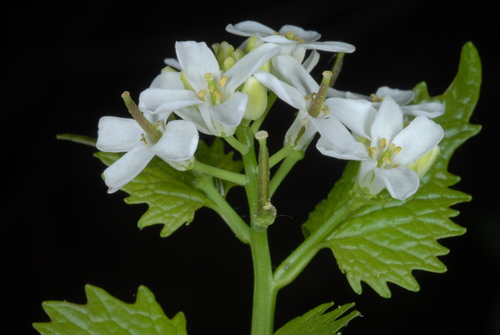
Barbarea australis
Hook.f.
Winter cress, Austral Winter-cress, Riverbed wintercress

(c) Natalie Tapson, some rights reserved (CC BY-NC-SA)

(c) Natalie Tapson, some rights reserved (CC BY-NC-SA)
What to Eat
Edible parts: Leaves
Edible Parts: Leaves Edible Uses: Young leaves - raw or cooked. A pungent, peppery flavour.
Where to Find It
It is a temperate plant. It grows along the moist edges of streams in the southern Central highlands in Tasmania. It needs some moisture and sun. Tasmania Herbarium. Hobart Botanical Gardens.
Australia*, Tasmania*,
How to Identify
A cabbage family herb. It grows 30-50 cm high and spreads 10-30 cm wide. The leaves near the base are divided into leaflets along the stalk and are 10 cm long. The leaves higher up and simple and with wavy edges. They clasp the stem. The flowers are small and yellow. The fruit are 3 cm long and slender. They are on stalks 1 cm long.
How to Grow
We have very little information on this species and do not know if it will be hardy in Britain, though judging by its native range it should succeed outdoors at least in the milder parts of this country. The following notes are based on the general needs of the genus. Succeeds in sun or shade in a moist well-drained soil.
Propagation: Seed - sow in situ in early spring to early summer.
Medicinal Uses
Antiscorbutic The leaves are antiscorbutic.
Other Uses
None known Special Uses
Wikipedia
Source ↗Barbarea australis, commonly known as native wintercress or riverbed wintercress, is a morphologically and ecologically typical Barbarea species with an unusual distribution: it is an endemic and threatened species from Tasmania. The leaves have a large end-lobe and only few side lobes, much like the leaf-shape of Barbarea stricta and Barbarea orthoceras. With regard to defence chemicals (glucosinolates), it is similar to other members of the genus.
Notes
There are 12 Barbarea species.
References (7)
- Bodkin, F., 1991, Encyclopedia Botanica. Cornstalk publishing, p 132
- Cribb, A.B. & J.W., 1976, Wild Food in Australia, Fontana. p 116
- Curtis, W.M., 1956, The Students Flora of Tasmania Vol 1 p 32
- Elliot, W.R., & Jones, D.L., 1982, Encyclopedia of Australian Plants suitable for cultivation. Vol 2. Lothian. p 306
- Plants for a Future database, The Field, Penpol, Lostwithiel, Cornwall, PL22 0NG, UK. http://www.scs.leeds.ac.uk/pfaf/
- Tasmanian Herbarium Vascular Plants list p 16
- Whiting, J. et al, 2004, Tasmania's Natural Flora. Tasmania's Natural Flora Editorial Committee PO Box 194, Ulverstone, Tasmania, Australia 7315 p 79