Barbarea verna
(Mill.) Asch.
Early cress, American land cress
(c) Nick Belliveau, some rights reserved (CC BY-NC), uploaded by Nick Belliveau

(c) Douglas Goldman, some rights reserved (CC BY-SA), uploaded by Douglas Goldman

(c) John D Reynolds, some rights reserved (CC BY-NC), uploaded by John D Reynolds
What to Eat
Edible parts: Leaves, Seeds, Vegetable
Edible Parts: Leaves Oil Seed Edible Uses: Oil Best parts: young leaves and raab. Window: late winter–spring. Rating: 3.5/5.Young leaves - raw, cooked or used as a seasoning. A hot, spicy watercress flavour, they are delicious in salads. Leaves can be obtained throughout the year if autumn-sown plants are given a light protection in winter. An edible oil is obtained from the seed. The seed can be sprouted and added to salads etc. Taste, Processing & Kitchen Notes: Raw flavor: cress-like pepper with pleasant brassica sweetness when grown cool and irrigated evenly. Heat/drought ramps up pungency and bitterness. For mild results, cut at 10–15 cm rosette stage. Light blanching or quick sauté with fat/acid balances bite. Bud clusters compact and tasty [2-3]. Seasonality (Phenology): Sow: late summer–fall (overwinter rosettes) or very early spring. Harvest greens: late winter–spring. Flower/bolt: late spring; edible raab window is short. Seed: early summer.
Where to Find It
It is a temperate plant. It will grows in the hills in Malaysia. In Haiti it occurs at 1600 m. In Argentina it grows from sea level to 600 m above sea level. Tasmania Herbarium.
Africa, Argentina, Asia, Australia, Austria, Britain, Cape Verde, Chile, East Africa, Europe*, France, Germany, Haiti, Hawaii, Indochina, Ireland, Italy, Madagascar, Malaysia, Mauritius, Mediterranean, Moldavia, Netherlands, New Zealand, North America, Pacific, Pakistan, Portugal, SE Asia, Senegal, South America, Spain, Switzerland, Tasmania, Turkey, Türkiye, USA, Vietnam, West Africa, West Indies,
How to Identify
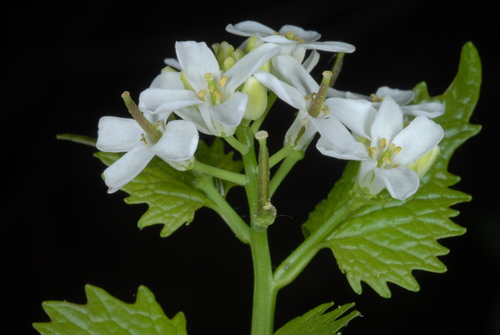
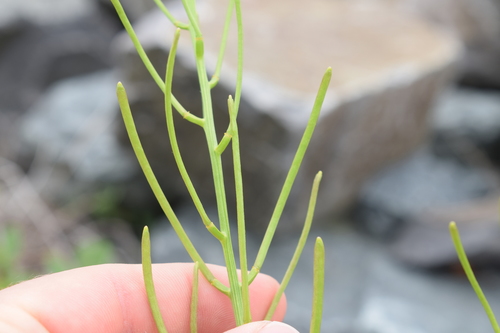
A cabbage family herb. The leaves are dark smooth and shiny. They come from the ground in many stemmed rings. Each stem has leaflets arranged in 2 rows. There is a large rounded leaflet at the end. The flowering stem can be 60 cm high. The flowers are bright yellow. The seed pods are narrow and like a cylinder. There is a short point at the end.
Nutrition Score: 8/100
| Part | Moisture | kJ | kcal | Protein | Vit A | Vit C | Iron | Zinc |
|---|---|---|---|---|---|---|---|---|
| Leaves | 89 | 21 | 5.14 | — | 130 | — | — | — |
How to Grow
Plants are grown from seeds. It easily self seeds.
Propagation: Seed - sow spring to September in situ at 3-weekly intervals to provide a succession of leaves. Germination usually takes place within 2 - 3 weeks.
Medicinal Uses
None known
Other Uses
Oil Ecology & Wildlife: Early bloom for pollinators; greens host brassica herbivores supporting predatory beneficials. Special Uses Food Forest
Wikipedia
Source ↗Barbarea verna is a biennial herb in the family Brassicaceae. Common names include land cress, American cress, bank cress, black wood cress, Belle Isle cress, Bermuda cress, poor man's cabbage, early yellowrocket, early wintercress, scurvy cress, creasy greens, and upland cress. It is native to southern Europe and western Asia, and naturalized elsewhere It has been cultivated as a leaf vegetable in England since the 17th century. As it requires less water than watercress, it is easier to cultivate.
Other Information
It is a commercially cultivated vegetable.
Notes
There are 12 Barbarea species.
Names & Synonyms
Anadndrano an tanety, Bank cress, Land cress, Scurvy grass, Sunnar
References (39)
- Abbet, C., et al, 2014, Ethnobotanical survey on wild alpine food plants in Lower and Central Valais (Switzerland). Journal of Ethnopharmacology 151 (2014) 624–634 (As Barbarea praecox)
- W. T. Aiton, Hortus kew. ed. 2, 4:109. 1812 (As Barbarea praecox)
- Amin, M. et al, 2023, Edible wild plant species used by different linguistic groups of Kohistan Upper Khyber Pakhtunkhwa (KP), Pakistan. Journal of Ethnobiology and Ethnomedicine 19:6 p 8
- Arora, R. K., 2014, Diversity in Underutilized Plant Species - An Asia-Pacific Perspective. Bioversity International. p 36 (As varum)
- Beckstrom-Sternberg, Stephen M., and James A. Duke. "The Foodplant Database." http://probe.nalusda.gov:8300/cgi-bin/browse/foodplantdb.(ACEDB version 4.0 - data version July 1994) (As Campe verna)
- Bircher, A. G. & Bircher, W. H., 2000, Encyclopedia of Fruit Trees and Edible Flowering Plants in Egypt and the Subtropics. AUC Press. p 54
- Bodkin, F., 1991, Encyclopedia Botanica. Cornstalk publishing, p 132
- Brouk, B., 1975, Plants Consumed by Man. Academic Press, London. p 103
- Burkill, I.H., 1966, A Dictionary of the Economic Products of the Malay Peninsula. Ministry of Agriculture and Cooperatives, Kuala Lumpur, Malaysia. Vol 1 (A-H) p 304 (As Barbarea praecox)
- Curtis, W.M., 1956, The Students Flora of Tasmania Vol 1 p 33
- Duarte, M. C., et al, 2022, Diversity of Useful Plants in Cabo Verde Islands: A Biogeographic and Conservation Perspective. Plants 2022, 11, 1313 p 10
- Duke, J.A., 1992, Handbook of Edible Weeds. CRC Press. p 46
- Ekman Herbarium records Haiti (As Barbarea praecox)
- Elias, T.S. & Dykeman P.A., 1990, Edible Wild Plants. A North American Field guide. Sterling, New York p 99
- Esperanca, M. J., 1988. Surviving in the wild. A glance at the wild plants and their uses. Vol. 2. p 355
- Facciola, S., 1998, Cornucopia 2: a Source Book of Edible Plants. Kampong Publications, p 52
- Fl. Brandenburg 1(1):36. 1860
- Flora of Australia, Volume 8, Lecythidales to Batales, Australian Government Publishing Service, Canberra (1982) p 319
- Hedrick, U.P., 1919, (Ed.), Sturtevant's edible plants of the world. p 92 (As Barbarea praecox)
- Hermandez Bermejo, J.E., and Leon, J. (Eds.), 1994, Neglected Crops. 1492 from a different perspective. FAO Plant Production and Protection Series No 26. FAO, Rome. p 263
- Heywood, V. H. & Zohary, D.,1995, A Catalogue of the Wild Relatives of Cultivated Plants Native to Europe. Flora Mediterranea 5 - 1995, p 388
- Jardin, C., 1970, List of Foods Used In Africa, FAO Nutrition Information Document Series No 2.p 58 (As Barbarea praecox)
- Kays, S. J., and Dias, J. C. S., 1995, Common Names of Commercially Cultivated Vegetables of the World in 15 languages. Economic Botany, Vol. 49, No. 2, pp. 115-152
- Lazarides, M. & Hince, B., 1993, Handbook of Economic Plants of Australia, CSIRO. p 31
- Lyle, K. L., 2010, The Complete Guide to Edible Wild Plants, Mushrooms, Fruits and Nuts. Falcon Guides. p 20
- Martin, F.W. & Ruberte, R.M., 1979, Edible Leaves of the Tropics. Antillian College Press, Mayaguez, Puerto Rico. p 187
- Plants for a Future database, The Field, Penpol, Lostwithiel, Cornwall, PL22 0NG, UK. http://www.scs.leeds.ac.uk/pfaf/
- Plants of Haiti Smithsonian Institute http://botany.si.edu
- Pham-Hoang Ho, 1999, An Illustrated Flora of Vietnam. Nha Xuat Ban Tre. p 605 (As Barbarea praecox)
- Razanameharizaka, J., et al, 2022, Catalogue Legumes Traditionnels de Madagascar. Université d’Antananarivo, Antananarivo (101), Madagascar. Vol. 1. p 30
- Saunders, C.F., 1948, Edible and Useful Wild Plants. Dover. New York. p 126 (As Barbarea praecox)
- Schneider, E., 2001, Vegetables from Amaranth to Zucchini: The essential reference. HarperCollins. p 228
- Seidemann J., 2005, World Spice Plants. Economic Usage, Botany, Taxonomy. Springer. p 62
- Skinner, G. & Brown, 1981, C., Simply Living. A gatherer's guide to New Zealand's fields, forests and shores. Reed. p 29
- Tasmanian Herbarium Vascular Plants list p 16
- Terra, G.J.A., 1973, Tropical Vegetables. Communication 54e Royal Tropical Institute, Amsterdam, p 27
- USDA, ARS, National Genetic Resources Program. Germplasm Resources Information Network - (GRIN). [Online Database] National Germplasm Resources Laboratory, Beltsville, Maryland. Available: www.ars-grin.gov/cgi-bin/npgs/html/econ.pl (10 April 2000)
- van Wyk, B., 2005, Food Plants of the World. An illustrated guide. Timber press. p 226
- Wiersema, J. H. & Leon, B., 2013, World Economic Plants. A Standard Reference CRC Press. 2nd Ed. p 93