Wurfbainia testacea
(Ridley) Skornick. & A. D. Poulsen
Cambodian cardamom
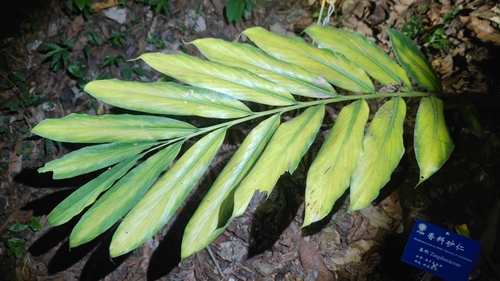
(c) 刘光裕 Liu Guangyu, some rights reserved (CC BY-NC), uploaded by 刘光裕 Liu Guangyu
What to Eat
Edible parts: Seeds, Spice, Leaves, Vegetable
The seeds are used like cardamom for flavouring. The young shoots are eaten as a vegetable cooked with chicken as a curry.
Where to Find It
A tropical plant. It grows on limestone country in Peninsula Malaysia. It needs a well drained soil and shade. It is best grown under the shade of trees and in Thailand above 500 m altitude. It often does not set fruit at lower altitude.
Asia, Cambodia, China, Indochina, Indonesia, Malaysia, SE Asia, Thailand, Vietnam,
How to Identify
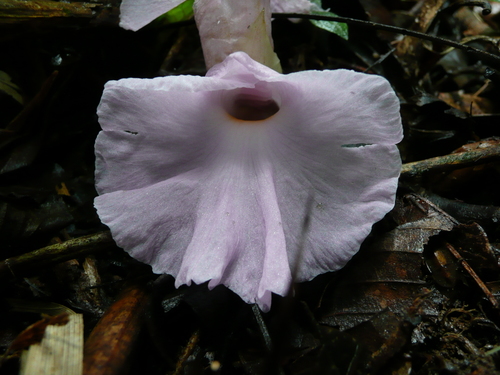
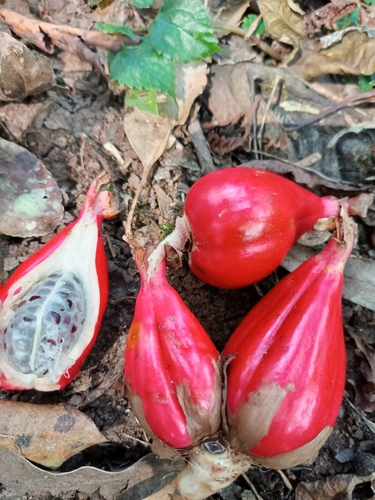
A ginger family herb that has an aroma. It keeps growing from year to year. It has underground stems or rhizomes. These produce leafy shoots. It grows 2-3 m tall. The shoots can have separate flowers. The leaves are oblong and 60 cm long by 10 cm wide. The base is narrowly wedge shaped. The flowers are in an oblong spike 15 cm long by 3 cm wide. The flower stalk can be 6-15-50 cm long. It has papery bracts with grooves along them. The flowers are 2 cm long by 1.5 cm wide and white with a yellow patch near the tip. The fruit is a round capsule 1.5 cm across. It is light grey. It can be smooth or have light ribs. It is pink and slightly hairy. The seed is brown with a white covering.
How to Grow
It is grown from young stems with a section of the rhizome.
Notes
There are about 150 Amomum species. They are mostly tropical.
Names & Synonyms
Bajch daaju khaasu, Ka tepus, Ke tepus, Kravanh, Krawaan, Krawan, Pla ko, Siam cardamon, White cardamon
References (10)
- Bircher, A. G. & Bircher, W. H., 2000, Encyclopedia of Fruit Trees and Edible Flowering Plants in Egypt and the Subtropics. AUC Press. p 24 (As Amomum testaceum and also as Amomum krervanh)
- Bull. Soc. Bot. France 53:138. 1906 (As Amomum krervanh)
- Burkill, I.H., 1966, A Dictionary of the Economic Products of the Malay Peninsula. Ministry of Agriculture and Cooperatives, Kuala Lumpur, Malaysia. Vol 1 (A-H) p 136 (As Amomum testaceumand also as Amomum krervanh)
- Hu, Shiu-ying, 2005, Food Plants of China. The Chinese University Press. p 326 (As Amomum krervanh)
- Japanese International Research Centre for Agricultural Science www.jircas.affrc.go.jp/project/value_addition/Vegetables
- Phon, P., 2000, Plants used in Cambodia. © Pauline Dy Phon, Phnom Penh, Cambodia. p 31 (As Amomum krervanh)
- PROSEA handbook Volume 13 Spices. p 245, p274 (As Amomum testaceum and also as Amomum krervanh)
- Purseglove, J.W., 1972, Tropical Crops. Monocotyledons. Longmans p 528 (As Amomum krervanh)
- Seidemann J., 2005, World Spice Plants. Economic Usage, Botany, Taxonomy. Springer. p 38, 35 (As Amomum testaceum and also as Amomum krervanh)
- World Checklist of Useful Plant Species 2020. Royal Botanic Gardens, Kew