Etlingera rosea
Burtt & R. M. Smith
Galoba papua

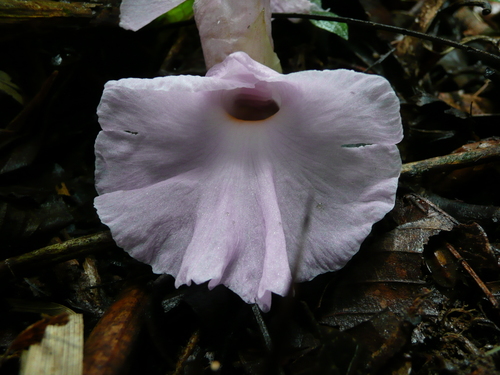
(c) Hakim, some rights reserved (CC BY-NC)

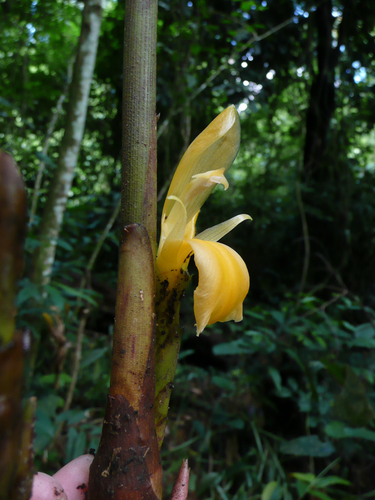
(c) Hakim, some rights reserved (CC BY-NC)

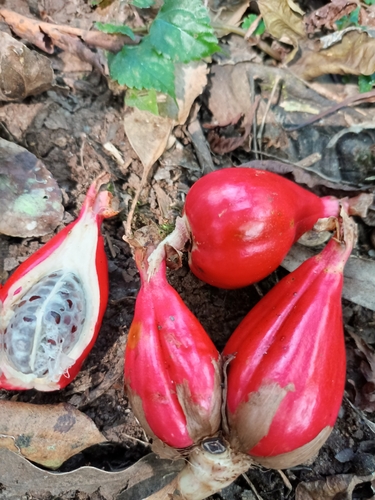
(c) Hakim, some rights reserved (CC BY-NC)
What to Eat
Edible parts: Aril, Spice
The aril (layer around the seed) is eaten or used as a spice. The seed clusters are eaten raw or candied.
Where to Find It
A tropical plant. It grows in lowland forests on heavy moist soils. It grows in Sulawesi and Papua.
Asia, Indonesia*, SE Asia,
How to Identify
A ginger family herb. It keeps growing from year to year. It has an underground stem or rhizome. It grows 5 m tall. The leaves have almost no stalks. The leaf blade is sword shaped and 50-55 cm long by 6-6.5 cm wide. The flowering shoot is like a spike. It is 5 cm across. It grows near the soil on a separate stalk about 6 cm long. The fruit is like a capsule like a berry. It is flattened and somewhat triangular shaped and hairy. It is 1 cm across and red. It splits into 3 parts.
How to Grow
We have no specific information for this species, but plants in this genus generally prefer a sunny position and a moist but well-drained, fertile, humus-rich soil.
Propagation: Seed - Division of the rhizomes.
Wikipedia
Source ↗Etlingera rosea is a monocotyledonous plant species described by Brian Laurence Burtt and Rosemary Margaret Smith. Etlingera rosea is part of the genus Etlingera and the family Zingiberaceae. The species' range is the Moluccas. No subspecies are listed in the Catalog of Life.
Notes
There are about 70 Etlingera species.
Names & Synonyms
Anipan, Assem putjuk, Galoba jantung, Gitipi tana, Potmepini
References (4)
- Burkill, I.H., 1966, A Dictionary of the Economic Products of the Malay Peninsula. Ministry of Agriculture and Cooperatives, Kuala Lumpur, Malaysia. Vol 1 (A-H) p 133 (As Amomum roseum Benth. et Hook.f.) NB Amomum roseum Roxb. is a synonym of Zingiber roseum.
- PROSEA handbook Volume 13 Spices. p 253
- PROSEA No. 2 (As Hornstedtia rumphii)
- Seidemann J., 2005, World Spice Plants. Economic Usage, Botany, Taxonomy. Springer. p 149