Zingiber ottensii
Valeton
Black ginger

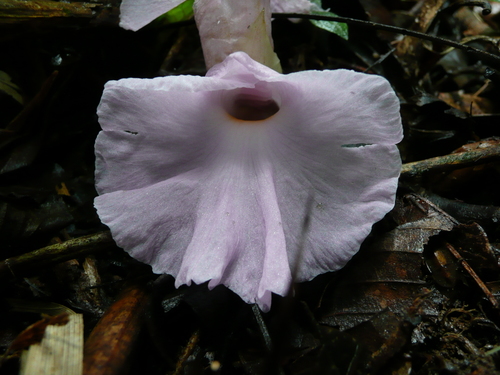
(c) Cheongweei Gan, some rights reserved (CC BY-NC), uploaded by Cheongweei Gan
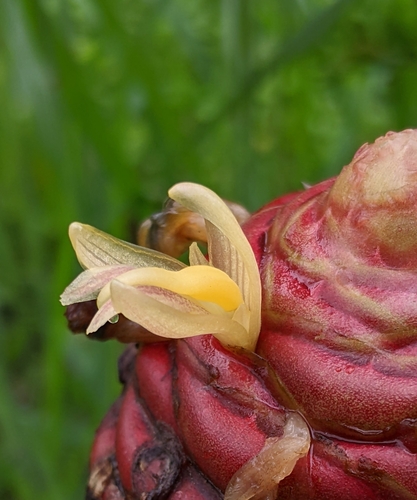
(c) accidentalshrike, some rights reserved (CC BY-NC), uploaded by accidentalshrike
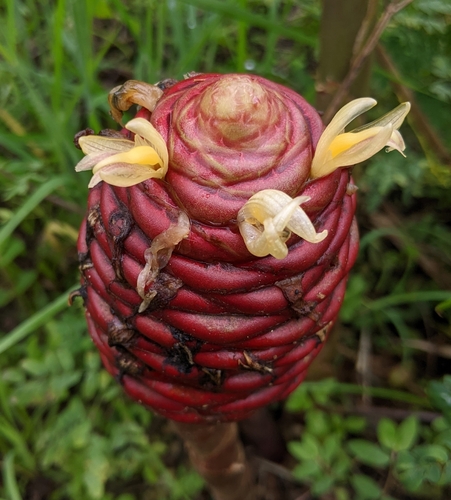
(c) accidentalshrike, some rights reserved (CC BY-NC), uploaded by accidentalshrike
What to Eat
Edible parts: Rhizome, Root, Flavouring
The rhizome is used as a spicy flavoring agent.
Where to Find It
A tropical plant. It is cultivated. It grows in moist, partly shaded evergreen and monsoon forest.
Asia, Indochina, Indonesia*, Malaysia, SE Asia, Thailand,
How to Identify
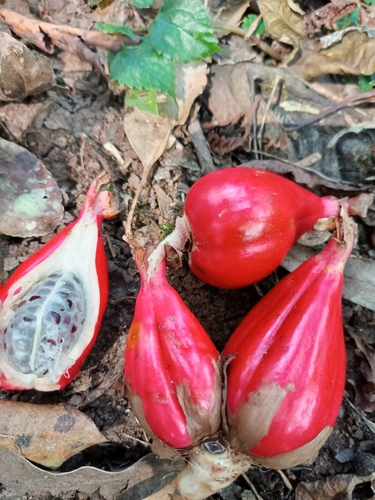
A ginger herb which keeps growing from year to year. It has underground stems or rhizomes. The leafy shoots grow 1.5 m tall. The rhizome is purplish inside. The leaves are a long oval shape and 35-40 cm long by 6-8 cm wide. The flowers are in a spike. This is on a separate stalk 25-40 cm long. The bracts are 4 cm long. They bulge outwards with tips which point inwards. They are bright red. The spike is 10-12 cm long by 4 cm wide. The fruit are red capsules.
How to Grow
It can be grown by division of the rhizome and offsets.
Medicinal Uses
The rhizome has traditional spice uses.
Names & Synonyms
Berseh hitam, Bunglai hantu, Kunyit hitam, Lampoyang hitam, Lampuyang hitam, Panglai hideung, Phlai dam, Phlai muang, Puu loei dam
References (5)
- Burkill, I.H., 1966, A Dictionary of the Economic Products of the Malay Peninsula. Ministry of Agriculture and Cooperatives, Kuala Lumpur, Malaysia. Vol 2 (I-Z) p 2344
- Lim, T. K., 2015, Edible Medicinal and Non Medicinal Plants. Volume 9, Modified Stems, Roots, Bulbs. Springer p 87
- Lim, T. K., 2016, Edible Medicinal and Non-Medicinal Plants: Volume 12 Modified Stems, Roots p 8
- PROSEA handbook Volume 13 Spices. p 267
- Sukarya, D. G., (Ed.) 2013, 3,500 Plant Species of the Botanic Gardens of Indonesia. LIPI p 1145