Meistera lappacea
(Ridl.) Skornick. & M. F. Newman
Malay cardamom

Royal Botanic Garden Edinburgh

Royal Botanic Garden Edinburgh

Royal Botanic Garden Edinburgh
What to Eat
Edible parts: Seeds - spice, Fruit
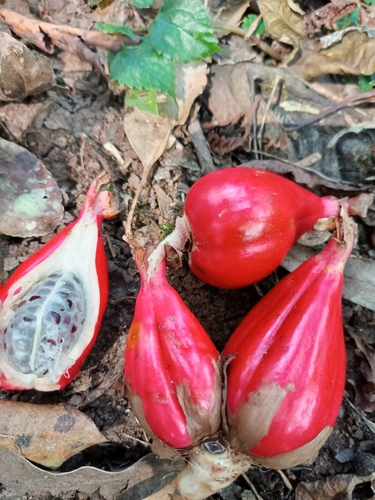
The fruit is eaten fresh. The seeds are used for flavoring, with a taste similar to wild cardamom.
Where to Find It
A tropical plant. It grows in lowland to mountain evergreen forests up to 1,500 m above sea level.
Asia, Indonesia, Malaysia, SE Asia, Thailand,
How to Identify
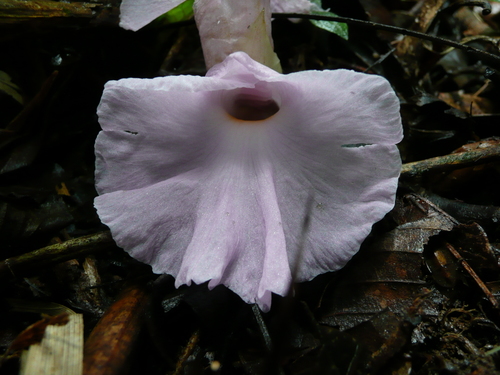
A herb in the ginger family. It grows 2-3 m high. It keeps growing from year to year. The stems are supported on short stilt roots and there is an underground stem or rhizome. The leaves are sword shaped and 53 cm long by 9 cm wide. The flower spikes are near the ground. The fruit are berry like and prickly with fleshy spines and on short 2 cm long stalks. The fruit are 3.5 cm long by 2.5 cm wide. They are green.
How to Grow
It can be grown from seed or division of the rhizome.
Notes
There are about 150 Amomum species. They are mostly tropical.
Names & Synonyms
Apush, Lempus, Sayang, Tepus rambutan
References (9)
- Bircher, A. G. & Bircher, W. H., 2000, Encyclopedia of Fruit Trees and Edible Flowering Plants in Egypt and the Subtropics. AUC Press. p 24 (As Amomum lappaceum)
- Burkill, I.H., 1966, A Dictionary of the Economic Products of the Malay Peninsula. Ministry of Agriculture and Cooperatives, Kuala Lumpur, Malaysia. Vol 1 (A-H) p (As Amomum lappaceum)
- Droop, A.J. & Newman, M.F., 2014, A revision of Amomum (Zingiberaceae) in Sumatra Edinburgh Journal of Botany 71: 193-258.
- Milow, P., et al, 2013, Malaysian species of plants with edible fruits or seeds and their evaluation. International Journal of Fruit Science. 14:1, 1-27 (As Amomum lappaceum)
- PROSEA handbook Volume 13 Spices. p 274 (As Amomum lappaceum)
- Ridley, 1924, Flora of the Mal. Penins. 4 p 263 (As Amomum lappaceum)
- Sukarya, D. G., (Ed.) 2013, 3,500 Plant Species of the Botanic Gardens of Indonesia. LIPI p 1060 (As Amomum lappaceum)
- Verheij, E. W. M. and Coronel, R.E., (Eds.), 1991, Plant Resources of South-East Asia. PROSEA No 2. Edible fruits and nuts. Pudoc Wageningen. p 313 (As Amomum lappaceum)
- World Checklist of Useful Plant Species 2020. Royal Botanic Gardens, Kew