Cinchona pubescens
Vahl
Red cinchona, Redbark
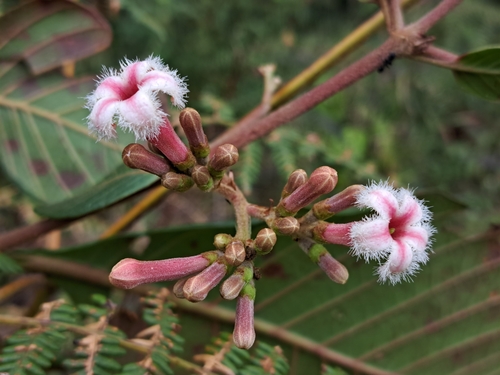
(c) Mario Cuervo, some rights reserved (CC BY-NC), uploaded by Mario Cuervo

(c) Mateo Hernandez Schmidt, some rights reserved (CC BY-NC-SA), uploaded by Mateo Hernandez Schmidt
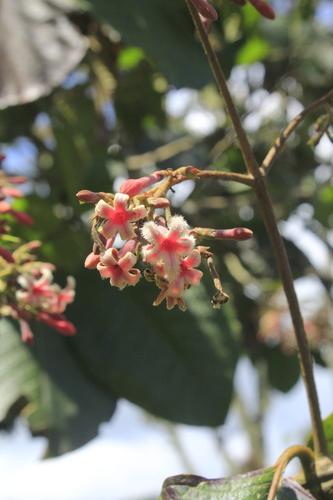
(c) Apipa, some rights reserved (CC BY-NC), uploaded by Apipa
What to Eat
Edible parts: Bark, Spice
Quinine, extracted from the inner bark of the tree, is used as a bitter flavouring in tonic waters, some liqueurs, carbonated drinks, baked goods, candy, and similar products.
Where to Find It
A tropical plant. It needs a temperature above 15-18°C. It grows on steep mountain slopes in tropical forests. It grows between 300-3,900 m above sea level.
Africa, Asia, Bolivia, Central America, China, Colombia, Costa Rica*, Ecuador, Guatemala, Hawaii, Honduras, India, Indonesia, Jamaica, Mexico, Pacific, Panama, Peru, Sao Tome and Principe, SE Asia, South America, St Helena, Taiwan, USA, Venezuela,
How to Identify
A deciduous tree. It grows 10-30 m tall. The small branches are thick and hairy. The leaf blades are broadly oval. They are 45 cm long by 15 cm wide. They are thin textures and hairy on both sides. The flowering arrangement is 25 cm long. There are many flowers. They are pink or red. The fruit are capsules 2.5 cm long and are twice as long as wide.
How to Grow
It grows best in areas where annual daytime temperatures are within the range 17 - 25°c, but can tolerate 9 - 28°c. It can be killed by temperatures of 5°c or lower. It prefers a mean annual rainfall in the range 2,500 - 3,500mm, but tolerates 1,400 - 4,000mm. Requires a well-drained, moist soil and a position in full sun or partial shade. It grows very poorly or not at all on soils that have been exposed to fire. Prefers a pH in the range 5 - 6, tolerating 4.5 - 6.5. A fast-growing tree, the plants start flowering after 2 - 3 years, and are uprooted and harvested after 8 - 12 years. In commercial plantations, the trees are coppiced when about 6 years old.
Propagation: Seed.
Medicinal Uses
Red bark has a long history of native use, especially as a treatment for fevers and malaria. Modern research has confirmed it to be highly effective for both purposes. The bark contains various alkaloids, particularly quinine and quinidine, with quinine making up 70–80% of total alkaloids. It is bitter, astringent, and tonic — lowering fevers, relaxing spasms, acting against malaria via the alkaloid quinine, and slowing the heart via the alkaloid quinidine. It is prepared as tablets, liquid extracts, tinctures, and powders for internal use in treating malaria, neuralgia, muscle cramps, and cardiac fibrillation. It is used in proprietary cold and influenza remedies, and the liquid extract is used as a cure for drunkenness. It is also used as a gargle for sore throats. Care must be taken with dosage, as excess can cause cinchonism, headache, rash, abdominal pain, deafness, and blindness. The herb, particularly in the form of the extracted alkaloid quinine, is subject to legal restrictions in some countries.
Other Uses
The alkaloid quinine, extracted from the bark, is used in hair oils, shampoos, sun-tan oil, and insecticides, as a vulcanizing agent in the rubber industry, and in the preparation of certain metals. Other uses rating: Low (2/5).
Wikipedia
Source ↗Cinchona pubescens, also known as red cinchona and quina or kina (Spanish: Cascarilla, cinchona; Portuguese: quina-do-amazonas, quineira), is native to Central and South America. It is known as a medicinal plant for its bark's high quinine content- and has similar uses to C. officinalis in the production of quinine, most famously used for treatment of malaria.
Production
It is fast growing.
Names & Synonyms
Jesuit's bark, Kina, Kinaboom, Kuinin, Peruvian bark, Pohon kina, Quino, Quinquina jaune
References (11)
- Brown, D., 2002, The Royal Horticultural Society encyclopedia of Herbs and their uses. DK Books. p 169
- Facciola, S., 1998, Cornucopia 2: a Source Book of Edible Plants. Kampong Publications, p 211 (As Cinchona succiruba)
- Kew Plants of the World On line
- PROSEA handbook Volume 13 Spices. p 275
- Seidemann J., 2005, World Spice Plants. Economic Usage, Botany, Taxonomy. Springer. p 99
- Skr. Naturhist.-Selsk. 1:19, t. 2. 1790
- Staples, G.W. and Herbst, D.R., 2005, A tropical Garden Flora. Bishop Museum Press, Honolulu, Hawaii. p 486
- Sukarya, D. G., (Ed.) 2013, 3,500 Plant Species of the Botanic Gardens of Indonesia. LIPI p 196
- Wiersema, J. H. & Leon, B., 2013, World Economic Plants. A Standard Reference CRC Press. 2nd Ed. p 175
- World Checklist of Useful Plant Species 2020. Royal Botanic Gardens, Kew
- www.worldagroforestrycentre.org/treedb/


