Galium aristatum
L.
Awned bedstraw
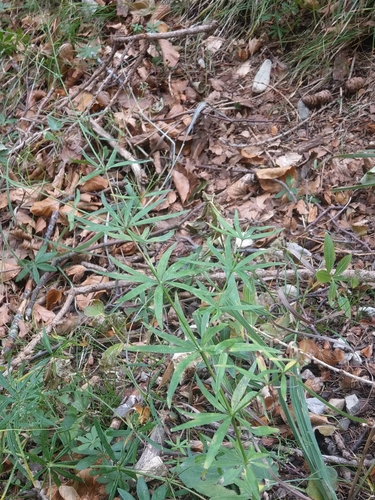
(c) joerg_ewald, some rights reserved (CC BY-NC), uploaded by joerg_ewald

(c) fmunoz, some rights reserved (CC BY-NC)

(c) fmunoz, some rights reserved (CC BY-NC)
What to Eat
Edible parts: Leaves
The leaves are eaten.
Where to Find It
It is a temperate plant.
Austria, Europe, France, Germany, Italy, Mediterranean, North America, Spain, Switzerland, USA,
How to Identify
A herb. The lower stem has 4 edges. The leaves are narrowly sword shaped and 4-7 cm long by 3-5 mm wide. They narrow to the tip. They are greyish green underneath. The flower buds are erect and the crown is flat. The lobes are pointed.
Wikipedia
Source ↗Galium aristatum, the awned bedstraw, is a plant species in the Rubiaceae, currently (May 2014) accepted as a distinct species. It is native to the Alps and the Pyrenees Mountains of Europe (Spain, France, Italy, Switzerland, Austria and Germany). It is also reportedly naturalized in a few places in New York State in the United States.
Notes
There are about 300 Galium species. There are 60 species in tropical America.
Names & Synonyms
References (1)
- Paoletti, M.G., Dreon, A.L., and Lorenzoni, G.G., 1995, Pistic, Traditional Food from Western Friuli, NE Italy. Economic Botany 49(1) pp 26-30


