Heliciopsis terminalis
(Kurz) Sleumer
False protea, Field rat walnut
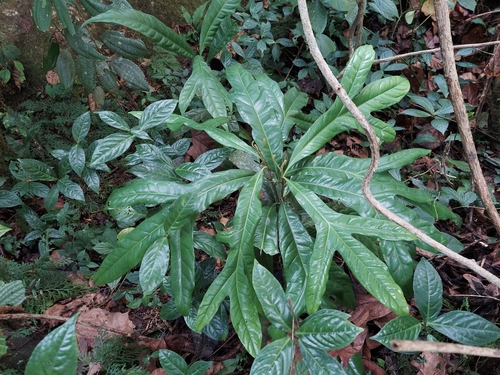
(c) Phuentsho, some rights reserved (CC BY-NC), uploaded by Phuentsho
What to Eat
Edible parts: Fruit, Seeds, Nuts
The fruit are eaten raw and the seeds are eaten as nuts.
Where to Find It
It grows between 900-1500 m altitude in Yunnan in China. It grows in subtropical broad-leaved evergreen forest.
Asia, Bhutan, Cambodia, China, Himalayas, India, Indochina, Laos, Myanmar, SE Asia, Thailand, Vietnam,
How to Identify
A tree. It grows 4-8 m high. The trunk is 1.5 m across. The leaves are sword shaped and 13-34 cm long by 4-9 cm wide. The leaves are smooth and do not have teeth. The flowers are white. Male and female flowers are on separate trees. The fruit are almost round and 3-4 cm long by 2.5 cm wide. They have a rough woody covering and a soft centre. There is only one seed.
Notes
There are 10 Heliciopsis species. They are in SE Asia and the Himalayas.
Names & Synonyms
Bicheixikaza, Maiguen
References (3)
- Flora of China @ efloras.org Volume 5
- Hu, Shiu-ying, 2005, Food Plants of China. The Chinese University Press. p 366
- Jin, Chen et al, 1999, Ethnobotanical studies on Wild Edible Fruits in Southern Yunnan: Folk Names: Nutritional Value and Uses. Economic Botany 53(1) pp 2-14
More from Proteaceae


