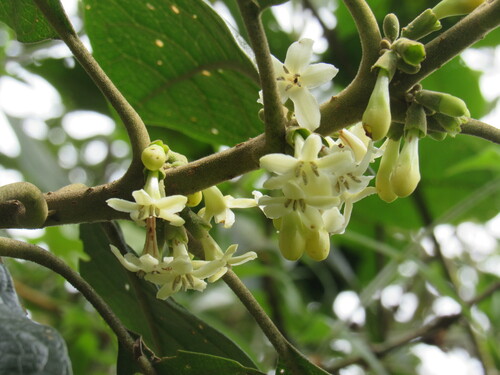
Vitex quinata
(Lour.) F. N. Williams
Joho lawe tree
no rights reserved, uploaded by 葉子

(c) Kinmatsu Lin, some rights reserved (CC BY-NC), uploaded by Kinmatsu Lin
no rights reserved, uploaded by 葉子
What to Eat
Edible parts: Fruit, Shoots
The fruit are eaten raw, and the young shoots are used as a vegetable.
Where to Find It
A tropical plant. In Yunnan in China it grows between 600-1300 m above sea level. It can be between 25-1,700 m above sea level. It grows in monsoon rainforest. In XTBG Yunnan.
Asia, China, India, Indochina, Indonesia, Japan, Laos, Malaysia, Myanmar, Northeastern India, Papua New Guinea, PNG, Philippines, SE Asia, Sikkim, Taiwan, Thailand, Tibet,
How to Identify
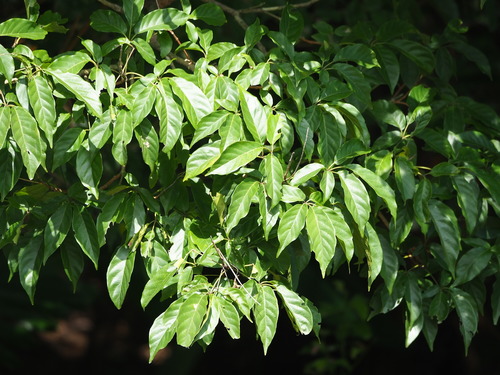
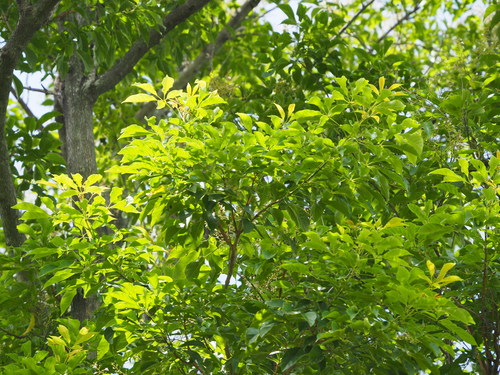
A shrub or large tree. It grows 14-32 m tall. The bark is pale brown and flaky or scaly and rough. The leaves have 3-5 leaflets. They are oval and 10 cm long. The flowers are in groups 20 cm long. They have a scent. The fruit is juicy and round. It is 1 cm across and black.
How to Grow
Plants can be grown from seeds.
Medicinal Uses
Some sources claim the bark is used as a tonic in folk medicine where an infusion can be made to increase appetite.
Other Uses
The wood is fine-textured, hard, heavy, elastic, resistant to moisture. It is used for house construction, bridges and boats. The heartwood is light straw to light brown in colour; it is not clearly demarcated from the lighter coloured sapwood. The texture is moderately fine and even, the grain is straight or interlocked. The wood is moderately hard to hard, and moderately heavy to heavy. Most specimens are small trees and their wood of rather limited dimensions, this limits their use to mainly items such as tool handles, posts, turnery, carving, and fancy articles.
Wikipedia
Source ↗Vitex quinata is a species of flowering plantin the family Lamiaceae. It is sometimes referred to by the common name joho lawe tree. It is native to the Andaman Islands, Assam (India), Bangladesh, the Bismarck Archipelago, Borneo, Cambodia, the Caroline Islands, South-Central China, Southeast China, the East Himalayas, Hainan (China), India, Java (Indonesia), Laos, the Lesser Sunda Islands (Indonesia), Malaysia, Maluku (Indonesia), Myanmar, Nansei-shoto, New Guinea, Pakistan, Philippines, Sulawesi (Indonesia), Sumatra (Indonesia), Taiwan, Thailand, and Vietnam.
Notes
Also put in the family Verbenaceae.
Names & Synonyms
Arekadal, Dieng-sart-udkhar, Gija, Khungsuman, Kyetyo, Kyetyo-po, Latsen, Leban bunga, Leban tandok, Maijiexie, Maragak-kung, Panchpate, Pohon piteka kalipapa, Tauksha, Tirale chiang, Tongcheepe
References (7)
- Ambasta, S.P. (Ed.), 2000, The Useful Plants of India. CSIR India. p 683
- Bull. Herb. Boissier ser. 2, 5:431. 1905
- Burkill, I.H., 1966, A Dictionary of the Economic Products of the Malay Peninsula. Ministry of Agriculture and Cooperatives, Kuala Lumpur, Malaysia. Vol 2 (I-Z) p 2279
- Jin, Chen et al, 1999, Ethnobotanical studies on Wild Edible Fruits in Southern Yunnan: Folk Names: Nutritional Value and Uses. Economic Botany 53(1) pp 2-14
- Savita, et al, 2006, Studies on wild edible plants of ethnic people in east Sikkim. Asian J. of Bio Sci. (2006) Vol. 1 No. 2 : 117-125
- Sukarya, D. G., (Ed.) 2013, 3,500 Plant Species of the Botanic Gardens of Indonesia. LIPI p 566
- World Checklist of Useful Plant Species 2020. Royal Botanic Gardens, Kew