Vitis retordii
Romanet du Caill. ex Planch.
Agia, Yaiputao
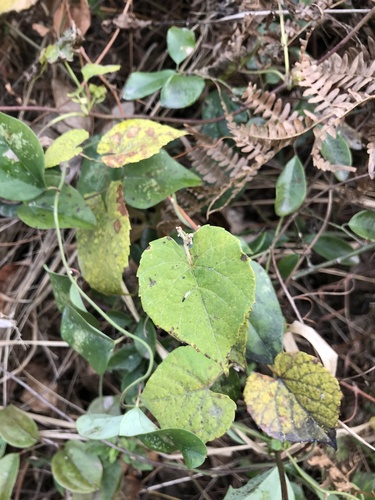
(c) biobank-lantauhk, some rights reserved (CC BY-NC), uploaded by biobank-lantauhk

Wikimedia Commons - Xu Yaxing

President and Fellows of Harvard College
What to Eat
Edible parts: Fruit
The fruit are eaten raw.
Dangerous Lookalikes
This plant can be confused with the following toxic species. Always verify identification carefully before consuming any wild plant.


Canadian Moonseed: No tendrils, single crescent/moon-shaped seed, leaf stem attaches to underside of leaf.
Agia: Vine with tendrils, round seeds, leaf stem at edge of leaf, bark that peels.
Where to Find It
A tropical plant. It grows in Yunnan in China between 1000-1300 m above sea level.
Asia, China, Indochina, Laos, SE Asia, Vietnam,
How to Identify
A vine. The branches have ridges along them. The tendrils are divided. The leaves are simple and oval. They are 6-15 cm long by 4-11 cm wide. They are hairy. The flower panicles are opposite the leaves and 6-10 cm long. The fruit are round berries 8 mm across.
Wikipedia
Source ↗Vitis retordii is a species of vining plant native to east Asia (China, Laos, Vietnam). The plant grows at an altitudes of 200–1,000 m (660–3,280 ft) and bears large grapes. It is also known as the woolly grape.
References (1)
- Jin, Chen et al, 1999, Ethnobotanical studies on Wild Edible Fruits in Southern Yunnan: Folk Names: Nutritional Value and Uses. Economic Botany 53(1) pp 2-14


