Geranium molle
L.
Dove's-foot crane's-bill

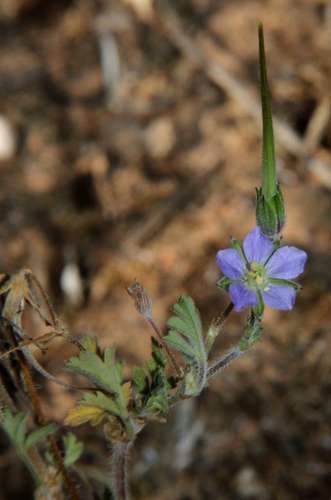
(c) Kostas Zontanos, some rights reserved (CC BY), uploaded by Kostas Zontanos
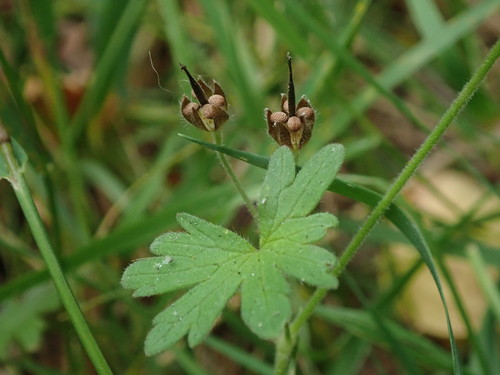
(c) Daniel Cahen, some rights reserved (CC BY), uploaded by Daniel Cahen
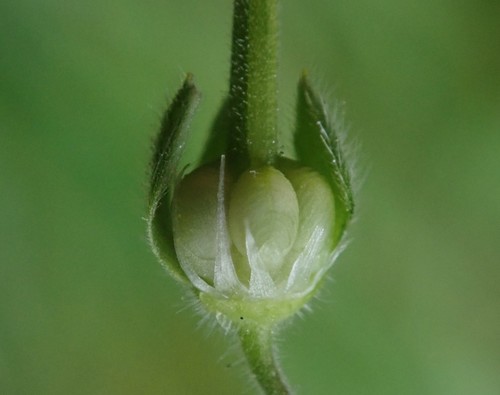
(c) Daniel Cahen, some rights reserved (CC BY), uploaded by Daniel Cahen
What to Eat
Edible parts: Leaves
None known.
Where to Find It
It is a temperate plant. It grows on rocky slopes and can be on sand dunes. In Argentina it grows from sea level and 2,500 m above sea level. Tasmania Herbarium.
Afghanistan, Argentina, Asia, Australia, Balkans, Bosnia, Chile, Crete, Croatia, Europe, Falklands, France, Greece, Himalayas, India, Italy, Luxembourg, Mediterranean, New Zealand, North Africa, Portugal, Russia, South America, Spain, Taiwan, Tasmania, Turkey, Türkiye, Uruguay,
How to Identify
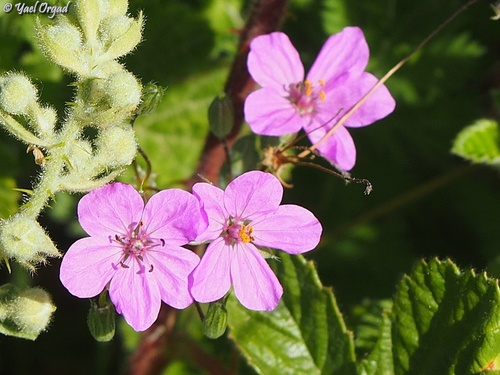
A low spreading herb. It forms tufts and creeps over the ground. It is greyish green and an annual plant. The stems branch from the base. They are softly hairy. The leaves near the base are rounded or kidney shaped. They are divided into 5-7 wedge shaped 3 lobed segments. The upper leaves are more deeply divided. The flowers are pinkish-purple. They are 7-10 mm across. They are in loose clusters. The petals have deep notches.
How to Grow
Succeeds in any moderately fertile retentive soil in a sunny position. Tolerates a wide range of soil types. Members of this genus are rarely if ever troubled by browsing deer or rabbits.
Propagation: Sow seed in spring in a cold frame. Once seedlings are large enough to handle, prick them out into individual pots and plant out during summer. Divide plants in spring or autumn. Larger clumps can be replanted directly into permanent positions, though smaller clumps are better potted up and grown on in a cold frame until rooting well, then planted out in spring.
Medicinal Uses
The plant is considered anodyne, astringent, and vulnerary.
Other Uses
None known.
Wikipedia
Source ↗Geranium molle, the dove's-foot crane's-bill or dovesfoot geranium, is an annual herbaceous plant of the family Geraniaceae.
Notes
There are about 300-400 Geranium species. They are mostly temperate.
Names & Synonyms
Alfilerillo comun, Crvenjak, Crvenki, Velonaki
References (12)
- Ambasta, S.P. (Ed.), 2000, The Useful Plants of India. CSIR India. p 234
- Blamey, M and Grey-Wilson, C., 2005, Wild flowers of the Mediterranean. A & C Black London. p 112
- Dretakis, M. et al, 2012, Flora and Fauna Biodiversity in an ancient olive grove in Crete (Greece) in Calabrese G. (Ed.) Study on Biodiversity in Century-Old Olive Groves. CIHEAM - Mediterranean Agronomic Institute of Bari. p 94
- Luczaj et al, 2013, Wild vegetable mixes sold in the markets of Dalmatia (southern Croatia). Journal of Ethnobiology and Ethnomedicine. 8:2
- Luczaj, L. et al, 2013, Wild food plants used in the villages of the Lake Vrana Nature Park (northern Dalmatia, Croatia). Acta Societatis Botanicorum Poloniae, 82(4): 275-281
- Luczaj, L. et al, 2014, Wild Food Plants of Dalmatia (Croatia). in A. Pieroni, C. L. Quave (eds.), Ethnobotany and Biocultural Diversities in the Balkans, p 142
- Malezas Comestibles del Cono Sur, INTA, 2009, Buernos Aires
- Paczkowska, G. & Chapman, A.R., 2000, The Western Australian Flora. A Descriptive Catalogue. Western Australian Herbarium. p 252
- Pieroni, A., 1999, Gathered wild food plants in the Upper Valley of the Serchio River (Garfagnana), Central Italy. Economic Botany 53(3) pp 327-341
- Sp. pl. 2:682. 1753
- Tasmanian Herbarium Vascular Plants list p 34
- Upson, R., & Lewis R., 2014, Updated Vascular Plant Checklist and Atlas for the Falkland Islands. Falklands Conservation and Kew.