Aponogeton junceus
Schlechtend.
Waterblom-metjie

(c) Bart Wursten, some rights reserved (CC BY-NC), uploaded by Bart Wursten
(c) Kevin Balkwill, some rights reserved (CC BY-NC), uploaded by Kevin Balkwill

(c) Bart Wursten, some rights reserved (CC BY-NC), uploaded by Bart Wursten
What to Eat
Edible parts: Corms, Leaves, Flowers, Tubers, Root
The tubers are eaten as a snack. The corms, leaves, flowers, and roots are also edible.
Where to Find It
A tropical plant. It grows in water in ponds and marshes. In Swaziland it grows in the lowveld.
Africa, Angola, Botswana, Central Africa, East Africa, Eswatini, Namibia, South Africa, Southern Africa, Swaziland, Zimbabwe,
How to Identify
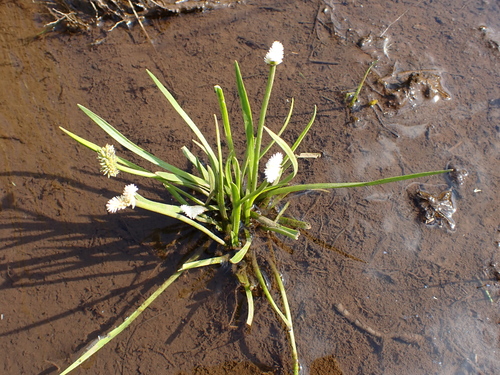
A small plant that keeps growing from year to year. It has a tuberous rhizome. The tubers are 3 cm across. This produces a few grass-like leaves. These are 10-12 cm long. The flower is on a slender stalk with a pair of spikes at the end. These are 1-2 cm long. The flowers are small, crowded, without stalks and white.
Notes
There are about 12-44 Aponogeton species. They are tropical and subtropical.
Names & Synonyms
References (8)
- Long, C., 2005, Swaziland's Flora - siSwati names and Uses http://www.sntc.org.sz/flora/
- Pemberton, R.W., 2000, Waterblommetjie (Aponogeton distachys, Aponogetonaceae), a recently domesticated aquatic Food Crop in Cape South Africa with Unusual Origins. Economic Botany 54(2) pp 144-149
- Peters, C. R., O'Brien, E. M., and Drummond, R.B., 1992, Edible Wild plants of Sub-saharan Africa. Kew. p 11
- Rodin, 1985,
- Romanowski, N., 2007, Edible Water Gardens. Hyland House. p 36
- Ruiters-Welcome, A. K., 2019, Food plants of southern Africa. Ph.D. thesis. Univ. of Johannesburg p 28
- Swaziland's Flora Database http://www.sntc.org.sz/flora (As Lehm.)
- Welcome, A. K. & Van Wyk, B.-E., 2019, An inventory and analysis of the food plants of southern Africa. South African Journal of Botany 122 (2019) 136–179


