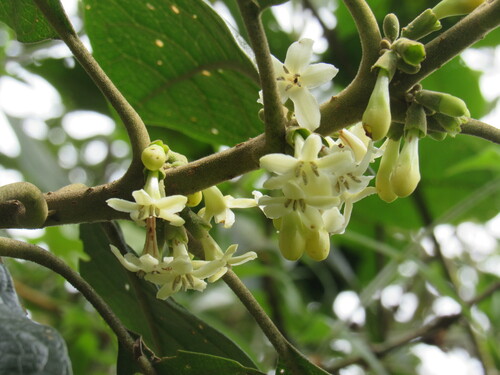
Callicarpa rubella
Lindl.
Soh shun, Chinese beauty berry

(c) bennybotany85, some rights reserved (CC BY-NC), uploaded by bennybotany85
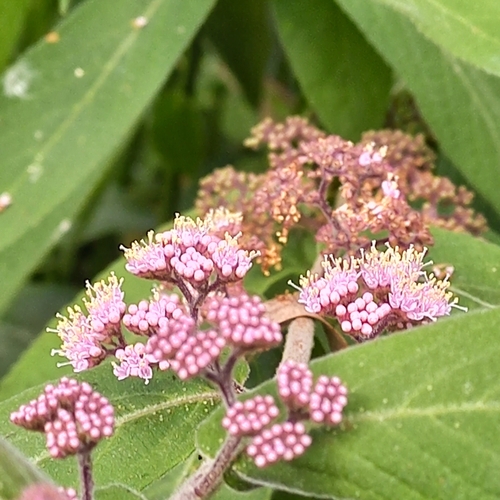
(c) jonnymac62, some rights reserved (CC BY-NC)
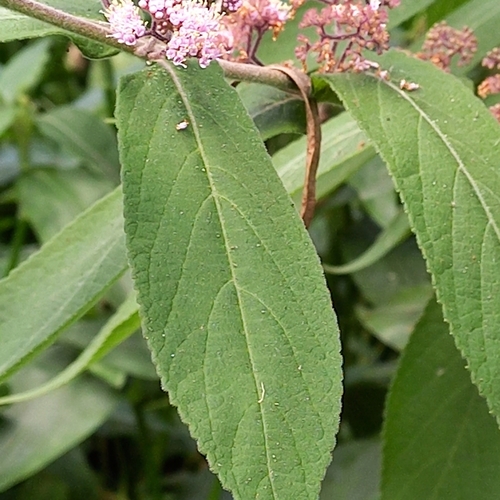
(c) jonnymac62, some rights reserved (CC BY-NC)
What to Eat
Edible parts: Leaves, ? edible or wrapping?, Bark - masticatory, Root
The roots are eaten. The leaves may have a wrapping use.
Where to Find It
It is a subtropical plant. It grows naturally in tropical and subtropical Asia. It needs a warm location. In southern China it grows between 100-3,500 m above sea level. It suits hardiness zones 9-11. In Sichuan and Yunnan.
Asia, Australia, Britain, China*, Europe, India, Indochina, Indonesia, Laos, Malaysia, Myanmar, Northeastern India, SE Asia, Thailand, Vietnam,
How to Identify
A compact semi-deciduous shrub. The stems are 2.7 m long. They arch over. The leaves are pale yellowish-green. They are 12 cm long. The flowers are small and pink. The fruit are deep purple berries. They remain on the plant for a long time.
How to Grow
Plants are grown from seeds.
Propagation: Seed - sow in a nursery seedbed and only just cover the seed. Germination usually takes place within 1 - 3 months at 18°c. When large enough to handle, prick the seedlings out into individual pots and grow them on until large enough to plant out Cuttings of half-ripe wood 10cm long in a frame. High percentage. Cuttings of mature wood of the current season's growth with a heel.
Medicinal Uses
The roots of the plant have been used in Indian folk medicine to treat tumors in the large intestine.
Wikipedia
Source ↗Callicarpa rubella is a species of beautyberry native to Southeast Asia. It is a shrub that produces pink or purple flowers followed by dark-purple berries. The berries are actually drupes. It is grown in gardens as an ornamental plant. The fruit attracts wildlife such as birds.
Notes
There are about 140-150 Callicarpa species. Most are in the tropics and subtropics. Previously in the Verbenaceae family.
Names & Synonyms
Bonmala, Gopura esing, Ja-lang-kwai
References (9)
- Bodkin, F., 1991, Encyclopedia Botanica. Cornstalk publishing, p 194
- Bot. Reg. 11: t. 883. 1825
- Cundall, P., (ed.), 2004, Gardening Australia: flora: the gardener's bible. ABC Books. p 283
- Etherington, K., & Imwold, D., (Eds), 2001, Botanica's Trees & Shrubs. The illustrated A-Z of over 8500 trees and shrubs. Random House, Australia. p 157
- Morley, B. & Everard, B., 1970, Wild Flowers of the World. Ebury press. Plate 104
- Patiri, B. & Borah, A., 2007, Wild Edible Plants of Assam. Geethaki Publishers. p 98
- Pegu, R., et al, 2013, Ethnobotanical study of Wild Edible Plants in Poba Reserved Forest, Assam, India. Research Journal of Agriculture and Forestry Sciences 1(3):1-10
- Sawian, J. T., et al, 2007, Wild edible plants of Meghalaya, North-east India. Natural Product Radiance Vol. 6(5): p 414
- Rao, R.R. & Neogi, B., 1980, Observation on the Ethnobotany of the Khasi and Garo tribes in Meghalaya (India). J. Econ. Tax. Bot. Vol. 1 pp 157-162