Ceriscoides turgida
(Roxb.) Tirveng
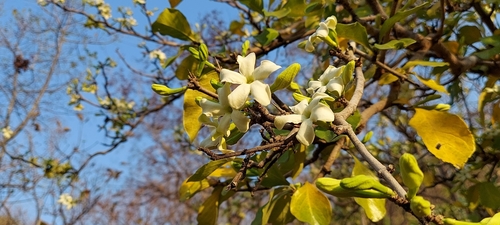
(c) Milind Girdhari, some rights reserved (CC BY-NC), uploaded by Milind Girdhari
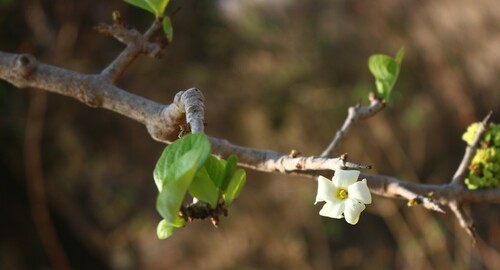
(c) Shiwalee Samant, some rights reserved (CC BY-NC)
What to Eat
Edible parts: Fruit, Shoots, Vegetable
The ripe fruit are eaten fresh or cooked and used as a vegetable.
Where to Find It
A tropical plant. It grows in dry deciduous forests in the Ghats in India.
Asia, India, Indochina, Laos, Myanmar, SE Asia, Sri Lanka, Thailand,
How to Identify
A shrub or small tree. It grows 8 m tall. It has spines. The leaves are opposite and clasp the stem. The leaves on lower branches are smaller and on higher branches are 4-9 cm long by 2-5 cm wide. They are thick and papery. The flowers have 5 parts. They are white and turn yellow with age. The fruit is a round berry 5 cm long by 4 cm wide. It has many seeds in a fleshy pulp.
Medicinal Uses
The plant is used in medicine.
Wikipedia
Source ↗Ceriscoides turgida (syn. Gardenia turgida), the mountain gardenia, is a species of flowering plant in the family Rubiaceae, native to the Indian Subcontinent and mainland Southeast Asia. A tree reaching 8 m (26 ft), its unripe fruit can be boiled and eaten as a famine food, but its ripe fruit are poisonous.
Production
Plants flower and fruit November to March in India.
Notes
It is used in medicine.
Names & Synonyms
Bengeri, Bomonia, Bootbangari, Dhauuk, Dudri, Ghurgia, Karhar, Karumba, Kharkar, Khurpendra, Madanghanta, Malangarai, Malankara, Manjuda, Pandhara fendra, Peddabikki, Pendra, Tellakokkita, Thanella, Vellakara, Vellakarae, Yerribikki
References (11)
- Ambasta, S.P. (Ed.), 2000, The Useful Plants of India. CSIR India. p 232 (As Gardenia turgida)
- Bull. Mus. Nat. Hist. Nat., Ser. 3, Bot. 35:15. 1978
- Dey, A. & Mukhererjee, A., 2015, Living and Survival Amidst Hunger: Wild Edible Botanicals as a Prime Forestt Productivity in the Rural Purulia District, West Bengal, India from Colonial to Present. Research Journal of Foresttry 9(3): 71-86 (As Gardenia turgida)
- Dobriyal, M. J. R. & Dobriyal, R., 2014, Non Wood Forestt Produce an Option for Ethnic Food and Nutritional Security in India. Int. J. of Usuf. Mngt. 15(1):17-37 (As Gardenia campanulata)
- Fl. ind. 2:557. 1824 (As Gardenia turgida)
- Pandey, K. C. & Pande, N., 2016, Ethnobotanical Documentation of Wild Edible Plants used by Gujjar Community of Tarai West Forest Division Ramnagar, Nainital, India, Current World Environment. Vol. 11(3), 808-818
- Ramachandran, V.S. and Nair, V.J., 1981, Ethnobotanical studies in Cannanore District, Kerala State (India). J Econ. Tax. Bot. Vol 2 pp 65-72
- Reddy, K. N. et al, 2007, Traditional knowledge on wild food plants in Andhra Pradesh. Indian Journal of Traditional Knowledge. Vol. 6(1): 223-229
- Setiya, A. V., et al, 2016, Exploration and documentation of some wild edible plants used by the aboriginals from Gadchiroli District (M.S.) India. International Advanced Research Journal in Science, Engineering and Technology. 3(7)
- Singh, H.B., Arora R.K.,1978, Wild edible Plants of India. Indian Council of Agricultural Research, New Delhi. p 76 (As Gardenia turgida)
- Yadav, D. K., 2011, Study on Biodiversity and Edible Bioresources of Betla National Park, Palamu, Jharkhand (India). The 2011 Las Vegas International Academic Conference.


