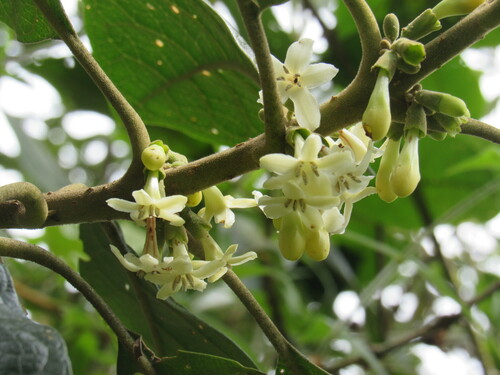
Clerodendrum wallichii
Merr.
Nodding glorybower, Wallich's glorybower

(c) kyosapir, some rights reserved (CC BY-NC)

(c) Chee Koi Jun, some rights reserved (CC BY-NC)

(c) Chee Koi Jun, some rights reserved (CC BY-NC)
What to Eat
Edible parts: Leaves
The leaves are cooked as a vegetable.
Where to Find It
A tropical and subtropical plant. It needs fertile, well-drained soil. It grows in open forests on mountain slopes between 100-1,200 m above sea level. It suits hardiness zones 10-12.
Asia, Bangladesh, Bhutan, China, Dominican Republic, Haiti, Hawaii, Himalayas, India*, Indonesia, Myanmar, Northeastern India, Pacific, Pakistan*, Puerto Rico, Samoa, SE Asia, Tibet, USA, Vietnam, West Indies,
How to Identify
An erect shrub. It grows 1.8-2.8 m high. The leaves can be 25 cm long. They are wavy at the edge and taper to the tip. The flowers are in panicles which hang from the ends of branches. These can be 30 cm long. The flowers are white or pale yellow. They can be 2 cm long. The fruit are purplish-black.
How to Grow
Plants can be grown from seeds and suckers.
Notes
There are about 400 Clerodendrum species.
Names & Synonyms
Bridal bush, Klerodendrum putih, Lekynrum siah blang, Medongdi
References (8)
- Etherington, K., & Imwold, D., (Eds), 2001, Botanica's Trees & Shrubs. The illustrated A-Z of over 8500 trees and shrubs. Random House, Australia. p 217
- J. Arnold Arbor. 33:220. 1952
- Kumar, Y J. et al, 1987, Further Contribution to the Ethnobotany of Meghalaya: Plants used by "War jaintia" of Jaintia Hill District. Econ. Tax. Bot. Vol 11 No. 1 pp 65-
- Llamas, K.A., 2003, Tropical Flowering Plants. Timber Press. p 241 (Clerodendrum wallichii)
- Plants of Haiti Smithsonian Institute http://botany.si.edu/antilles/West Indies
- Singh, B., et al, 2012, Wild edible plants used by Garo tribes of Nokrek Biosphere Reserve in Meghalaya, India. Indian Journal of Traditional Knowledge. 11(1) pp 166-171
- Staples, G.W. and Herbst, D.R., 2005, A tropical Garden Flora. Bishop Museum Press, Honolulu, Hawaii. p 561
- Sukarya, D. G., (Ed.) 2013, 3,500 Plant Species of the Botanic Gardens of Indonesia. LIPI p 614