Curcuma aromatica
Salisbury
Wild turmeric, Yellow zeodary

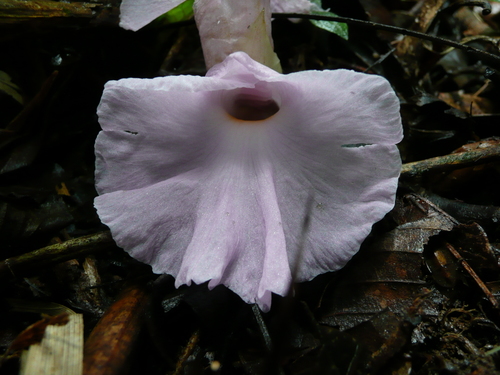
(c) obijin, some rights reserved (CC BY-NC)

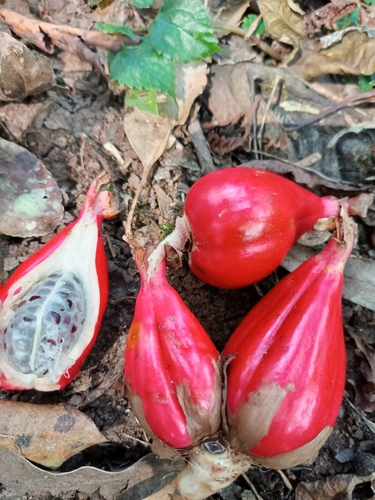
(c) spitzenkorper, some rights reserved (CC BY-NC)
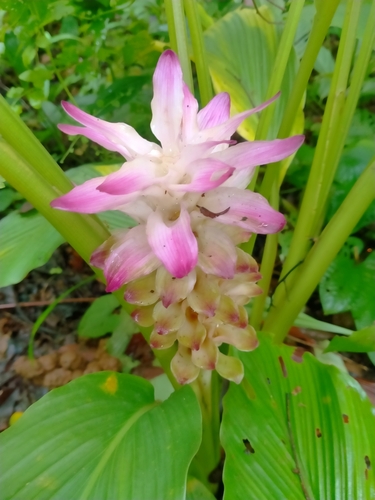
(c) virenvaz, some rights reserved (CC BY-NC)
What to Eat
Edible parts: Shoots, Rhizomes, Root, Starch
Young shoots are eaten as a vegetable. The rhizome is pounded and used as a substitute for turmeric.
Where to Find It
A tropical plant. They need warm, frost-free climates. They need moist, humus-rich, well drained soil. It suits hardiness zones 10-12. In Yunnan.
Asia, Australia, Bangladesh, Bhutan, China, Himalayas, India*, Indochina, Laos, Myanmar, Nepal, SE Asia, Sri Lanka, Thailand, Tibet, Vietnam,
How to Identify
A ginger family herb that keeps growing from year to year. It grows 1 m tall and spreads widely. It has fleshy underground roots or rhizomes. It has cane like false stems and sword shaped leaves. The leaves are pointed and can be 60 cm long. The flowers are on leafy stems. They are in cone like heads. The flowers have 3 petals. There are large coloured bracts around the flowers. The flower stems are 60 cm long and the flowering head is 20 cm long. The lower bracts are pale green and the upper bracts are pink. The flowers are yellow and white.
How to Grow
They can be grown from seed or by division.
Propagation: Seed - best sown as soon as it is ripe. Germinates best at temperatures around 20°c. Division of the rhizome when the plant is dormant.
Medicinal Uses
Wild turmeric has rhizomes with a peculiar fragrance and cream color. The rhizomes are often used as a culinary ingredient, and in traditional medicine, for skin disorders and as an antibacterial agent. It is also commonly used in ethnic cosmetic products. As a culinary ingredient it is used in limited quantities as a natural food colour. Leaves are broad and very decorative, elliptic with a leaf stem running as long to the tip of the blade. A fresh stalk with flowers and leaves, cut to proper size and shape, can be used as a floral indoor decoration in vase for up to 10 days.
Wikipedia
Source ↗Curcuma aromatica (common name: wild turmeric) is a member of the genus Curcuma belonging to the family Zingiberaceae. Botanically close to Curcuma australasica, wild turmeric has been widely used as a cosmetic herbal in South Asia and nearby regions. In Tamil and Malayalam, it is known as Kasthuri Manjal (கஸ்துரி மஞ்சள்/കസ്തൂരി മഞ്ഞൾ), and in Telugu, bontha-pasupu (బొంతపసుపు).
Notes
There are about 50 Curcuma species. They are mostly in SE Asia. They are tropical or subtropical.
Names & Synonyms
Banha-ledo, Ban-halud, Bon haldi, Cochin turmeric, Indian arrowroot, Jangli-haldi, Kasturi pasupu, Kasturi-arishina, Kasturi-manjal, Mar-lar-pu, Nangdum, Palua, Ran-halada, Tawn-sanwin, Van haldi, Vana-haridra
References (21)
- Acharya K. P. and Acharya, R., 2010, Eating from the Wild: Indigenous knowledge on wild edible plants in Parroha VDC of Rupandehi District, Central Nepal. International Journal of Social Forestry. 3(1):28-48
- Ambasta, S.P. (Ed.), 2000, The Useful Plants of India. CSIR India. p 151
- Behera K. K., et al, 2008, Wild Edible Plants of Mayurbhanj District, Orissa, India. J. Econ. Taxon. Bot. Vol. 32 (Suppl.) pp 305-314
- Brown, D., 2002, The Royal Horticultural Society encyclopedia of Herbs and their uses. DK Books. p 186
- Burkill, I.H., 1966, A Dictionary of the Economic Products of the Malay Peninsula. Ministry of Agriculture and Cooperatives, Kuala Lumpur, Malaysia. Vol 1 (A-H) p 714
- Cundall, P., (ed.), 2004, Gardening Australia: flora: the gardener's bible. ABC Books. p 447
- Facciola, S., 1998, Cornucopia 2: a Source Book of Edible Plants. Kampong Publications, p 248
- Hu, Shiu-ying, 2005, Food Plants of China. The Chinese University Press. p 327
- Jiwajinda, S., et al, 2002, Suppressive Effects of Edible Thai Plants on Superoxide and Nitric Oxide Generation. Asian Pacific Journal of Cancer Prevention, Vol 3, 2002
- Lim, T. K., 2016, Edible Medicinal and Non-Medicinal Plants: Volume 12 Modified Stems, Roots p 6
- Kumar, R. & Saikia, P., 2020, Wild edible plants of Jharkhand and their utilitarian perspectives. Indian Journal of Traditional Knowledge Vol 19 (2), April 2020, pp 237-250
- Kumar, Y J. et al, 1987, Further Contribution to the Ethnobotany of Meghalaya: Plants used by "War jaintia" of Jaintia Hill District. Econ. Tax. Bot. Vol 11 No. 1 pp 65-
- Misra, R. C., et al, 2013, Genetic resources of wild tuberous food plants traditionally used in Similipal Biosphere Reserve, Odisha, India. Genetic Resources and Crop Evolution. Vol. 60 No. 2. Springer
- Pandy, R. K. & Saini, S. K., 2007, Edible plants of tropical forests among tribal communities of Madhya Pradesh. Indian Journal of Traditional Knowledge. 6(1), pp 185-190
- Parad. lond. 2: t. 96. 1808
- Seidemann J., 2005, World Spice Plants. Economic Usage, Botany, Taxonomy. Springer. p 126
- Shin, T., et al, 2018, Traditional knowledge of wild edible plants with special emphasis on medicinal uses in Southern Shan State, Myanmar. Journal of Ethnobiology and Ethnomedicine (2018) 14:48
- Shrestha, S., 2021, Wild Edible Plants of Dhankuta, Eastern Nepal. Rupantaran : A Multidisciplinary Journal Vol. V : pp 100-109, September, 2021 p 103
- Tanaka,
- World Checklist of Useful Plant Species 2020. Royal Botanic Gardens, Kew
- Xu, Z., Tao, G. & Tan, J., 1988, Tropical Wild Flowers and Plants in Xishuangbanna, Agricultural Publishing House. photo 44