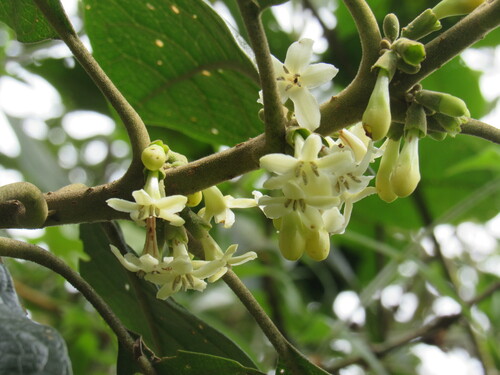
Salvia mukerjeei
Bennet & Raizada
Eastern Sage, Woolly sage, Glass-wort

iNaturalist · cc0
no rights reserved
no rights reserved

iNaturalist · cc0
no rights reserved
no rights reserved
What to Eat
Edible parts: Flowers, Stems
The flowering tips and flower spikes are eaten raw in salads or cooked as a vegetable. The stems are peeled and eaten.
Where to Find It
It is a subtropical plant. In the Himalayas it grows in drier areas between 1,500-3,000 m above sea level. It needs to be in a sunny position. It suits hardiness zone 6-9.
Asia, Himalayas, India, Nepal, Pakistan,
Countries: United Arab Emirates, Afghanistan, Armenia, Azerbaijan, Bangladesh, Bahrain, Brunei, Bhutan, China, Georgia, Indonesia, Israel, India, Iraq, Iran, Jordan, Japan, Kyrgyzstan, Cambodia, North Korea, South Korea, Kuwait, Kazakhstan, Laos, Lebanon, Sri Lanka, Myanmar, Mongolia, Maldives, Malaysia, Nepal, Oman, Philippines, Pakistan, Qatar, Saudi Arabia, Singapore, Syria, Thailand, Tajikistan, Timor-Leste, Turkmenistan, Turkey, Taiwan, Uzbekistan, Vietnam, Yemen
How to Identify
An erect herb. It grows 30 cm tall. It keeps growing from year to year. It has a white woolly covering. The leaves are clustered at the base of the stem. The leaves are 5-10 cm long by 1-3 cm wide. The flowers are white, purple or blue.
Names & Synonyms
Bunda, Ghanaii, Matter jarrai, Tooth
Salvia cana Wall. ex Benth.Salvia integrifolia HardwickeSalvia lanata Roxb.Stenarrhea lanata D. Don
References (5)
- Ahmad, K., et al, 2018, Ethnobotanical investigation of wild vegetables used among local communities in northwest Pakistan. Acta Soc Bot Pol. 2019;88(1):3616.
- Ambasta, S.P. (Ed.), 2000, The Useful Plants of India. CSIR India. p 543 (As Salvia lanata)
- Hedrick, U.P., 1919, (Ed.), Sturtevant's edible plants of the world. p 591 (As Salvia lanata)
- Kumar, P. D., et al, 2015, Ethnobotanical Knowledge and Usage of Wild Plants in Theog Forest Division, Himachal Pradesh, North Western Himalaya. The Journal of Ethnobiology and Traditional Medicine. Photon 124(2015) 922-935 (As Salvia lanata)
- Negi, K.S., 1988, Some little known wild edible plants of U.P. Hills. J. Econ. Tax. Bot. Vol. 12 No. 2 pp 345-360 (As Salvia lanata)