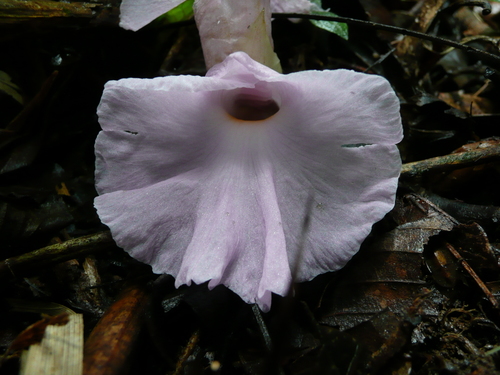
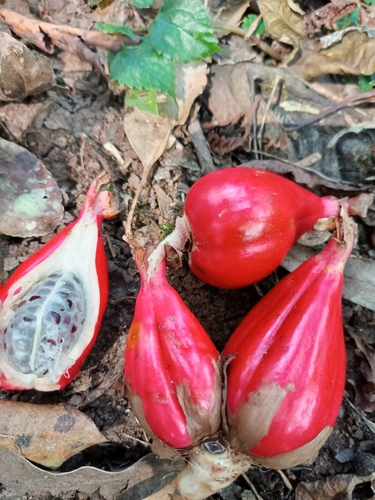
Amomum tomrey
Gagnep.
Tom-rey

Moscow State University (copyright is managed by Dr. Alexey P. Seregin)
What to Eat
Edible parts: Seeds, Spice
The seeds are used as a spice and flavouring for stews.
Where to Find It
A tropical plant. It grows in lowland evergreen and deciduous forests. It occurs on limestone bedrock at about 100 m above sea level in Thailand.
Asia, Cambodia, Indochina, Laos, SE Asia, Thailand, Vietnam,
How to Identify
A ginger family herb. It grows about 2 m tall. The rhizome is about 0.5-1.5 cm across. The leafy shoots are slender and grow in clumps. They are pale green to purple at the base. There are 4-26 leaves. The blade is 19-45 cm long by 6-10 cm wide. The flowering shoots are a flattened round shaped and 3 cm across. The fruiting stalk is 6-13 cm long. The fruit are round to oblong and with 3 grooves along them. They are 2 cm across. The seed are angular and 6-7 mm long by 4-5 mm wide. They are brown with a white coating.
Other Information
It is a cultivated plant.
Notes
There are about 150 Amomum species. They are mostly tropical.
References (1)
- Burkill, I.H., 1966, A Dictionary of the Economic Products of the Malay Peninsula. Ministry of Agriculture and Cooperatives, Kuala Lumpur, Malaysia. Vol 1 (A-H) p 927