Lindera glauca
(Siebold & Zucc.) Blume
Spicebush
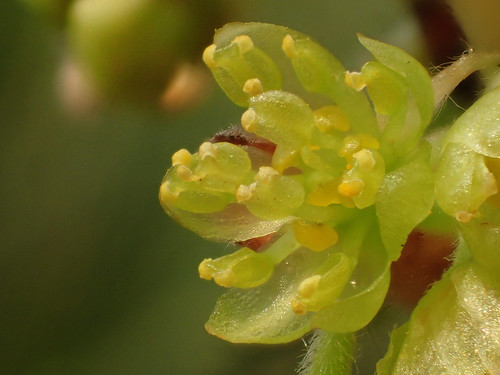
no rights reserved, uploaded by 葉子
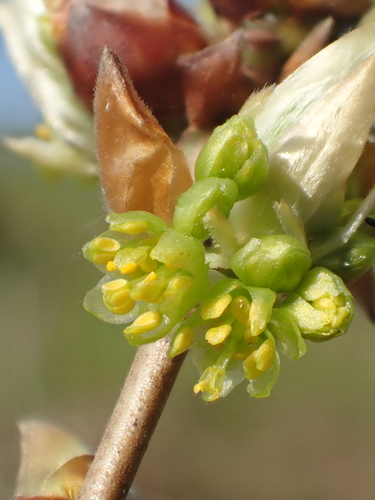
no rights reserved, uploaded by 葉子
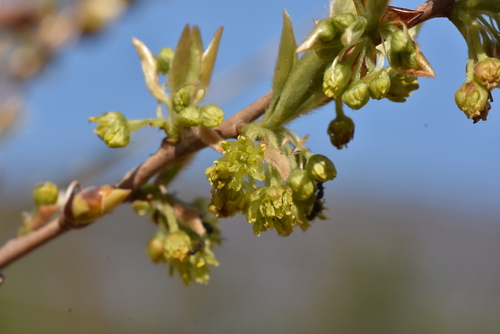
(c) 黃俊曄, some rights reserved (CC BY-NC), uploaded by 黃俊曄
What to Eat
Edible parts: Fruit, Spice, Leaves
The fruits are used as a pepper substitute. Dried, powdered leaves are mixed into noodles and dumplings as a flavouring.
Where to Find It
A subtropical plant. In central China it grows in forests and on mountain slopes below 900 m above sea level. In Sichuan.
Asia, China, Japan, Korea, Malaysia, Myanmar, SE Asia, Taiwan, Vietnam,
How to Identify
A shrub or small tree. It grows 8 m tall. The bark is smooth and grey to white. The young branches are white to yellow with brown hairs. The leaves are alternate and the leaf blade is oval and 4-9 cm long by 2-4 cm wide. There are white hairs underneath. Male and female flowers are separate.
How to Grow
It is grown by seed and cuttings.
Propagation: Sow seed as soon as it is ripe, as viability is short and the seed must not be allowed to dry out. Prick seedlings into individual pots when large enough and grow on until ready to plant out. Cuttings of half-ripe wood in a frame. Layering.
Medicinal Uses
The roots, branchlets, leaves, and fruit are used medicinally.
Other Uses
An essential oil obtained from the leaves and pericarp is used in the manufacture of incense and joss sticks. Oil from the seed is used for making soap and as a lubricant. The wood is used in woodwork.
Wikipedia
Lindera glauca is a deciduous shrub growing 5 m tall by 5 m wide. Hardy to UK zone 6. Hermaphroditic flowers. Grows in light sandy, medium loamy, and heavy clay soils, preferring well-drained conditions. Suitable for mildly acid, neutral, or mildly alkaline soils. Tolerates semi-shade or full sun and requires consistently moist soil. Features attractive aromatic foliage with star-shaped flowers and showy red to black fruit.
Names & Synonyms
Shan-hu-shu, Yama-kobashi
References (6)
- Brown, D., 2002, The Royal Horticultural Society encyclopedia of Herbs and their uses. DK Books. p 263
- Burkill, I.H., 1966, A Dictionary of the Economic Products of the Malay Peninsula. Ministry of Agriculture and Cooperatives, Kuala Lumpur, Malaysia. Vol 2 (I-Z) p 1370
- Facciola, S., 1998, Cornucopia 2: a Source Book of Edible Plants. Kampong Publications, p 139
- Mus. bot. 1:325. 1851
- Tanaka,
- www.efloras.org Flora of China Volume 7


