Tetramerista glabra
Miq.
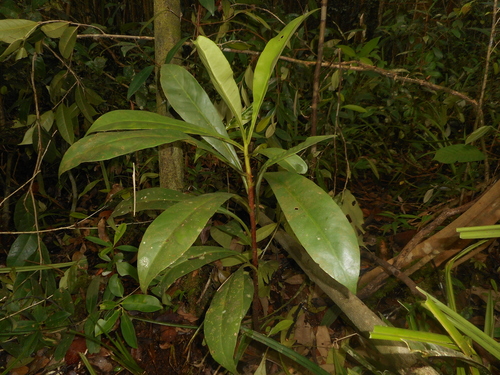
(c) Arief Hamidi, some rights reserved (CC BY-NC), uploaded by Arief Hamidi

(c) Salam Firdaus, some rights reserved (CC BY-NC)

(c) Salam Firdaus, some rights reserved (CC BY-NC)
What to Eat
Edible parts: Fruit
The fruit is eaten.
Where to Find It
A tropical plant.
A mid-canopy tree in undisturbed mangrove, (peat)-swamp, mixed dipterocarp and keranga forests, growing in alluvial sites and along rivers with sandy to clay soils; at elevations up to 500 metrs.
How to Identify
A tropical tree from Southeast Asia, Indonesia, and Malaysia in the Tetrameristaceae family.
How to Grow
Young trees coppice freely.
Other Uses
The heartwood is light yellow to light brown, often with pink glints and the presence of red and white deposits in the pores; it is not clearly demarcated from the 4 - 7cm wide band of sapwood. The texture is medium; the grain straight or slightly interlocked, sometimes oblique; lustre is low]; the unseasoned wood has an unpleasant aroma. The wood is moderately heavy; moderately hard; somewhat durable having a moderate resistance to fungi but susceptible to dry wood borers and termites. It seasons fairly quickly, with a high risk of checking and distortion; once dry it is moderately stable in service. It can be worked with ordinary tools, though there is a slight gumming of sawteeth due to resin; planed surfaces tend to be fibrous and require careful sanding; Filling can be necessary in order to obtain a good finish; nailing and screwing are good, but require pre-boring, especially for thinner material; gluing is correct. The wood is used for flooring, furniture components, joinery, interior panelling, boxes and crates etc. The wood is used for fencing, planks, posts. The wood is used for fuel.
Production
Tetramerista occurs in Indonesia and Malaysia. There may be 3 species.
Names & Synonyms
Padada paya, Ponga, Punah, Punah tembaga, Simasam
References (5)
- Burkill, I.H., 1966, A Dictionary of the Economic Products of the Malay Peninsula. Ministry of Agriculture and Cooperatives, Kuala Lumpur, Malaysia. Vol 2 (I-Z) p 2183
- Heyne, K., 1927, p 1079
- Heywood, V.H., Brummitt, R.K., Culham, A., and Seberg, O., 2007, Flowering Plant Families of the World. Royal Botanical Gardens, Kew. p 318
- Milow, P., et al, 2013, Malaysian species of plants with edible fruits or seeds and their evaluation. International Journal of Fruit Science. 14:1, 1-27
- World Checklist of Useful Plant Species 2020. Royal Botanic Gardens, Kew