Ampelopteris prolifera
(Retz.) Copeland
Dheki Shak
(c) Jacy Chen, some rights reserved (CC BY), uploaded by Jacy Chen

(c) Ricky Taylor, some rights reserved (CC BY-NC), uploaded by Ricky Taylor

(c) pacomouse, some rights reserved (CC BY-NC)
What to Eat
Edible parts: Leaves, Fronds, Vegetable
The young frond tips are eaten as a vegetable, commonly cooked in stir-fries and soups. The fronds and leaves are sold in local markets.
Where to Find It
It is a tropical and subtropical plant. It grows on land but usually near water and in wet ground. It can grow in shady and sunny locations. In southern China it grows between 100-1,000 m above sea level.
Africa, Angola, Asia, Australia, Bangladesh, Burundi, Cambodia, Cameroon, Central Africa, Central African Republic, CAR, China, Congo DR, East Africa, Eswatini, Guinea, Guinée, Himalayas, India, Indonesia, Kenya, Laos, Madagascar, Malawi, Malaysia, Mauritius, Mexico, Mozambique, Myanmar, Nepal, New Caledonia, Northeastern India, Pakistan, Philippines, SE Asia, Senegal, South Africa, Southern Africa, Sri Lanka, Swaziland, Taiwan, Tanzania, Thailand, Vietnam, West Africa, Zambia, Zimbabwe,
How to Identify
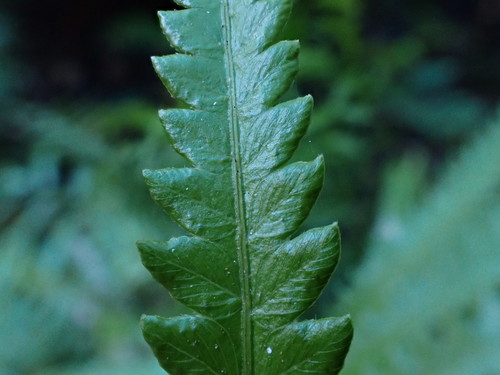
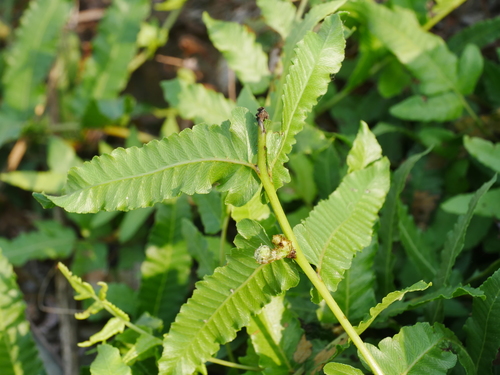
A fern. It forms large colonies. It has a creeping, scaly rhizome. This is about 1 cm thick. The scales are dark brown and oval shaped but fall off older parts. The fronds form tufts. There are 2 kinds of fronds. One has a leaflet at the end and the other grows indefinitely to about 4 m long.
How to Grow
Prefers a sunny position. The plant requires permanent moisture; the rhizome is often found growing in water. The plants are usually sterile. The sori are produced particularly during dry periods. The freely proliferating buds result in effective local dispersal. It has been suggested that the plant spreads along river systems by flood waters breaking off the fronds and then depositing them on banks further downstream.
Medicinal Uses
The young fronds are laxative. The leaf-sap is drunk, in a mixture with Hypoestes aristata, to treat meningitis and encephalitis. The plant is also used in traditional medicine in India.
Other Uses
A leaf extract showed antiviral activity against cucumber mosaic virus in Chenopodium amaranticolor.
Other Information
Leaves are sold in local markets.
Notes
There is only one Ampelopteris species.
Names & Synonyms
Dhenki
References (11)
- Ambasta S.P. (Ed.), 2000, The Useful Plants of India. CSIR India. p 36
- Andrews, S.B., 1990, Ferns of Queensland. A handbook to the ferns and fern allies. Queensland DPI p 350
- Bandyopadhyay, S., et al, 2012, A Census of Wild Edible Plants from Howrah District, West Bengal, India. Proceedings of UGC sponsored National Seminar 2012
- Burkill, H. M., 1985, The useful plants of west tropical Africa, Vol. 5. Kew.
- Grubben, G. J. H. and Denton, O. A. (eds), 2004, Plant Resources of Tropical Africa 2. Vegetables. PROTA, Wageningen, Netherlands. p 559
- Liu, Y., et al, 2012, Food uses of ferns in China: a review. Acta Societatis Botanicorum Poloniae 84(4): 263-270
- Paczkowska, G. & Chapman, A.R., 2000, The Western Australian Flora. A Descriptive Catalogue. Western Australian Herbarium. p 26
- Sarker, S. K., & Enayet Hossain, A. B. M., 2009, Pteridophytes of Greater Mymensingh District of Bangladesh used as Vegetables and Medicines. Bangladesh J. Plant Taxon. 16(1) 47-56. p 49
- Swaziland's Flora Database http://www.sntc.org.sz/flora
- World Checklist of Useful Plant Species 2020. Royal Botanic Gardens, Kew (As Thelypteris prolifera)
- www.eFloras.org Flora of China