Commiphora caudata
(Wight & Arn.) Engl.
Hill mango, Green commiphora
(c) Siddarth Machado, some rights reserved (CC BY), uploaded by Siddarth Machado
(c) Siddarth Machado, some rights reserved (CC BY), uploaded by Siddarth Machado
(c) Siddarth Machado, some rights reserved (CC BY), uploaded by Siddarth Machado
What to Eat
Edible parts: Fruit
Both ripe and unripe fruit are pickled.
Where to Find It
A tropical plant. In southern India it grows between 750-1,100 m above sea level.
Asia, India, Sri Lanka,
How to Identify
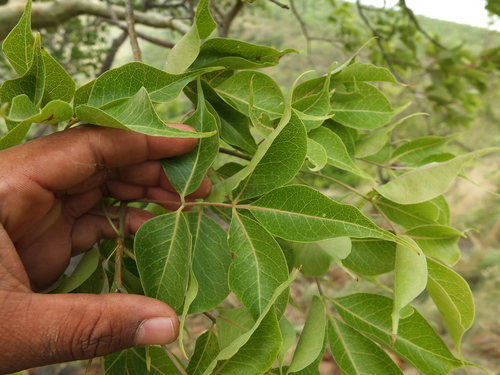
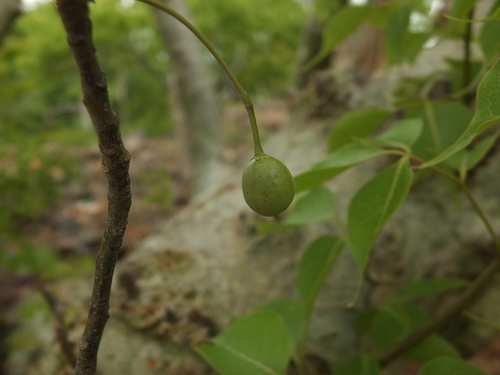
A tree. It grows 12-20 m tall. It loses its leaves during the year. The trunk is 15-25 cm across. The leaves are alternate of in spirals. The leaves have leaflets along the stalk and one at the end. The flowers are greenish-yellow. The fruit is round and fleshy. It has 2-6 valves There is one seed.
How to Grow
Plants can be grown from seed or cuttings.
Propagation: Seed - Cuttings. Very easy.
Medicinal Uses
The endosperm obtained from four or five fresh or dried seeds is taken two times a day for two to three days to relieve stomach ache.
Other Uses
The heartwood is grey with darker streaks; the sapwood is white. The wood cuts smoothly.
Wikipedia
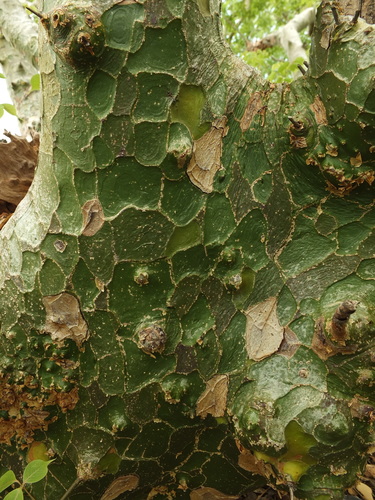
Source ↗Commiphora caudata, the hill mango or green commiphora, is the most abundant Asian species of Commiphora of flowering plants in the frankincense and myrrh family, Burseraceae. It can be found in Southern India and Sri Lanka, usually growing in the full sun on hilly granite rock outcrops in dry zone areas. It is a small to medium-sized deciduous tree which is said to be able to reach height of 10-20m, but usually is less high. The tree has a smooth, succulent green bark, which partly flakes off with age, giving rise to a characteristic patchwork of green and brown patches. Its sap has a strong resinous scent. The tree has medicinal properties. The fruit is a globose fleshy drupe with 2 to 6 valves and 1 seed that is black and has 4 wings. Remnants of branches can form a kind of thorns on the trunk. The flowers have a greenish to cream-yellow pedestal with pink to red petals.
Production
In southern India plants flower April to June.
Notes
There are about 165 Commiphora species.
Names & Synonyms
Kiliya maram, Kiluvai, Konda-mamidi, Kondamavu, Mangkiluvai, Pachaikiluvai
References (6)
- Ambasta, S.P. (Ed.), 2000, The Useful Plants of India. CSIR India. p 138
- A. L. P. P. de Candolle & A. C. de Candolle, Monogr. phan. 4:27. 1883
- Arinathan, V., et al, 2007, Wild edibles used by Palliyars of the western Ghats, Tamil Nadu. Indian Journal of Traditional Knowledge. 6(1) pp 163-168
- Dobriyal, M. J. R. & Dobriyal, R., 2014, Non Wood Forest Produce an Option for Ethnic Food and Nutritional Security in India. Int. J. of Usuf. Mngt. 15(1):17-37
- Wiersema, J. H. & Leon, B., 2013, World Economic Plants. A Standard Reference CRC Press. 2nd Ed. p 193
- World Checklist of Useful Plant Species 2020. Royal Botanic Gardens, Kew


