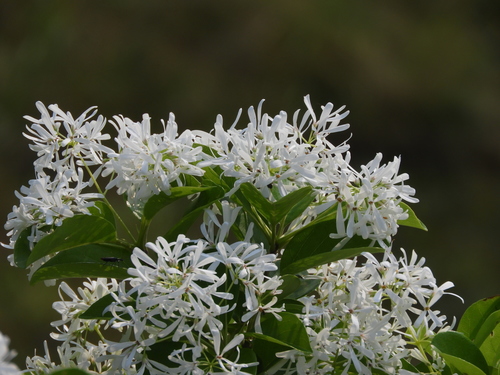
Jasminum arborescens
Roxb.
Tree Jasmine
OleaceaeSeeds/Nuts

iNaturalist · cc-by
(c) Siddarth Machado, some rights reserved (CC BY), uploaded by Siddarth Machado
(c) Siddarth Machado, some rights reserved (CC BY), uploaded by Siddarth Machado
iNaturalist · cc-by
(c) Chayant Gonsalves, some rights reserved (CC BY), uploaded by Chayant Gonsalves
(c) Chayant Gonsalves, some rights reserved (CC BY), uploaded by Chayant Gonsalves
iNaturalist · cc-by
(c) Siddarth Machado, some rights reserved (CC BY), uploaded by Siddarth Machado
(c) Siddarth Machado, some rights reserved (CC BY), uploaded by Siddarth Machado
What to Eat
Edible parts: Seeds
The seeds are eaten and serve as a famine food.
Where to Find It
It is a tropical plant. In Pakistan it grows between 200-1,000 m altitude.
Asia, Himalayas, India, Nepal, Pakistan, Myanmar, SE Asia,
Countries: United Arab Emirates, Afghanistan, Armenia, Azerbaijan, Bangladesh, Bahrain, Brunei, Bhutan, China, Georgia, Indonesia, Israel, India, Iraq, Iran, Jordan, Japan, Kyrgyzstan, Cambodia, North Korea, South Korea, Kuwait, Kazakhstan, Laos, Lebanon, Sri Lanka, Myanmar, Mongolia, Maldives, Malaysia, Nepal, Oman, Philippines, Pakistan, Qatar, Saudi Arabia, Singapore, Syria, Thailand, Tajikistan, Timor-Leste, Turkmenistan, Turkey, Taiwan, Uzbekistan, Vietnam, Yemen
How to Identify
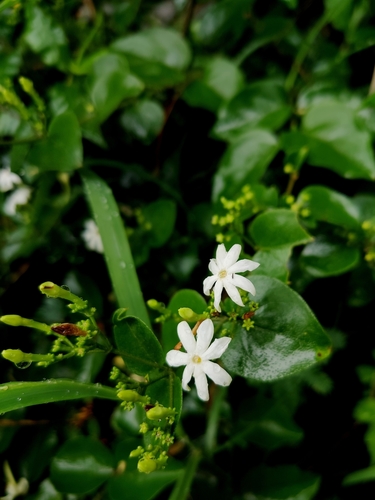
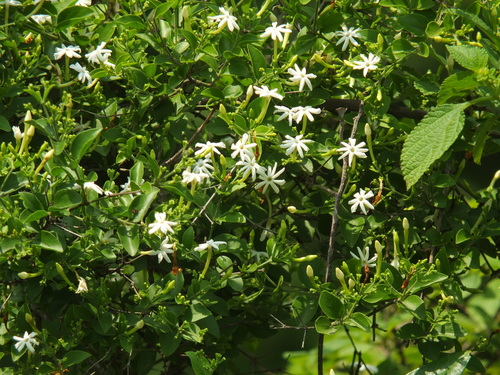
A large shrub. The small branches are hairy. The leaves are simple and opposite. They vary in size. They can be 18 cm long and 10 cm wide. They are broadly oval and have a soft covering when young. The flowers are fragrant. The fruit is a berry and 1-1.5 cm long. They are black when ripe.
Other Information
They are a famine food.
Notes
There are between 200 and 500 Jasminum species.
Names & Synonyms
Adavinalle, Barakunda, Bela chameli, Bonomali, Bura kunda, Chameli, Gadahundbaha, Mutabela, Nab-mallica, Nagamalli, Navamannlica, Sabe, Saptala
Jasminum arborescens var. latifolium (Roxb.) C. B. ClarkeJasminum latifolium Roxb.Jasminum montanum Roth.Jasminum roxburghianum Wall. ex C. B. ClarkeJasminum velutinum Kobuskiand others
References (4)
- Ambasta, S.P. (Ed.), 2000, The Useful Plants of India. CSIR India. p 299
- Green, P. S., 2003, Synopsis of the Oleaceae from the Indian Sub-Continent. Kew Bulletin, Vol. 58, No. 2 (2003), pp. 257-295
- Singh, H.B., Arora R.K.,1978, Wild edible Plants of India. Indian Council of Agricultural Research, New Delhi. p 84 (As Jasminum arborescens var. latifolia)
- WATT, (As Jasminum arborescens var. latifolia)