Machilus edulis
King ex Hook.f.
Pumsi
(c) Rinzin Dorji, some rights reserved (CC BY-NC)

Aparajita Datta
(c) Rinzin Dorji, some rights reserved (CC BY-NC)
(c) Phuentsho, some rights reserved (CC BY-NC)
What to Eat
Edible parts: Fruit
The fruit are eaten raw, either fresh or after being allowed to cure for a few days in hot dry conditions. The flesh is scooped out and consumed. Fruits are commonly sold in markets and are nutritious.
Where to Find It
It is a subtropical plant. In Sikkim the trees are mostly above 1,700 m altitude. They are common between 1,600-1,900 m above sea level.
Asia, Bhutan, Himalayas, India, Nepal, Northeastern India, Sikkim,
How to Identify
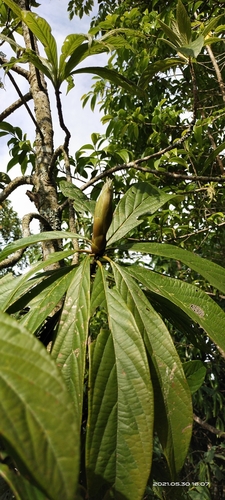
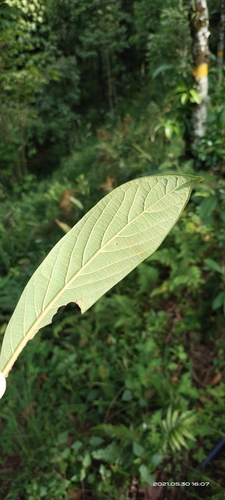
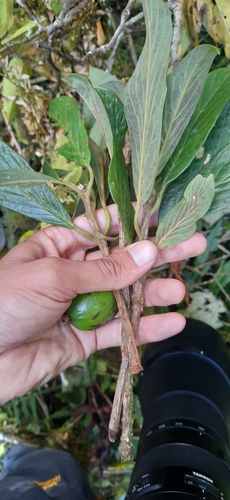
An evergreen tree. It grows 15-20 m high. The trunk is straight. The branches are spreading. The bark is dark brown in forests and lighter in open spaces. The leaves are sword shaped with a short leaf stalk. Fruit are about 4-5 cm across.
Nutrition Score: 7/100
| Part | Moisture | kJ | kcal | Protein | Vit A | Vit C | Iron | Zinc |
|---|---|---|---|---|---|---|---|---|
| Fruit | — | — | 4.5 | — | — | — | 2.5 | — |
How to Grow
Plants can be grown from seeds. Seeds germinate in 45-70 days. They cannot be grown from cuttings.
Production
Yields can be 5-75 kg per tree. A fruit weighs about 32 g. The fruit are picked and stored in a warm, dark, non-airy enclosure for curing. This improves the flavour. In Sikkim fruit are available January to March.
Other Information
Fruit are commonly sold in markets.
Notes
There are about 200 Machilus species. The fruit are nutritious.
Names & Synonyms
Aracado, Guli, Kawla, Lalikaulo, Lapche kaulo, Lapche kawla, Lapche phal, Pamshi, Phamphal, Phum-kung, Phumsey, Pomsee, Pumpsi
References (21)
- Ambasta, S.P. (Ed.), 2000, The Useful Plants of India. CSIR India. p 346
- Chettri, N. & Sharma, E., Non-timber Forest Produce: Utilization, Distribution and Status in the Khangchendzonga Biosphere Reserve, Sikkim, India.
- Dangol, D. R. et al, 2017, Wild Edible Plants in Nepal. Proceedings of 2nd National Workshop on CUAOGR, 2017.
- Dash, S. S. & Singh, P. Trees of Sikkim p 98
- Gautam, R. S., et al, 2020, Wild Edible Fruits of Nepal. Int. J. Appl. Sci. Biotechnol. Vol 8(3): 289-304
- Ghimeray, A. K., Lamsal, K., et al, 2010, Wild edible angiospermic plants of the Illam Hills (Eastern Nepal) and their mode of use by local community. Korean J. Pl. Taxon. 40(1) (As Mechilus)
- Kumar, A., et al, 2012, Ethnobotanical Edible Plant Biodiversity of Lepcha Tribes. Indian Forester, 138 (9):798-803
- Manju Sundriyal, and R. C. Sundriyal, Wild Edible Plants of the Sikkim Himalaya: Marketing, Value Addition and Implications for Management. Economic Botany: Vol. 58, No. 2, pp. 300–315.
- Manju Sundriyal, and R. C. Sundriyal, 2003, Underutilized edible plants of the Sikkim Himalaya: Need for domestication. Current Science, Vol. 85, No. 6, p 731
- Manju, S., and Sundriyal, R. C., 2001, Wild Edible Plants of the Sikkim Himalaya: Nutritive Values of Selected Species. Economic Botany 55(3): 377-390
- Pandey, Y., Upadhyay, S. & Bhatt, S. S., 2018, Phyto-chemical constituent os some wild edible fruits of Sikkim Himalaya. Journal of Pharmacognosy and Phytochemistry 2018; 7(3): 1045-1047
- Salvi, J. et al, 2016, A review: Underutilized wild edible plants as a potential source of alternative nutrition. International Journal of Botany Studies. Volume 1; Issue 4; May 2016; Page No. 32-36
- Savita, et al, 2006, Studies on wild edible plants of ethnic people in east Sikkim. Asian J. of Bio Sci. (2006) Vol. 1 No. 2 : 117-125
- Sharma, G., et al, 2016, Agrobiodiversity in the Sikkim Himalaya. International Centre for Integrated Mountain Development, ICIMOD Working Paper 2016/5 p 21
- Singh, K.K., Singh, M. & Joshi, S. C., 2014, Phenolic content and Antioxidant Activity of some Underutilized Wild Edible Fruits of the Sikkim Himalaya. SMU Medical Journal. Vol. 1, No. 2 July 2014
- Sundriyal, M., et al, 1998, Wild edibles and other useful plants from the Sikkim Himalaya, India. Oecologia Montana 7:43-54
- Sundriyal, Manju and Sundriyal R. C., 2001, Seed Germination and Response of Stem-cuttings to Hormonal Treatment in Six Priority Wild Edible Fruit Species in Sikkim Himalaya. Indian Forester Vol. 127 No. 6 June 2001. pp 695-717
- Sundriyal, M., et al, 2004, Dietary Use of Wild Plant Resources in the Sikkim Himalaya, India. Economic Botany 58(4) pp 626-638
- Sundriyal, M. & Sundriyal, R. C., 2004, Structure, Phenology, Fruit Yield, and Future Prospects of some Prominent Wild Edible Plant Species of the Sikkim Himalaya, India. Journal of Ethnobiology 24(1): 113-138
- Suresh, C. P. et al, 2014, Wild Edible Tree Fruits of Sikkim Himalayas. Journal of Tree Sciences 33(1): 43-48
- Uprety, Y., et al, 2016, Traditional use and management of NTFPs in Kangchenjunga Landscape: implications for conservation and livelihoods. Journal of Ethnobiology and Ethnomedicine (2016) 12:19


