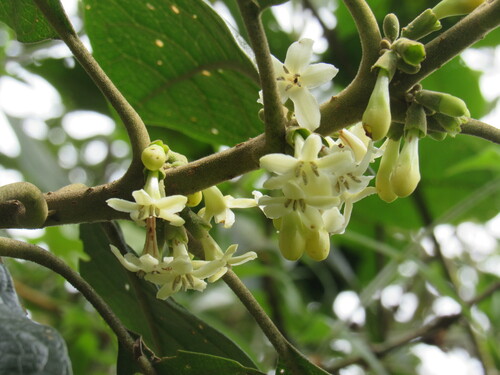
Meriandra dianthera
(Roth ex Roem. & Schult.) Briq.
Bengal sage

iNaturalist · cc-by
(c) nberhe, some rights reserved (CC BY)
(c) nberhe, some rights reserved (CC BY)

iNaturalist · cc-by
(c) nberhe, some rights reserved (CC BY)
(c) nberhe, some rights reserved (CC BY)

iNaturalist · cc-by
(c) nberhe, some rights reserved (CC BY)
(c) nberhe, some rights reserved (CC BY)
What to Eat
Edible parts: Leaves, Flowers
The leaves and flowers are used for flavouring and are edible.
Where to Find It
It is a subtropical plant.
Africa, Asia, East Africa, Ethiopia, India, Middle East, Northeastern India, Pakistan, Saudi Arabia, Yemen,
Countries: United Arab Emirates, Afghanistan, Armenia, Angola, Azerbaijan, Bangladesh, Burkina Faso, Bahrain, Burundi, Benin, Brunei, Bhutan, Botswana, Congo (DRC), Central African Republic, Congo (Republic), Cote d'Ivoire, Cameroon, China, Cape Verde, Djibouti, Algeria, Egypt, Eritrea, Ethiopia, Gabon, Georgia, Ghana, Gambia, Guinea, Equatorial Guinea, Guinea-Bissau, Indonesia, Israel, India, Iraq, Iran, Jordan, Japan, Kenya, Kyrgyzstan, Cambodia, Comoros, North Korea, South Korea, Kuwait, Kazakhstan, Laos, Lebanon, Sri Lanka, Liberia, Lesotho, Libya, Morocco, Madagascar, Mali, Myanmar, Mongolia, Mauritania, Mauritius, Maldives, Malawi, Malaysia, Mozambique, Namibia, Niger, Nigeria, Nepal, Oman, Philippines, Pakistan, Qatar, Rwanda, Saudi Arabia, Seychelles, Sudan, Singapore, Sierra Leone, Senegal, Somalia, South Sudan, Sao Tome & Principe, Syria, Eswatini, Chad, Togo, Thailand, Tajikistan, Timor-Leste, Turkmenistan, Tunisia, Turkey, Taiwan, Tanzania, Uganda, Uzbekistan, Vietnam, Yemen, South Africa, Zambia, Zimbabwe
How to Identify
A herb or small shrub. It has an aroma like camphor. The stems are woody. The leaves are about 1 m above ground. The leaves are oval and 5-11 cm long by 1-3 cm wide.
Other Information
It is sold in local markets.
Notes
There are 2 Meriandra species.
Names & Synonyms
Hadha toke, Kafurkapai, Kanghumaan, Nechilo, Sima-karpuramu
Meriandra abyssinica F. Muell.Meriandra bengalensis (J. Koenig ex Roxb.) Benth.Salvia abyssinica R. Br. [Invalid]Salvia bengalensis Konig ex RoxburghSalvia dianthera Roth ex Roem. & Schult.Salvia dianthera RothSalvia stachydea Klein ex Schult.
References (8)
- Ambasta, S.P. (Ed.), 2000, The Useful Plants of India. CSIR India. p 366
- Asfaw, Z. and Tadesse, M., 2001, Prospects for Sustainable Use and Development of Wild Food Plants in Ethiopia. Economic Botany, Vol. 55, No. 1, pp. 47-62
- Devi, O.S., P. Komor & D. Das, 2010, A checklist of traditional edible bio-resources from Ima markets of Imphal Valley, Manipur, India. Journal of Threatened Taxa 2(11): 1291-1296 (As Meriandra bengalensis)
- Feyssa, D. H., et al, 2011, Seasonal availability an consumption of wild edible plants in semiarid Ethiopia; Implications to food security and climate change adaptation. Journal of Horticulture and Forestry 3(5): 138-149 (As Meriandra bengalensis)
- Flora of Pakistan. www.eFloras.org
- Hedrick, U.P., 1919, (Ed.), Sturtevant's edible plants of the world. p 411
- INFOODSUpdatedFGU-list.xls
- Konsam, S., et al, 2016, Assessment of wild leafy vegetables traditionally consumed by the ethnic communities of Manipur, northeast India. Journal of Ethnobiology and Ethnomedicine, 12:9 (As Meriandra bengalensis)