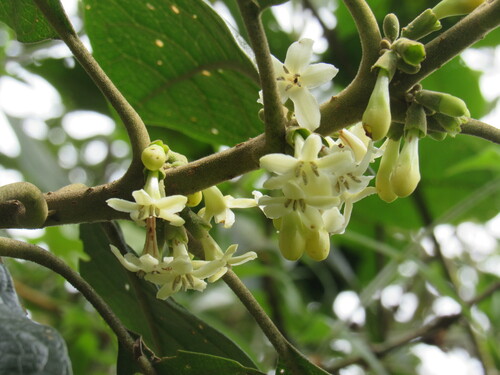
Meriandra strobilifera
Benth.
Cone bearing sage

gbif · cc-by
Royal Botanic Gardens, Kew
Royal Botanic Gardens, Kew

gbif · cc-by
Royal Botanic Gardens, Kew
Royal Botanic Gardens, Kew

gbif · cc-by
Royal Botanic Gardens, Kew
Royal Botanic Gardens, Kew
What to Eat
Edible parts: Leaves - flavouring, Flowers
The leaves are used as a flavoring and can be dried and stored for later use. The flowers are eaten raw or cooked.
Known Hazards
Where to Find It
It is a temperate plant. It grows in dry rocky places in the Western Himalayas between 1,500-1,800 m above sea level.
Asia, Himalayas, India, Northeastern India,
Countries: United Arab Emirates, Afghanistan, Armenia, Azerbaijan, Bangladesh, Bahrain, Brunei, Bhutan, China, Georgia, Indonesia, Israel, India, Iraq, Iran, Jordan, Japan, Kyrgyzstan, Cambodia, North Korea, South Korea, Kuwait, Kazakhstan, Laos, Lebanon, Sri Lanka, Myanmar, Mongolia, Maldives, Malaysia, Nepal, Oman, Philippines, Pakistan, Qatar, Saudi Arabia, Singapore, Syria, Thailand, Tajikistan, Timor-Leste, Turkmenistan, Turkey, Taiwan, Uzbekistan, Vietnam, Yemen
How to Identify
A shrub. It has a camphor like scent. The stems are woody and 1 m tall. The leaves are on the higher section. The leaves are oblong to narrowly oval and 5-11 cm long by 1-3 cm wide. They have a thick texture. There are fine teeth along the edge.
Medicinal Uses
None mentioned.
Names & Synonyms
Kanghuman, Lengmasel
References (4)
- Ambasta, S.P. (Ed.), 2000, The Useful Plants of India. CSIR India. p 367
- Gangte, H. E., et al, 2013, Wild Edible Plants used by the Zou Tribe in Manipur, India. International Journal of Scientific and Research Publications, Volume 3, Issue 5
- Guite, C., 2016, A study of wild edible plants associated with the Paite tribe of Manipur, India, International Journal of Current Research. Vol. 8, Issue, 11, pp. 40927-40932
- Thokchom, R., et al, 2016, Documentation and assessment of wild medicinal and edible flowers of valley districts of Manipur. International Journal of Research in Applied, Natural and Social Sciences. 4(11):13-20