Piper sylvaticum
Roxb.
Mountain long pepper

(c) Denis Wadesky, certains droits réservés (CC BY-NC), publiées par Denis Wadesky

(c) Denis Wadesky, certains droits réservés (CC BY-NC), publiées par Denis Wadesky

(c) Denis Wadesky, certains droits réservés (CC BY-NC), publiées par Denis Wadesky
What to Eat
Edible parts: Fruit, Spice, Leaves
The fruit is used in food preparation as a spice. The leaves are eaten as a vegetable.
Known Hazards
Where to Find It
A tropical plant. In south China it grows in wet places at about 800 m above sea level. In Yunnan.
Asia, Bangladesh, China, India, Indochina, Laos, Myanmar, Northeastern India, SE Asia, Tibet,
How to Identify
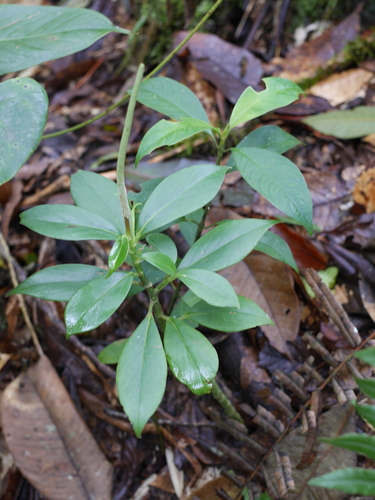
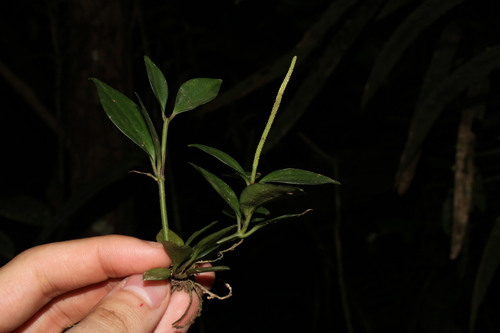
A climber. It has stolons or runners. The stems are ridged. They have fine hairs when young. The leaf stalks are 1-7 cm long. The leaf blade is oval and 8-11 cm long by 4-8 cm wide. The flower spikes are opposite the leaves. Male spikes are slender and 5-8 cm long. Female spikes are erect and 2-3 cm long by 3-4 mm wide. The fruit is fleshy, round and 3 mm across.
Wikipedia
Source ↗Piper sylvaticum is a climber in the Piperaceae, or pepper, family. It is found in the northeast of the Indian subcontinent, and in China. The fruits are used in medicinal products.
Names & Synonyms
Pahari pipul, Rari, Taw-kun
References (4)
- Ambasta, S.P. (Ed.), 2000, The Useful Plants of India. CSIR India. p 461
- Angami, A., et al, 2006, Status and potential of wild edible plants of Arunachal Pradesh. Indian Journal of Traditional Knowledge 5(4) October 2006, pp 541-550
- Hedrick, U.P., 1919, (Ed.), Sturtevant's edible plants of the world. p 501
- Srivastava, R. C., 2009, Traditional knowledge of Adi tribe of Arunachal Pradesh on plants. Indian Journal of Traditional Knowledge. 8(2): 146-153