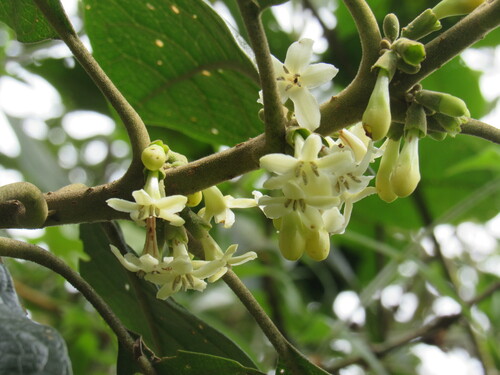
Premna bengalensis
C. B. Clarke

President and Fellows of Harvard College
What to Eat
Edible parts: Bark, Fruit
The soft, sweet bark is edible. The fruit is also edible.
Where to Find It
It is a tropical plant. It grows between 300-900 m above sea level in Nepal. It grows in evergreen forests near streams.
Asia, Bangladesh, Himalayas, India, Myanmar, Nepal, Northeastern India, SE Asia, Sikkim, Vietnam,
How to Identify
A large shrub or small tree. It grows 9 m tall. It can grow 10-20 m tall. The trunk can be fluted. The bark is greyish white. It peels off in papery flakes 2 cm thick The leaves are simple and opposite. They are narrowly oval or sword shaped and 8-24 cm long by 4-15 cm wide. The edges can be slightly wavy. The flowers are in branched groups at the ends of branches. The fruit is fleshy and oval and 5-8 mm across.
Medicinal Uses
The bark has traditional medicinal uses.
Other Uses
The wood is a light brownish white or cream-coloured. It is even-grained, hard and durable. A good wood to use for the posts of native houses; when old it is used for bridge-work as it lasts well in water. It would do for turnery and carvings.
Notes
Also put in the family Verbenaceae.
Names & Synonyms
Banglalatana, Bolgoppa, Dauli, Dhauli, Dhola-uja, Dieng-lih, Gohora, Guyheli, Jol-chong-i-maiphi, Koya jarul, Kyun-nalin, Lalo-asing, Makauk-nyaung, Mlung-greng, Nakechal, Sungna
References (2)
- Ambasta, S.P. (Ed.), 2000, The Useful Plants of India. CSIR India. p 489
- Pasha, M. K. & Uddin, S. B., 2019, Minor Edible Fruits of Bangladesh. Bangladesh J. Plant Taxon. 26(2): 299–313